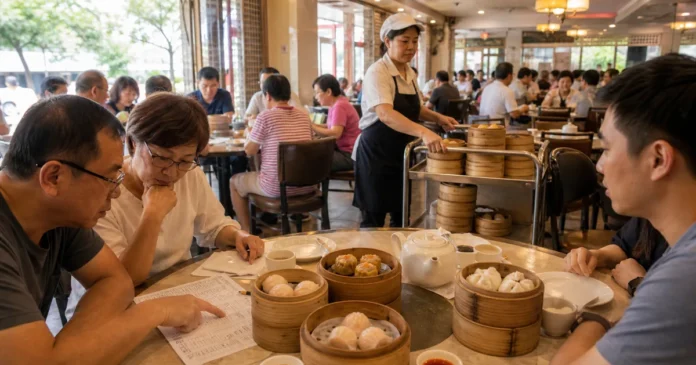

Dim sum in Kuala Lumpur is a morning meal, and that is the single most useful thing to know about it. The best places open early, do their real trade between about 8am and 11am, and close in the early afternoon. Turning up for a late lunch means a reduced selection at best.
The city has a strong Cantonese dim sum tradition, and it is one of the better value special meals here. It is also one where the format varies more than visitors expect.
The short version
- Go between 8am and 10am, and go on a weekday if you can. Weekend mornings are packed
- Two formats exist. Push cart trolleys, and order sheets where you tick boxes
- Push carts are disappearing, so if the experience matters to you, seek one out deliberately
- The good items sell out, which is the real reason to arrive early
- Around RM6 to RM12 a basket at a standard place as of September 2026
Push cart or order sheet
The difference changes the whole meal, and most guides do not mention that there is a choice.
Push cart is the traditional format. Staff wheel trolleys of steamer baskets around the room and you point at what you want as it passes. Nothing is ordered in advance. The advantages are that you see the food before committing, which solves the language problem entirely, and that it is a genuinely enjoyable way to eat. The disadvantages are that you get what comes past rather than what you want, and popular items are frequently gone by the time the trolley reaches the back of the room.
Order sheet is now the more common format. You get a paper menu, tick quantities against each item, and hand it in. Everything arrives fresh from the kitchen rather than after circulating on a trolley, and you can order exactly what you want. Many sheets have photographs or English, and where they do not, the item names are usually recognisable.
The trolleys are slowly vanishing across the region as labour costs rise and the format proves inefficient. There are still restaurants in KL running them, often the hotel Chinese restaurants and a handful of long established independents, but it is worth checking rather than assuming.
What to order
A basket usually holds three or four pieces, so a table of two ordering five or six baskets plus a couple of extras will eat well.
The ones to start with:
- Har gow, prawn dumplings in a translucent wrapper. The benchmark item, and the one that tells you how good a kitchen is
- Siew mai, open topped pork and prawn dumplings, often with a dot of roe on top
- Char siew bao, fluffy steamed buns filled with sweet barbecued pork
- Cheong fun, silky rice noodle rolls with prawn or char siew, served in sweet soy
- Lo mai gai, glutinous rice with chicken and mushroom steamed in a lotus leaf. Filling, so order it late
- Egg tarts, the dessert, and the baked ones with flaky pastry are worth waiting for if they are fresh
The ones people either love or avoid: chicken feet in black bean sauce, which is a genuine speciality and much better than newcomers expect; and various offal items that are entirely optional.
| Dish | What it is | Order it |
|---|---|---|
| Har gow | Prawn dumpling, translucent wrapper | First, it tells you how good the kitchen is |
| Siew mai | Open topped pork and prawn dumpling | Always |
| Char siew bao | Steamed barbecue pork bun | If you have a sweet tooth |
| Cheong fun | Rice noodle roll in sweet soy | Early, it goes cold badly |
| Lo mai gai | Sticky rice in a lotus leaf | Late, it is very filling |
| Chicken feet | Braised in black bean | If you are curious, it is better than expected |
| Egg tart | The dessert | Last, and only if freshly baked |
Order in waves. Get four or five baskets, eat them, then order more. Ordering everything at once means cold dumplings and a table with no room.
The timing rule
This matters more than which restaurant you pick.
Kitchens make a set quantity of each item in the morning. The popular things run out. At a busy place the har gow and the fresh egg tarts can be gone well before noon, and what remains from about 1pm is the slower moving stock.
Arrive between 8am and 10am for the full selection at its freshest. Some places open as early as 6am or 7am and the trolleys start circulating around 7.30am.
Weekday over weekend. Saturday and Sunday mornings are family occasions in KL and the popular restaurants are genuinely packed, with waits. Midweek you will usually walk in.
Book for weekends at the upmarket places. Hotel Chinese restaurants and the well known names take reservations and fill up.
Where to go, by what you want
Restaurants change hands and hours shift, so check before making a journey.
For the traditional no frills version, the long established independents along Jalan Ipoh and in the older Chinese neighbourhoods are where locals go. Ming Court on Jalan Ipoh is one of the names that comes up consistently, and the braised chicken feet are its most cited dish. Plain rooms, early opening, low prices.
For push carts, hotel Chinese restaurants are now among the more reliable places to find them still running, since they have the staff to do it. Xin Cuisine at the Concorde is one that operates in the trolley format.
For convenience, chains such as Jin Xuan and the various Hong Kong style dim sum outlets have branches across the city and in malls, with English menus and photographs. Consistent rather than exceptional, and a fair option if you are short of time or nervous about ordering.
In Chinatown, there are dim sum shops within walking distance of Pasar Seni if you are already in the old city. Our Chinatown guide covers the area.
What it costs
As of September 2026, a basket at a standard neighbourhood restaurant runs roughly RM6 to RM12, with premium items such as prawn dumplings at the upper end. Two people ordering six to eight baskets plus tea generally spend around RM50 to RM90.
Hotel restaurants and the upmarket names charge considerably more, often RM12 to RM25 a basket, and weekend all you can eat dim sum promotions at hotels are common and can be good value if you are hungry.
Tea is charged per person and appears on the bill whether you asked for it or not. This is standard practice, not an error, and it is a small amount.
Practical notes
It is not halal. Pork is central to dim sum, and the restaurants are not certified. There are halal dim sum outlets in KL using chicken and prawn instead, but they are a separate category and worth searching for specifically rather than assuming.
Vegetarians will struggle at a standard dim sum restaurant. A few items are vegetable based but the kitchen is not, and even the vegetable dumplings often contain prawn. Our vegetarian and vegan guide has better options.
It is loud and busy, especially at weekends, and tables are close together. That is part of the experience rather than a failing.
Tables may be shared at the busier traditional places when you are a pair. Normal, and nobody is being rude.
Frequently asked questions
What time should I go for dim sum in Kuala Lumpur?
Between 8am and 10am. Restaurants open early, often from 6am or 7am, and the popular items sell out through the morning. By early afternoon the selection has thinned and many places have closed.
Are there still push cart dim sum restaurants in KL?
Yes, but fewer every year. The trolley format is disappearing across the region as labour costs rise. Hotel Chinese restaurants are now among the more reliable places to find it, so check in advance if the trolleys are what you want.
How much does dim sum cost in KL?
Roughly RM6 to RM12 a basket at a standard restaurant as of September 2026, and RM12 to RM25 at hotel and upmarket places. Two people generally spend RM50 to RM90 at a normal restaurant. Tea is charged per person and appears automatically.
What should I order at dim sum for the first time?
Har gow prawn dumplings, siew mai pork dumplings, char siew bao barbecue pork buns, cheong fun rice noodle rolls, and egg tarts for dessert. Order in waves of four or five baskets rather than everything at once.
Is dim sum halal in Malaysia?
Standard dim sum is not, since pork is central to it. There are dedicated halal dim sum restaurants in KL that use chicken and prawn instead, but they are a separate category and worth seeking out specifically.
Do I need to book?
Midweek, no. Weekend mornings at the well known and hotel restaurants, yes, because dim sum is a family occasion here and they fill up.
Explore more
- Where to eat in Kuala Lumpur, the full food guide
- Chinatown and Petaling Street, the area guide
- The Malaysian dishes worth seeking out
- Best brunch spots in KL, if you want a later start

