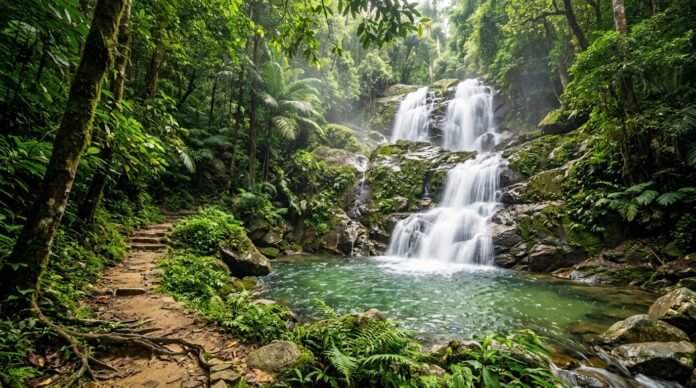

Less than an hour north of Kuala Lumpur, a seven-tier waterfall tumbles down through the rainforest, and hardly any visitors know it’s there. Kanching is one of the best value half days out of the city: cheap, genuinely wild, and close enough that you can be back for a late lunch.
Two things to sort out before you go, though. First, people constantly confuse Kanching with Templer Park next door, and they are not the same place. Second, this is real rainforest with real hazards, including flash floods and some very determined monkeys. Get both straight and you’ll have a lovely, low-cost day. Here’s how.
Some links in this post are affiliate links. If you book through them, I earn a small commission at no extra cost to you. Thanks for supporting the blog.
The short version
- What it is: Kanching Eco Forest Park (Taman Eko Rimba Kanching), a seven-tiered waterfall with a hiking trail running up beside it.
- Where: Near Rawang, about 20 to 25 km north of KL, roughly 30 to 45 minutes by car.
- Cost: A small entrance fee plus parking. Foreign visitors pay a bit more than Malaysians, and it’s a little higher at weekends. Bring small cash.
- Effort: Levels one to three are easy paved steps. Above that it gets steep, rocky and properly wild.
- Time needed: Two to four hours at the falls, half a day door to door.
- Best for: Nature lovers, families who stick to the lower tiers, and anyone wanting a cheap escape from the city heat.
On prices: fees are set by the Selangor Forestry Department and change from time to time, and there are separate local and foreigner rates. Treat any figure here as a rough guide and bring cash for the booth.
Kanching or Templer Park? Clearing up the confusion
This trips up almost everyone, including tour operators, so it’s worth thirty seconds. Kanching and Templer Park are two separate parks in the same stretch of rainforest north of Batu Caves. They’re often sold together, and some old articles use the names interchangeably. They aren’t interchangeable.
- Kanching Eco Forest Park (Taman Eko Rimba Kanching) is the seven-tier waterfall most people actually want. It has a proper entrance, a ticket booth, a car park, toilets and food stalls, and a paved lower section. This is the one this guide is about.
- Templer Park (Taman Rimba Templer) is a quieter, wilder reserve a few kilometres away. It has its own waterfall, but the trail is more overgrown, there’s no entrance fee and nobody collecting one, and it’s better suited to confident hikers. It also sits below Bukit Takun, a dramatic limestone hill.
If your plan is a scenic waterfall with easy access and facilities, go to Kanching. If you specifically want a remote, off-grid jungle trek and you’re an experienced walker, Templer Park is the wilder option, but don’t go alone and don’t expect signage. For most visitors, and for a first trip, Kanching is the answer.
The seven tiers, and how far you should go
Kanching’s waterfall drops through seven levels, and the genius of the place is that the effort scales with how far up you want to go. You choose your own difficulty.
- Levels 1 to 3: easy. A paved walkway and concrete steps take you up to the third fall. The first is only a five-minute stroll from the car park. This section suits families, kids and anyone in normal shoes. Level 2 is the popular one, with the biggest pool and the picnic crowds.
- Levels 4 to 5: moderate. The concrete ends and a dirt-and-rock trail begins. Steeper, rooty, slippery when wet. You want proper shoes here, and it thins out fast because most people stop at level 3.
- Levels 6 to 7: for fit hikers. Steep rocky slopes and some scrambling. Fewer people, cleaner pools, and the reward of a quiet swim near the top. Reckon on about an hour of climbing to reach the upper falls.
The whole thing is a short but real hike, a couple of kilometres up and back with a decent bit of elevation. You don’t have to do all seven. Plenty of people have a perfectly good day going no further than level 3, dipping in a pool and heading back. The higher you go, the wilder and quieter it gets.
Swimming is one of the main draws. The pools below the falls are cool and clear, especially higher up, and after a sweaty climb they’re wonderful. Just read the safety section below first, because water in a rainforest can turn dangerous quickly.
Safety, read this properly
Kanching is beautiful, but it’s a real rainforest with real risks, and a few of them have proved deadly at waterfalls like this across Malaysia. None of this is meant to scare you off. It’s meant to keep your day a good one.
Flash floods are the serious one
This is the risk that actually kills people. Heavy rain falling on the hills upstream can send the river rising fast, even if it looks fine and sunny where you’re standing. Tourism Selangor’s own guidance for the park is blunt about it: a downpour in the hills causes the river to rise rapidly.
So the rules are simple and non-negotiable:
- Do not go if rain is forecast, and leave immediately if it starts, even light rain. Don’t wait to see how bad it gets.
- Watch the water. If the level rises, the flow strengthens, or the water turns brown or muddy, get out of the river and off the low ground at once. Those are your warning signs.
- Go in the morning. KL’s rain is heaviest in the afternoon, so an early start dodges the worst of it. Our rainy season guide explains the pattern.
- Skip it in the monsoon. The forest reserve is often officially closed from around mid-November to the end of January for exactly this reason. Check before you plan a wet-season visit.
The monkeys will rob you
Long-tailed macaques patrol the trail, especially around levels 3 and 4, and they are bold, organised and completely unafraid of people. They will open an unattended bag, snatch food from your hand, and bite through a supposedly waterproof pouch. This is the single most common complaint about Kanching.
- Don’t carry visible food, and never eat in front of them. If you picnic, do it in a busy area near the entrance.
- Never feed them. It’s why they’re aggressive in the first place, and it’s bad for the animals.
- Keep bags zipped, closed and on you. Don’t set anything down while you swim.
- Don’t try to snatch stolen items back. A bag isn’t worth a bite.
The rest
- Slippery rocks. Wet granite is lethal underfoot. Wear shoes with grip, and take the upper levels slowly.
- Leeches appear after rain, particularly on the higher trails. Harmless but unpleasant. Repellent and covered ankles help.
- Don’t hike alone above level 3. The upper trail is quiet and it’s easy to slip with nobody around.
- Tell someone your plan if you’re going high, and turn back with plenty of daylight to spare.
How to get to Kanching from KL
This is the one weak point of the trip. Unlike some day trips out of KL, Kanching is not easy without a car, because it sits on a forest road with no station at the door.
| Option | Time | Rough cost | Notes |
|---|---|---|---|
| Drive | 30 to 45 min | Petrol plus RM4 to RM5 parking | By far the easiest. Parking is at the entrance. |
| Grab | 30 to 45 min | Around RM30 to RM50 each way | Fine going out. The catch is getting one back. |
| Guided tour | Half day | Varies | Usually paired with Batu Caves. Solves the transport. |
| Train plus Grab | About 1 hour plus | Train fare plus short Grab | KTM to Rawang, then a short Grab to the gate. |
The getting-back problem
Driving is genuinely the best option here. If you Grab out, understand the risk before you go: Grab coverage at the park is thin, and you may wait a long time for a driver to accept a pickup from a forest road, especially on a quiet weekday. Standing sweaty in a car park watching an app spin is a real possibility. If you go by Grab, be ready to be patient, or ask your outbound driver whether they’ll wait.
The train-plus-Grab combo works too: take the KTM Komuter toward Rawang, then a short Grab or taxi to the entrance, which is only a few minutes away. But you still face the same return problem from the park itself. Our Grab guide and KL rail guide cover the basics.
Honestly, for a group, the cleanest answer is a guided Batu Caves and Kanching tour (also on GetYourGuide), which most operators run as a single half-day trip. The two sit on the same road north of the city, so pairing them makes sense and removes the transport headache entirely.
What to bring
- Proper shoes with grip. Trainers for the lower levels, hiking shoes if you’re going high. Not flip flops.
- Small cash. For the entrance booth, parking and the RM0.50 toilets. Don’t rely on cards.
- Insect repellent. For mosquitoes, and leeches after rain.
- Swimwear and a quick-dry towel. Wear the swimwear under your clothes.
- Water and a little food, eaten away from the monkeys.
- A dry bag for your phone, kept closed and on you.
- A light rain check on your weather app before you leave. See our KL packing guide.
Facilities at the entrance include toilets, changing rooms and food stalls. They’re functional rather than pristine, so manage expectations, and carry your own tissue.
A half day that works
| Time | What |
|---|---|
| 8.00am | Leave KL early, before the heat and the afternoon rain risk. |
| 8.45am | Arrive, pay at the booth, start up the paved lower levels. |
| 9.00 to 11.00am | Hike as high as you fancy. Swim at a quiet upper pool. |
| 11.00am | Back down, dry off, snack away from the monkeys. |
| Midday | Out before any afternoon storm. Optional Batu Caves on the way back. |
Pair it with Batu Caves
Kanching sits on the same road north of the city as Batu Caves, so the two make a natural morning double. Do the waterfall first, while it’s cool and the flash-flood risk is lowest, then stop at Batu Caves on the way back into town. It’s the pairing most tours use, and it works just as well under your own steam.
Common mistakes
- Going when rain is forecast. The flash-flood risk is real. Reschedule, don’t gamble.
- Confusing Kanching with Templer Park. Different parks. For the easy seven-tier falls, you want Kanching.
- Leaving food or bags unattended. The monkeys will have them in seconds.
- Wearing the wrong shoes. Wet rock plus flip flops equals a fall.
- Grabbing out with no plan to get back. Coverage at the park is unreliable. Drive, or arrange the return.
- Going in the afternoon. Hotter, busier, and right into the daily rain window.
- Visiting in the monsoon. The reserve is often closed from roughly mid-November to end of January.
- Pushing to level 7 when tired or alone. The upper trail is steep and quiet. Know your limit.
Is it worth it?
For nature lovers, absolutely. Kanching gives you genuine rainforest, a proper waterfall you can climb and swim in, and near-total escape from the city, all for the price of a coffee and less than an hour’s travel. It’s one of the best value half days around KL, and it’s still refreshingly under-visited on weekdays.
It’s not for everyone, though. If you want polished facilities, guaranteed dry weather or a gentle stroll with no monkeys and no risk, this isn’t it. And if you’re only in KL for a couple of days, a waterfall hike probably shouldn’t beat the city’s food and culture. But if you love the outdoors and you pick a dry morning, Kanching is a small gem. Go early, respect the water, guard your snacks, and you’ll have a brilliant morning.
Frequently asked questions
How far is Kanching Waterfall from Kuala Lumpur?
About 20 to 25 km north of the city, near Rawang, which is roughly a 30 to 45 minute drive. It’s one of the closest proper rainforest waterfalls to KL.
Is Kanching the same as Templer Park?
No. They’re two separate parks in the same stretch of forest and are often confused. Kanching Eco Forest Park has the accessible seven-tier waterfall with a ticket booth and facilities. Templer Park is a wilder, quieter reserve nearby with its own waterfall and rougher trails. For an easy waterfall visit, go to Kanching.
How much does Kanching Waterfall cost?
There’s a modest entrance fee plus a small parking charge. Foreign visitors pay a little more than Malaysians, and the rate is slightly higher at weekends and on public holidays. Fees are set by the Selangor Forestry Department and change over time, so bring small cash and treat any quoted figure as a guide.
Can you swim at Kanching Waterfall?
Yes, in the pools below the falls, and the water is cooler and clearer the higher you climb. Only swim when the weather is settled, get out immediately if the water rises or turns muddy, and take care on slippery rocks.
Is Kanching safe?
It’s safe with sensible precautions. The main risks are flash floods after rain upstream, slippery rocks, and bold monkeys that steal food and bags. Go on a dry morning, leave if it rains, keep your belongings secured, and don’t hike the upper levels alone.
Is Kanching good for kids?
The lower levels are, with paved steps and shallow pools near the entrance that work well for families. The upper levels are too steep and slippery for small children. Keep a close eye near the water and around the monkeys. See our guide to KL with kids.
What’s the best time to visit Kanching?
A dry weekday morning. Weekends get crowded, afternoons bring both heat and rain, and the drier months roughly from March to September are safer than the monsoon, when the reserve is often closed. See our guide to the best time to visit KL.
Explore more
- Day trips from Kuala Lumpur, with everything compared
- Batu Caves from KL, the natural pairing
- Things to do in KL when it rains
- Visiting KL in the rainy season
- How to use Grab in Malaysia
- Best time to visit Kuala Lumpur

