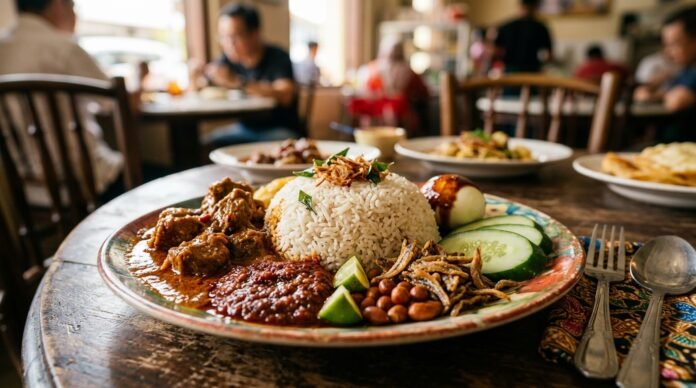

Malaysian food is one of the great cuisines of the world, and KL is the best single place to eat your way through it, because the city brings Malay, Chinese, and Indian cooking together on the same streets. For a first timer the menu can be bewildering, so this is the shortlist of dishes you should actually seek out, what each one is, and where to find it, so you arrive knowing exactly what to order.
Some links below are affiliate links. If you book through them I earn a small commission at no extra cost to you.
The short answer
Start with nasi lemak, the national dish, then work through laksa, char kway teow, satay, roti canai, char siu and roast meats, Hokkien mee, banana leaf rice, and a Malaysian Indian or mamak meal. Finish with cendol or ais kacang to beat the heat. Eat these at busy hawker stalls and kopitiams rather than restaurants, and you will have tasted the real KL. Here is the rundown.
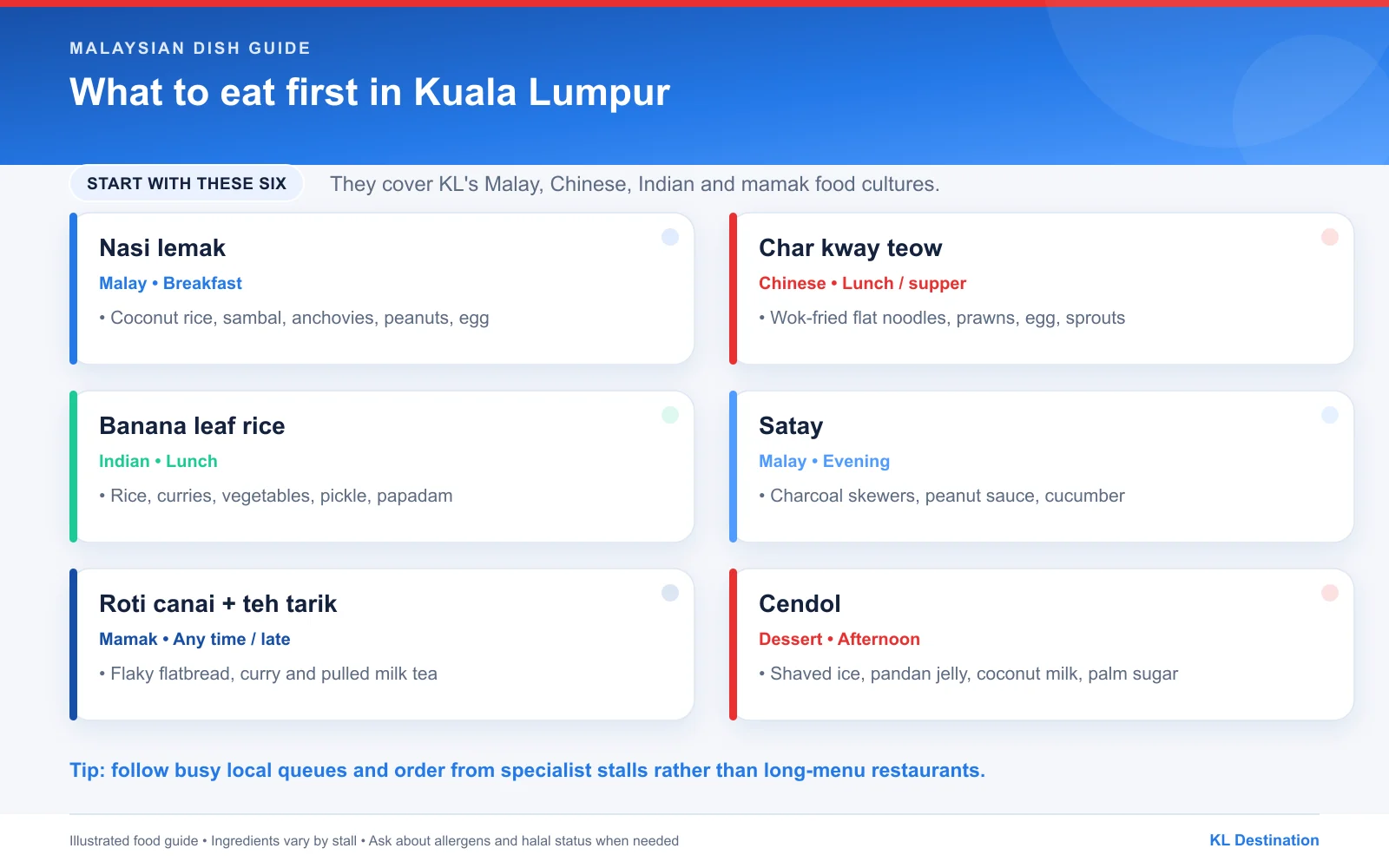
The five dishes I would not leave KL without trying
If you are only here for a couple of days and want the quick answer, make it these five:
- Nasi lemak the national dish
- Char kway teow smoky wok fried noodles
- Satay grilled skewers with peanut sauce
- Roti canai flaky flatbread with curry
- Cendol the classic shaved ice dessert
The full rundown of each dish follows, along with what separates a good version from a forgettable one.
Nasi lemak
The national dish and the one to try first: coconut rice with sambal, fried anchovies, peanuts, cucumber, and egg, often with fried chicken or other add ons. Eaten any time of day, best from a busy stall in the morning, and judged on its sambal. There is a whole guide to it in the best nasi lemak in KL.
Laksa
A noodle soup that comes in several regional styles, from the rich coconut curry laksa to the sour, fish based asam laksa. Both are bold and worth trying, and which you prefer says a lot about your palate. Easiest tried at any hawker centre, where curry laksa is the more common KL style.
Char kway teow
Flat rice noodles stir fried over high heat with prawns, egg, bean sprouts, and chives, smoky from the wok. A benchmark hawker dish, and a good stall’s version, with that charred wok aroma, is one of my favourite things to eat in the city. For a first try, the stalls of Jalan Alor and most hawker centres do it, though plenty of locals swear by their own neighbourhood stall.
Satay
Grilled skewers of marinated chicken or beef served with a thick peanut sauce, cucumber, and rice cakes. A classic evening and street food order, and a staple of food streets like Jalan Alor.
Roti canai and a mamak meal
Roti canai is a flaky, griddled flatbread served with dhal and curry for dipping, the classic Malaysian breakfast and a mamak staple. The mamak, the Indian Muslim eateries open at all hours, are an institution: cheap, fast, and where you get roti, mee goreng, teh tarik (pulled milky tea), and a real slice of everyday KL life. Have at least one mamak meal.
Banana leaf rice
A South Indian feast served on a banana leaf: rice surrounded by vegetable sides, curries, pickles, and pappadum, with meat or fish optional, and refills of rice and sides often included. A brilliant, filling, vegetarian friendly meal, especially around Brickfields and Indian areas.
Char siu and roast meats
The Chinese roast meat stalls do glistening char siu (barbecue pork), roast pork with crackling, and roast duck, served over rice or noodles. Look for the stalls with hanging meats and a queue. Not halal, so found in Chinese areas and food courts rather than mamaks.
Hokkien mee and other noodles
KL style Hokkien mee is thick noodles braised in a dark, savoury soy sauce with pork and prawns, a local speciality. Beyond it, explore wonton mee, pan mee, and curry mee, since the noodle variety alone could fill a trip.
Cendol, ais kacang, and drinks
Save room for the sweet stuff that doubles as heat relief. Cendol is shaved ice with coconut milk, palm sugar, and green rice flour jellies, and ais kacang is a towering shaved ice dessert piled with sweet toppings. To drink, try teh tarik, the frothy pulled milk tea, kopi from a kopitiam, and fresh coconut or sugar cane juice. They are as much a part of the food culture as the savoury dishes.
Durian, for the brave
No Malaysian food list is complete without durian, the spiky tropical fruit known as the king of fruits. Its rich, custardy flesh and famously powerful smell divide opinion like nothing else, banned in many hotels and on public transport, adored by locals, and a genuine rite of passage for visitors. If you are even slightly curious, try it: buy a small portion from a stall in season, hold your nose if you must, and find out which camp you fall into. The Musang King variety is the prized one. Love it or hate it, you will not forget it.
Dishes worth going out of your way for
The list above covers the essentials. These are the next tier, the ones that reward a slightly longer walk or a deliberate detour.
Bak kut teh
Pork ribs simmered for hours in a broth of Chinese herbs and spices, and the dish most associated with Klang, just outside KL, where it is widely believed to have been created. The name translates as meat bone tea, though there is no tea in the pot. It refers to the strong Chinese tea traditionally served alongside to cut the richness.
The Malaysian version is dark, herbal and soy-heavy, quite different from the clear peppery Teochew style you find in Singapore. A dry version has become popular around Klang too, with the broth reduced to a thick, tangier gravy. Traditionally a breakfast dish, eaten with rice or shallot oil rice and youtiao dough sticks for dipping. A chicken version, chik kut teh, exists as a halal alternative.
Nasi kandar
Rice with a spread of curries, originally from Penang and now everywhere. You point at what you want ladled over your plate, which makes it approachable when you cannot read a menu. Ask for it banjir, meaning flooded, and several gravies get poured over everything, which is how it is meant to be eaten. Worth knowing that the bill depends entirely on what you pointed at, so three meat dishes will cost far more than you expect.
Hainanese chicken rice
Poached chicken with rice cooked in the resulting stock, served with chilli sauce, ginger paste and a bowl of broth. It looks plain and it is judged entirely on the rice, which should be fragrant and slightly slick rather than dry. A lunchtime staple in Chinese coffee shops across the city.
Rendang
Beef slow-cooked in coconut milk and spice paste until the liquid has reduced away and the meat is dark and dry rather than saucy. If what arrives looks like a wet curry, it has been undercooked or shortcut. Common at Malay stalls and nasi campur counters, and a centrepiece at festive meals.
Popiah and rojak
Two snacks that rarely make tourist lists. Popiah is a soft fresh spring roll filled with stewed turnip, egg, peanuts and sweet sauce, assembled to order. Rojak is a fruit and vegetable salad tossed in a thick, pungent shrimp paste dressing with peanuts, which sounds wrong and works. Both are cheap, common at hawker centres, and neither is spicy.
Kuih
The umbrella term for a huge family of bite-sized cakes and sweets, many made with coconut, palm sugar, glutinous rice and pandan, and often brightly coloured. Sold by the piece from morning markets and stalls. Buying an assorted handful for a few ringgit is one of the better cheap pleasures here, and it is where a lot of Peranakan influence shows up.
How to tell a good version from a mediocre one
Most of these are sold on every second street, and the gap between a great version and a forgettable one is wide. Each has one thing locals judge it on.
| Dish | What decides whether it is good |
|---|---|
| Nasi lemak | The sambal. Dark, slightly sweet, properly cooked down, not a raw chilli hit |
| Char kway teow | Wok hei, the smoky char from a very hot wok. Without it, it is just fried noodles |
| Roti canai | Crisp at the edges, chewy inside. Stretched to order, never pre-made |
| Satay | Charcoal not gas, and a peanut sauce that is coarse rather than smooth |
| Chicken rice | The rice, not the chicken. Fragrant with stock and shallot |
| Bak kut teh | Depth of broth. Layered and herbal rather than simply salty |
| Cendol | Real gula melaka palm sugar, smoky rather than flatly sweet |
A few words that make ordering easier
English is widely spoken and you will manage without any of this, but these terms appear on handwritten menus and stall boards constantly, and knowing them removes most of the guesswork.
| Word | What it means |
|---|---|
| Goreng | Fried. Mee goreng is fried noodles, nasi goreng fried rice |
| Kuah | Gravy or sauce |
| Banjir | Flooded, meaning extra gravy poured over everything |
| Kosong | Plain or empty. Roti kosong is plain roti, kopi kosong is coffee without sugar |
| Bungkus or tapau | Takeaway |
| Kurang manis | Less sweet. Useful, since drinks are sweet by default |
| Kurang pedas | Less spicy |
| Ais or peng | Iced. Teh ais is iced tea |
| Tambah | More, or a refill |
One habit worth adopting: drinks here are sweet unless you say otherwise. Asking for kurang manis is completely normal and stalls will not blink.
What to eat, and when
Timing matters more than visitors expect. Several of these dishes are made in the morning and sell out, and a few stalls that look permanent only open after dark.
| When | What is at its best |
|---|---|
| Breakfast, 7am to 10am | Nasi lemak, roti canai, bak kut teh, kopitiam toast and eggs |
| Lunch, 12pm to 2pm | Chicken rice, nasi kandar, banana leaf rice, economy rice stalls |
| Afternoon | Kuih, cendol, teh tarik, rojak |
| Dinner onward | Hawker centres, char kway teow, Hokkien mee, satay |
| Late night | Mamak. Roti, maggi goreng and teh tarik until very late |
The general rule: anything cooked fresh in the morning is best in the morning. Turning up at a famous nasi lemak stall at 2pm often means it has gone.
What tourists get wrong
A few easily avoided mistakes that keep visitors from the best of KL’s food:
- Defaulting to Western food in malls when the best, cheapest eating is at hawker stalls and mamaks
- Eating at empty stalls, when the crowd and the queue are the real quality signal
- Skipping the mamak, which is where everyday KL actually eats
- Assuming everything is spicy, when plenty of dishes are mild and you can ask for less chilli
- Ordering one dish each instead of sharing several across the table, which is the whole point
Where to eat it all
The golden rule: eat at busy hawker stalls, kopitiams, and mamaks rather than restaurants or hotel buffets, since that is where these dishes are best and cheapest. Follow the queues, mix across stalls, and do not be shy about pointing. For how that works see the best hawker centres, for the famous food street the Jalan Alor guide, and for the full scene the KL food guide.
Frequently asked questions
What food is Kuala Lumpur famous for?
KL is famous for its mix of Malay, Chinese, and Indian food in one city: nasi lemak, laksa, char kway teow, satay, roti canai, banana leaf rice, char siu, and Hokkien mee, plus desserts like cendol. It is one of the world’s great food cities.
What is the national dish of Malaysia?
Nasi lemak, coconut rice with sambal, anchovies, peanuts, cucumber, and egg, often with fried chicken. It is eaten any time of day and is the dish to try first in KL.
What should a vegetarian eat in KL?
Banana leaf rice (ordered vegetarian), roti canai with dhal, Indian and Chinese vegetable dishes, and the many vegetarian stalls and restaurants make KL easy for vegetarians. Indian areas like Brickfields are especially good.
Is Malaysian food spicy?
It can be, especially sambal and some curries, but plenty of dishes are mild, and you can usually ask for less chilli. There is something for every spice tolerance, so do not let heat put you off exploring.
What are the top 5 Malaysian dishes to try?
For a short trip, prioritise nasi lemak, char kway teow, satay, roti canai, and cendol for dessert. Between them they cover the Malay, Chinese, and Indian threads of Malaysian cooking and the sweet finish, a solid first taste of the cuisine.
Should I try durian in KL?
If you are curious, yes. Durian is a rite of passage, with a rich, custardy flesh and a famously divisive smell. Buy a small portion from a stall in season, with Musang King the prized variety. Note it is banned in many hotels and on transport because of the smell.
Where is the best place to try Malaysian food in KL?
Busy hawker centres, kopitiams, and mamaks rather than restaurants or hotel buffets, where the food is best and cheapest. Follow the local queues and order across several stalls.
Explore more
- Kuala Lumpur food and where to eat
- Best hawker centres in KL
- Best nasi lemak in KL
- Jalan Alor food guide
- KL in 3 days itinerary
Taste it all faster
A food tour on your first day is the quickest way to try many of these dishes and learn where to find them. Browse KL food tours on Klook.

