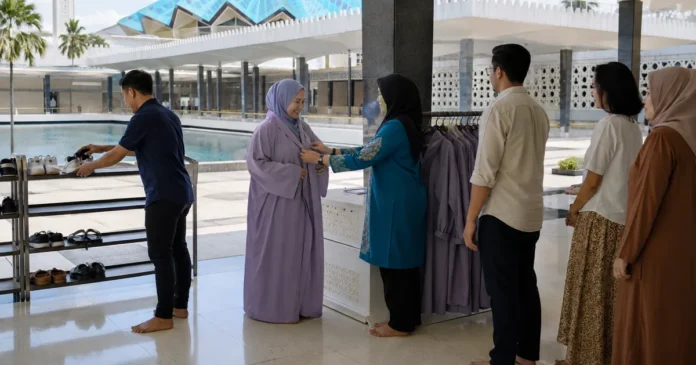

Kuala Lumpur is genuinely multi faith, and its mosques and temples are among the best free things to do here. They are also the places visitors most worry about getting wrong, which is why a lot of people walk past rather than in.
The anxiety is misplaced. All of the buildings below welcome respectful visitors, most lend you whatever you are missing, and nobody is waiting to be offended. Here is the etiquette once, then the buildings.
The etiquette, in one place
It is the same almost everywhere and it is not complicated.
- Cover shoulders and knees. This applies to men as well as women and is the one rule that matters
- Remove your shoes before entering the prayer hall of a mosque or the inner area of a Hindu or Chinese temple. There will be a rack or a designated spot
- Women cover their hair in mosques. A scarf, or the robe provided
- Do not walk in front of anyone praying, and stay out of the prayer hall proper at a mosque unless invited
- Photography is generally fine of the building, less so of people at prayer. Ask, or wait
- Dress modestly and you will be lent nothing, which is the easiest version. Long trousers and a t shirt with sleeves clears every door in this article
Mosques lend robes free at the door. You do not need to buy anything, plan anything or change your clothes before you set out. Turn up in shorts and they will hand you a robe.
Our guide to cultural etiquette in Kuala Lumpur goes wider than religious buildings if you want the rest.
Masjid Negara, the National Mosque
The one to see if you only see one. A modernist building from 1965 with a folded blue roof meant to suggest an open umbrella, a tall minaret, and long reflecting pools. It is a very different thing from an Ottoman or Mughal mosque and more interesting for it.
Free, and robes are lent at the door.
The Friday timing is what catches people out. Non Muslim visitors are admitted Saturday to Thursday, 9.30am to 12.30pm and 3pm to 6pm. On Friday the morning belongs to Friday prayers and visitors are admitted from 3pm only. Turning up at 10am on a Friday means being turned away.
It sits next to the Islamic Arts Museum, so the two make an obvious half day. Our guide to the Islamic Arts Museum covers that pairing and the practicalities of getting out there.
Masjid Jamek, the old city mosque
The oldest mosque in Kuala Lumpur, built in 1909 at the confluence of the Klang and Gombak rivers, which is the exact spot the city started. Moorish revival, with onion domes and pink and white brick, much smaller and more intimate than Masjid Negara.
Free, robes lent, and closed to visitors during prayer times. The advantage is location. It has its own LRT station and it is a few minutes from Merdeka Square, so it costs you nothing to fold into an old town walk.
The riverside plaza around it is lit at night and worth a look after dark.
Sri Mahamariamman Temple, Chinatown
The oldest Hindu temple in the city, founded in 1873, and impossible to miss because of the gopuram, the tiered tower over the entrance covered in painted deities.
Free. Remove your shoes at the entrance, where there is usually a small charge to mind them. Twenty minutes is enough unless a ceremony is happening, in which case stay.
It is a short walk from Petaling Street, so it goes naturally with a Chinatown morning. This is also the temple behind the annual Thaipusam procession to Batu Caves, which is worth knowing if you are here in late January or February.
Sin Sze Si Ya Temple, Chinatown
The oldest Taoist temple in Kuala Lumpur, founded in 1864 by Yap Ah Loy, the Kapitan China who effectively built the early city. Small, dark, heavy with incense, and tucked off a side street where most visitors walk straight past.
Free, and ten minutes. Worth it precisely because it is not on the circuit, and because the history in it is the history of the city rather than of a religion.
The two that have their own guides
Thean Hou Temple is the six tier Chinese temple on Robson Hill and probably the most photogenic building in the city. Free, quiet on weekday mornings, and awkward to reach because there is no station near it. Our Thean Hou Temple guide covers the best time to go and how to get there.
Batu Caves is a Hindu temple inside a limestone cave at the top of 272 painted steps, about half an hour north on the KTM Komuter. Free to enter the main Temple Cave. Our Batu Caves guide covers the climb, the monkeys and which of the paid caves to skip.
How to fit them together
These split cleanly into two geographic groups, and doing them that way saves a lot of travelling.
| Group | What is in it | Time needed |
|---|---|---|
| Old town and Chinatown | Masjid Jamek, Sri Mahamariamman, Sin Sze Si Ya | Half a morning, all walkable |
| Lake Gardens | Masjid Negara, plus the Islamic Arts Museum | Half a day |
| Out of the centre | Thean Hou, Batu Caves | Separate trips |
The old town group is the efficient one. Three religious buildings from three traditions within about fifteen minutes of walking, all free, with Masjid Jamek LRT in the middle of it.
Honest notes
Prayer times close things unpredictably. Mosques shut to visitors five times a day and the timings shift through the year. If a specific mosque matters to you, allow a buffer or go mid morning.
Friday is the difficult day. Masjid Negara opens to visitors only from 3pm, and other mosques restrict access around midday prayers. Plan Friday around the Chinatown temples or the museum instead.
Ramadan changes the atmosphere rather than the access. Mosques are busier, the evenings are livelier, and it is a good time to visit provided you are discreet about eating and drinking in daylight.
Not everything is worth a special trip. Sin Sze Si Ya is ten minutes and only makes sense because you are already in Chinatown. Thean Hou needs a dedicated Grab ride each way, so go only if the photographs are the point for you.
Frequently asked questions
Can non Muslims visit mosques in Kuala Lumpur?
Yes, at set visiting hours outside prayer times. Masjid Negara and Masjid Jamek both welcome visitors, entry is free, and robes are lent at the door if you are not dressed appropriately.
What should I wear to visit a mosque in KL?
Shoulders and knees covered, and women cover their hair. Long trousers and a sleeved top is enough for men. If you turn up in shorts you will be lent a robe at no charge, so it is not worth planning your day around.
When is the National Mosque open to visitors?
Saturday to Thursday, 9.30am to 12.30pm and 3pm to 6pm. On Friday it opens to visitors from 3pm only, because the morning is given over to Friday prayers.
Do you have to pay to enter temples and mosques in KL?
No. Masjid Negara, Masjid Jamek, Sri Mahamariamman, Sin Sze Si Ya and Thean Hou are all free, as is the main Temple Cave at Batu Caves. There is often a small charge to mind your shoes at Hindu temples.
Which is the oldest temple in Kuala Lumpur?
Sin Sze Si Ya, a Taoist temple founded in 1864 by Yap Ah Loy. Sri Mahamariamman, founded in 1873, is the oldest Hindu temple, and Masjid Jamek, from 1909, is the oldest mosque.
Can I take photographs inside?
Generally yes of the buildings, and with more care around people at prayer. If in doubt, wait or ask. Nobody minds being asked.
Explore more
- Things to do in Kuala Lumpur, the full guide
- Batu Caves, the one everybody goes to
- Merdeka Square and the old town, which pairs with Masjid Jamek
- Chinatown and Petaling Street, for the two temples there

