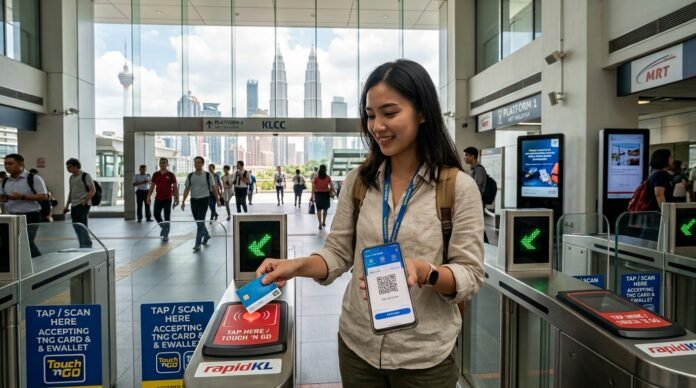

Kuala Lumpur runs on Touch ‘n Go. It’s how you tap onto the trains, pay tolls, and increasingly how you pay for everything from hawker food to convenience-store snacks. But here’s what trips up almost every visitor: “Touch ‘n Go” is actually two different things with the same name, the physical card and the eWallet app, and they do different jobs. Mixing them up is the single most common payment confusion in KL.
This guide clears it up: what each one is, which you actually need as a tourist, how to pay for the trains and buses, whether foreigners can register the app, and the one real catch, topping it up.
Some links in this post are affiliate links. If you book through them, I earn a small commission at no extra cost to you. Thanks for supporting the blog.
The short version
- The card is a physical tap card for trains, buses, tolls and parking. No registration, buy it on arrival, and for most KL visitors it’s the essential one.
- The eWallet app is for QR-code payments at shops and stalls, and for reloading the card. Handy, but optional for a short trip.
- Buses need the card. Cash isn’t accepted on RapidKL buses, and the app alone can’t tap you onto a train or bus.
- Foreigners can now register the eWallet (since 2025), but topping it up with a foreign card often fails, which is the main hassle.
- Simplest plan: buy a physical card at a station, load RM30, and tap away. Add the app only if you want to go fully cashless.
First, check whether you need a Malaysian wallet at all
This is the part almost nothing written for visitors mentions, and for a large share of Malaysia’s inbound travellers it makes the rest of this page unnecessary.
Malaysia’s national QR standard is DuitNow QR, run by PayNet, the country’s payments network. It is the black and white code you see at almost every counter, stall and market table. What matters for you is that DuitNow QR is linked to several foreign payment networks, so a visitor can scan a Malaysian code using the app they already have at home.
Supported inbound networks and apps as of September 2026 include:
- Singapore, via NETS
- Indonesia, via QRIS
- Thailand, via PromptPay
- Cambodia, via Bakong and Maybank KH
- China, via Alipay+, WeChat Pay and UnionPay
- South Korea, via paybooc
The flow is the same as at home: open your banking or wallet app, scan the DuitNow QR at the counter, enter the amount in ringgit, and confirm. Your own app converts and deducts in your home currency.
So if you are coming from one of those countries, try your usual app on the first DuitNow code you see. If it works, you can skip the Touch ‘n Go eWallet entirely and read only the physical card section below, which is still worth having for the trains.
If you are coming from Europe, North America, Australia or anywhere else on that list’s outside, this does not help you, and the rest of this page is written for you. Confirm the current country and app list with PayNet, because the network keeps adding partners.
Card vs eWallet: the crucial difference
Get this one thing straight and the rest is easy. They share a brand, but they are not the same product.
| Touch ‘n Go card | Touch ‘n Go eWallet | |
|---|---|---|
| What it is | A physical tap card | A phone app |
| How you pay | Tap the card on a reader | Scan a QR code in the app |
| Trains and buses | Yes, tap to ride | No, cannot board with the app alone |
| Tolls and parking | Yes | Yes, if linked to a card |
| Shops and food stalls | Rarely | Yes, at millions of merchants |
| Registration | None needed | Passport plus phone number |
The key takeaway: the app cannot tap you onto a train or bus. For public transport you need the physical card. The app is for QR payments and for topping the card up. Many visitors assume the app replaces the card, arrive at a train gate, and get stuck. It doesn’t.
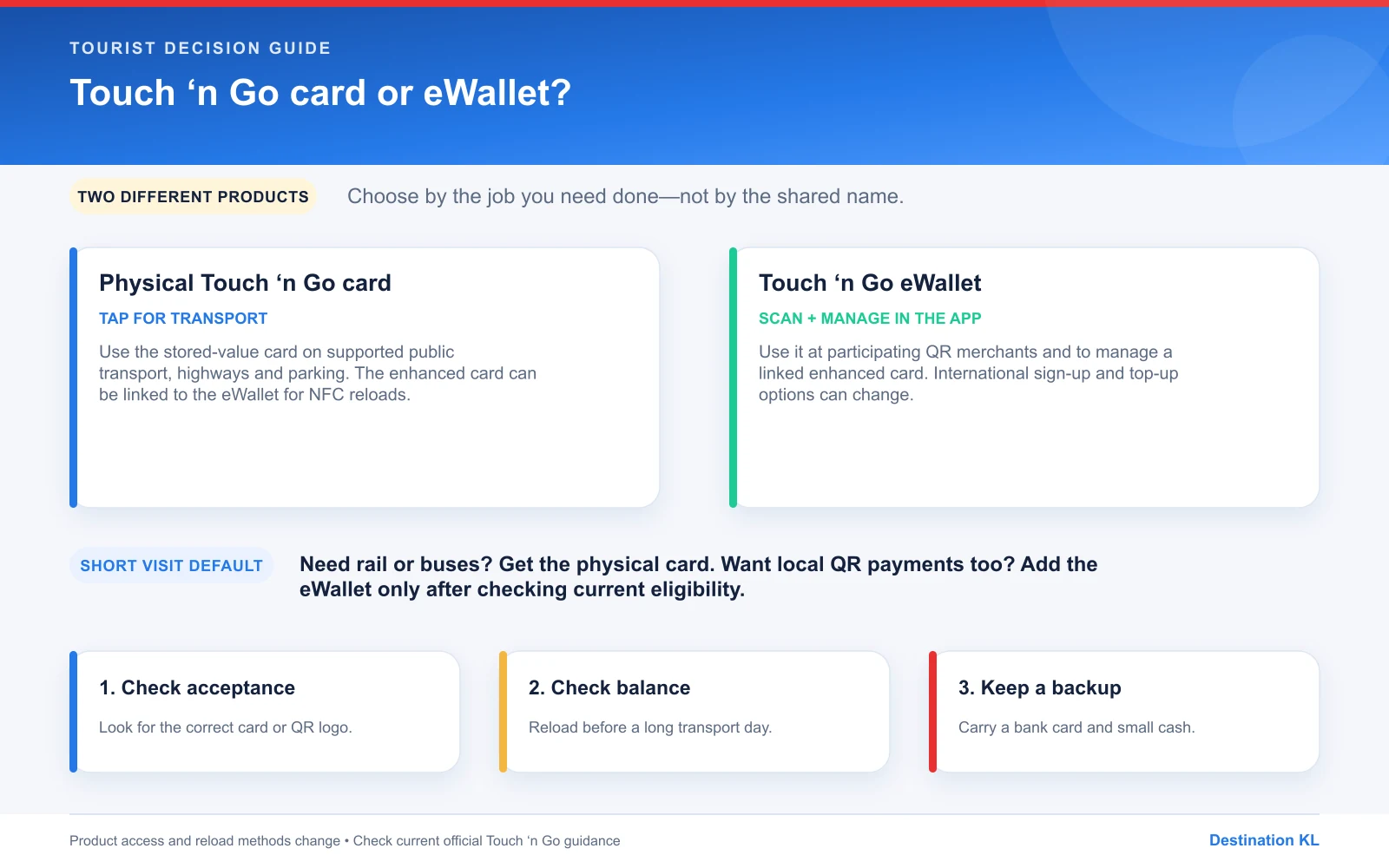
The physical Touch ‘n Go card
For a KL visitor, this is the one that matters most. It’s a contactless stored-value card you just tap, and it works across:
- Trains, the LRT, MRT, Monorail and KTM Komuter. Tap in and out at the gates.
- Buses, RapidKL and feeder buses. This is important: cash is not accepted on the buses, so without a card you can’t ride them.
- Tolls and parking, handy if you rent a car or take toll roads.
Where to buy it: the Touch ‘n Go Service Centre at Nu Sentral next to KL Sentral, ticket counters and machines at many MRT, LRT and Monorail stations, some 7-Eleven stores, and at the airport. It’s easy to grab one on arrival.
Cost and reloading: the card itself costs roughly RM10 to RM15, sometimes with a little starting credit. Reload it with cash at the top-up machines and counters in stations, or, if you have the newer Enhanced NFC version, straight from your phone through the eWallet app. A good rule is to keep around RM20 to RM30 on it so you’re never caught short at a gate.
No registration needed. Unlike the app, the card works straight out of the packet. That simplicity is exactly why it’s the smart first buy. Our rail guide explains riding the trains, and the airport to city guide covers arriving.
The Touch ‘n Go eWallet app
The eWallet is a phone app for cashless QR payments, and Malaysia is very much a QR-payment country. With it you can:
- Pay by scanning a QR code at over two million merchants, convenience stores, cafes, restaurants, and many hawker stalls and markets.
- Reload your physical card from your phone, if it’s an Enhanced NFC card.
- Pay tolls and parking by linking your card, and top up for online shopping and bills.
Can foreigners register? Yes. Since 2025, Touch ‘n Go opened eWallet registration to international visitors, and by 2026 the app accepts international mobile numbers, so you no longer need a Malaysian SIM or bank account to sign up. You register with your passport and phone number, and you can even do it before you arrive. Note that until you complete identity verification (eKYC, a passport photo and a selfie in the app), your wallet balance is capped at around RM200, which is fine for most short trips. Completing eKYC raises the limit substantially.
The catch: topping up the eWallet
This is the real hurdle for tourists, and most guides skip it. Registering is easy; funding the wallet is where people get stuck, because many foreign credit and debit cards are simply not accepted for top-ups. To make matters trickier, auto-reload and quick-payment via debit cards were discontinued in 2026. Your practical options:
- A Wise card tends to work smoothly for reloading the eWallet, and is a popular workaround for travellers. You can set up a Wise account before you travel.
- A cash Reload PIN, bought over the counter at 7-Eleven and other convenience stores, then entered in the app. This is the reliable, no-card-needed method.
- Reload kiosks at some stations and malls.
If topping up sounds like a faff for a few days’ visit, that’s a fair reaction, and it leads to the honest question below.
Do you actually need the eWallet as a tourist?
Honest answer: not necessarily. Here’s how to decide.
- The physical card: essentially yes. If you’re using the trains and buses at all, buy one. It’s cheap, simple and needs no setup.
- The eWallet app: optional. It’s genuinely useful for going fully cashless at shops and stalls, but between the registration and the top-up hurdle, plenty of short-stay visitors skip it and get by fine on the card plus some cash and a regular credit card, which is widely accepted at malls, restaurants and hotels.
Get the eWallet if you want the smoothest cashless experience, you’re staying a while, or you already have a Wise card to fund it. Otherwise, don’t feel you’re missing much: card for transport, cash for hawker stalls and markets, credit card for bigger spends is a perfectly good combination in KL.
Touch n Go, GrabPay or Boost: which wallet suits a visitor?
Malaysia has several e-wallets, and the comparisons written for residents rank them on cashback, bill payments and merchant promotions. None of that is the question a visitor is asking.
For a tourist there is only one discriminator that matters: can you register and load money without a Malaysian bank account or phone number? On that test the Malaysian wallets are more alike than different, and all of them are harder work than the marketing suggests.
The practical answer for most short visits: do not install a second Malaysian wallet. If you get one working, Touch n Go is the one worth the effort, because it has the broadest acceptance and doubles as parking and toll payment. GrabPay only makes sense if you are already using Grab for rides, since it lives inside that app. Boost offers a visitor nothing Touch n Go does not, with the same registration friction and narrower acceptance.
If Touch n Go defeats you, adding another wallet will not go better, and your time is better spent carrying a little more cash. For the wider picture of how to pay across a trip, see our guide to cash versus card in Malaysia.
Paying for the KL trains, specifically
At any LRT, MRT or Monorail station you have two easy options: tap your Touch ‘n Go card at the gate, or buy a single-journey token from the machine for that one trip. The card is far more convenient if you’ll ride more than a couple of times. On the KLIA Ekspres from the airport, you can pay with a Touch ‘n Go card, a QR code, or a contactless bank card at the gates. See our rail guide for the full how-to.
One thing to skip: you may read about the My50 unlimited travel pass. It’s a great deal, but it’s for Malaysians only, so as a tourist you can’t use it. Don’t waste time chasing it.
Quick start: your first hour in KL
- At the airport or your first station, buy a physical Touch ‘n Go card.
- Load about RM30 onto it with cash at a top-up machine or counter.
- Tap in and out at the train gates, and tap on the bus. That’s your transport sorted.
- Optional: download the eWallet app, register with your passport, and fund it with a Wise card or a cash Reload PIN if you want QR payments too.
You’ll want mobile data for the app and for maps and Grab, so sort out a local eSIM or SIM early. See our best eSIM for Malaysia guide, and our Grab guide for ride-hailing.
Frequently asked questions
Do tourists need a Touch ‘n Go card in KL?
If you plan to use the trains or buses, yes, a physical Touch ‘n Go card is the simplest way to pay, and it’s essential for RapidKL buses since they don’t accept cash. It needs no registration, costs around RM10 to RM15, and you tap it at train gates and on buses. You can also buy single-journey train tokens, but a card is far more convenient for multiple rides.
What is the difference between the Touch ‘n Go card and the eWallet?
The card is a physical tap card for trains, buses, tolls and parking. The eWallet is a phone app for scanning QR codes to pay at shops and stalls, and for reloading the card. Crucially, the app alone cannot tap you onto a train or bus, you need the physical card for public transport. Many visitors confuse the two.
Can foreigners register for the Touch ‘n Go eWallet?
Yes. Since 2025, international visitors can register, and by 2026 the app accepts international mobile numbers, so you don’t need a Malaysian SIM or bank account. You sign up with your passport and phone number and can even do it before arriving. The main difficulty isn’t registering, it’s topping up, since many foreign cards are rejected. A Wise card or a cash Reload PIN from a convenience store are the usual workarounds.
How do I top up the Touch ‘n Go eWallet with a foreign card?
Many foreign credit and debit cards don’t work for eWallet top-ups, and auto-reload via debit card was discontinued in 2026. The most reliable methods for tourists are a Wise card, which generally works, or buying a cash Reload PIN over the counter at 7-Eleven and other convenience stores and entering it in the app. Some stations and malls also have reload kiosks.
Can I use the Touch ‘n Go eWallet app to enter the train?
No. The eWallet app cannot tap you through train or bus gates on its own. For public transport you need the physical Touch ‘n Go card, or a single-journey token for trains. The app is for QR payments at shops and for reloading your card, not for boarding.
Can I pay in Malaysia with my own country’s app?
Possibly. Malaysia’s DuitNow QR is linked to several foreign networks, so visitors from Singapore (NETS), Indonesia (QRIS), Thailand (PromptPay), Cambodia (Bakong), China (Alipay+, WeChat Pay, UnionPay) and South Korea (paybooc) can scan a Malaysian DuitNow code with the app they already use at home. You enter the amount in ringgit and your own app converts. If your country is not on that list, this will not work for you.

