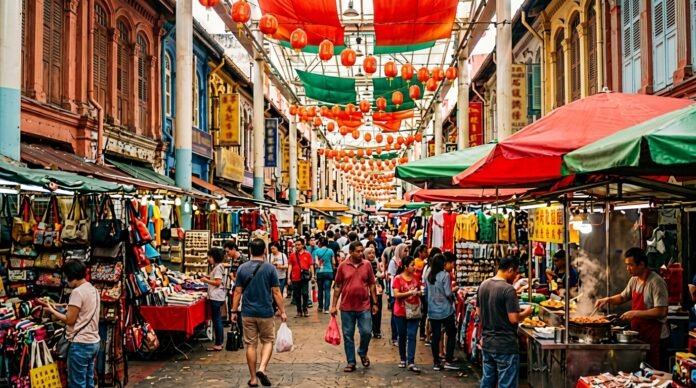

Chinatown is where old Kuala Lumpur still breathes. Centred on Petaling Street, it is the city’s most characterful district: heritage shophouses, temple incense, market chaos, and some of the best cheap food in KL, all a short walk from the modern centre. It is also where your money goes furthest. Here is the complete picture of the area, the vibe, where to stay, what to eat, what to do, and how to get around.
Some links below are affiliate links. If you book through them I earn a small commission at no extra cost to you.
The short version
Chinatown and Petaling Street are old KL: heritage buildings, the covered market, temples, and brilliant cheap food, with budget hotels, hostels, and a wave of boutique shophouse stays. It is central, well connected by train, and full of atmosphere, though gritty in places. Best for budget travelers, backpackers, and food and heritage lovers.
Chinatown at a glance
| Question | Answer |
|---|---|
| Station | Pasar Seni, an interchange between the Kelana Jaya LRT and the Kajang MRT line, one stop from KL Sentral |
| Rooms from | Dorm beds from around RM20, basic private rooms from around RM80 as of August 2026 |
| Mid range and up | Thin. Tian Jing on Jalan Sultan RM150 to RM300, MoMo’s RM110 to RM250, Else Kuala Lumpur RM500 to RM800 |
| Petaling Street market | Roughly 10am to 9.30pm daily, busiest in the evening |
| Central Market | Daily 10am to 10pm, per Central Market’s own site. Many listings still say it shuts at 6.30pm |
| Kwai Chai Hong | Free to walk into, and best after dark when the lane is lit |
| After 11pm | Largely shuts. Quiet streets and a handful of late places |
| Best for | Budget travellers, repeat visitors, food and heritage |
The vibe
Chinatown is loud, colourful, and alive, busiest by day when the market is in full swing and the food stalls are going. It mixes Chinese, Indian, and old colonial KL in a few dense blocks, with temples, clan houses, street art, and shophouses turned into cafes and boutique stays. It is gritty and worn in places, which is part of the charm, and the opposite of polished KLCC. For how it compares with other areas see the Kuala Lumpur neighborhoods guide.
Where to stay in Chinatown
This is the best central area for budget travelers, with strong hostels, cheap hotels, and a growing set of stylish boutique stays in restored shophouses (Else Kuala Lumpur, set in a beautifully restored heritage building, is the standout design option), so you can sleep cheaply without sleeping badly. It is central and well connected, though noisier by day than by night. For the full breakdown see the best budget hotels in KL and the best boutique hotels in Chinatown.
What to eat
Chinatown is one of the best eating areas in the city, home to legendary old stalls that have made the same dish for generations, from noodles to claypot to roast meats. Petaling Street and the surrounding lanes are dense with hawker food, and it is some of the cheapest quality eating in KL. Follow the longest local queues. For specifics see the KL food guide and the best hawker centres.
Some dishes and names to look for (hours and exact spots shift, so check and follow the queues):
- Hokkien mee, KL’s dark, smoky charcoal-fried noodles, the dish Chinatown is most known for. Kim Lian Kee on Petaling Street bills itself as its birthplace and has served it since 1927.
- Claypot chicken rice, cooked over charcoal with crispy rice crust at the bottom, a Chinatown signature.
- Curry laksa and yong tau foo down Madras Lane, the narrow alley off Petaling Street (daytime).
- Air Mata Kucing, the famous iced herbal cooler from the long-running stall near the southern Petaling Street arch, the perfect heat-beater.
- For a sit-down meal, Chocha Foodstore, a modern restaurant and tea house in a beautifully restored old hotel building, regularly cited among the region’s best.
What to do
Chinatown is a walking and eating district more than a ticketed one, but there is plenty to see:
- Wander Petaling Street (Jalan Petaling) market, busiest and best after 6pm, and bargain for knock-offs and souvenirs.
- Visit the ornate Sri Mahamariamman Temple, the oldest Hindu temple in KL, and the Taoist Guan Di Temple and Sin Sze Si Ya Temple (the city’s oldest), all within a short walk.
- Photograph Kwai Chai Hong, a restored heritage laneway with murals capturing 1960s Chinatown life.
- Browse Central Market for crafts in the air conditioning, a five-minute walk away.
- Hunt the street art, old shophouses, and tucked-away cafes between the lanes.
- Step into REXKL, the city’s first cinema, gutted by fire and rebuilt as a cultural hub with a bookshop, food and events. It is the biggest change in Chinatown in a decade and the easiest of KL’s adaptive reuse projects to reach on foot.
It pairs naturally with the colonial old town around Merdeka Square next door. For more see things to do in Kuala Lumpur.
To put the area in context, a 3 Cultures Walking Tour winds through Chinatown, Central Market, Merdeka Square, Jamek Mosque and the old temples, with a guide to explain the history.
If you are here mainly for the food, a Michelin-guided Chinatown heritage and flavours tour focuses on the eating rather than the sights.
When to go, and what is actually open
Chinatown runs on two different rhythms, and turning up at the wrong hour is the most common way to be disappointed by it.
Mornings and early afternoons are for the food and the temples. Madras Lane, the old kopitiams and the hawker stalls are at their best before about 2pm, and several close for the day once they sell out. The temples are calm and the light is good for photographs.
Evenings are for the market. Petaling Street runs roughly 10am to 9.30pm, but the covered stretch only really comes alive after dark, and the point of it is the atmosphere rather than the goods. Kwai Chai Hong is also better lit and more atmospheric after sunset, and it is free to walk into.
One thing worth correcting, because a lot of listings have it wrong. Central Market is open daily from 10am to 10pm according to its own website, not the 6.30pm closing time that appears on several aggregator pages and travel guides. If you have been told the air conditioning shuts at half six, it does not, and an early evening hour in there is a good way to wait out a downpour.
After about eleven the area empties. Shutters come down, the market packs up, and the streets go quiet fast. That is a genuine advantage if you are here to sleep and a genuine drawback if you wanted somewhere to go afterwards, in which case Bukit Bintang is twenty minutes away. Hours drift, so confirm anything you are travelling specifically for.
Getting there and around
Chinatown is central and well served by rail. The station is Pasar Seni, an interchange between the Kelana Jaya LRT and the Kajang MRT line, which is the strongest combination in the old town because it gives you two directions without changing. KL Sentral is one stop away for airport trains and day trips, and Bukit Bintang and KLCC are both a few minutes on the MRT or LRT, and it is very walkable within itself and into the adjoining old town. From the airport, take the KLIA Ekspres to KL Sentral then a short train or Grab. For the full picture see getting around Kuala Lumpur and KLIA to KL city.
Who it suits, and who should look elsewhere
Chinatown suits budget travelers, backpackers, solo travelers wanting atmosphere, and food and heritage lovers. It suits less well anyone after resort polish, quiet luxury, or a glossy modern base, who would do better in KLCC, or Bukit Bintang for walkable shopping and nightlife. For the alternatives see the neighborhoods guide.
Frequently asked questions
Is Chinatown a good area to stay in KL?
Yes, especially for budget travelers and anyone who wants atmosphere and great cheap food. It is central, well connected by train, and full of heritage, with strong hostels, cheap hotels, and stylish shophouse boutique stays. It is grittier and noisier by day than polished KLCC.
What is Petaling Street known for?
Petaling Street is the heart of KL’s Chinatown: a covered market famous for stalls and bargaining, surrounded by legendary hawker food, temples, and old shophouses. It is one of the most characterful and affordable corners of the city.
Is Chinatown KL safe?
Yes, with normal city awareness. It is busy and well trodden by day and evening. Keep an eye on your belongings in the market crowds, as with any busy tourist area, and use Grab for longer trips late at night.
Where should I eat in Chinatown?
Follow the longest local queues on and around Petaling Street, where old stalls serve noodles, claypot, and roast meats cheaply. Well-known names include Kim Lian Kee for Hokkien mee, the Madras Lane stalls for curry laksa, and the Air Mata Kucing stall for the famous iced cooler. See the KL food and hawker centre guides for more picks.
What time does Central Market close?
10pm, daily, according to Central Market’s own website, with doors opening at 10am. A number of listings and travel guides still say it closes at 6.30pm, which is wrong and sends people away three and a half hours early. It is a useful place to wait out an afternoon downpour, since the whole thing is under cover and air conditioned.
Which station is Chinatown Kuala Lumpur?
Pasar Seni, which is an interchange between the Kelana Jaya LRT and the Kajang MRT line. That makes it one of the better connected stations in the city, since you get two directions of travel without changing. KL Sentral is one stop away, and Bukit Bintang and KLCC are both a few minutes on the train.
Is Chinatown KL cheaper than Bukit Bintang?
At the bottom of the market, yes. Dorm beds start around RM20 and basic private rooms around RM80, below Bukit Bintang’s floor of roughly RM90. Above about RM150 it reverses, because Chinatown’s stock is small and skews towards boutique heritage conversions, so Bukit Bintang offers far more choice in the middle of the range.
Explore more
- Kuala Lumpur neighborhoods
- Best budget hotels in KL
- Kuala Lumpur food and where to eat
- Bukit Bintang guide
- Getting around Kuala Lumpur
Ready to base yourself here?
Chinatown is the best value central base: see the best budget hotels in KL.

