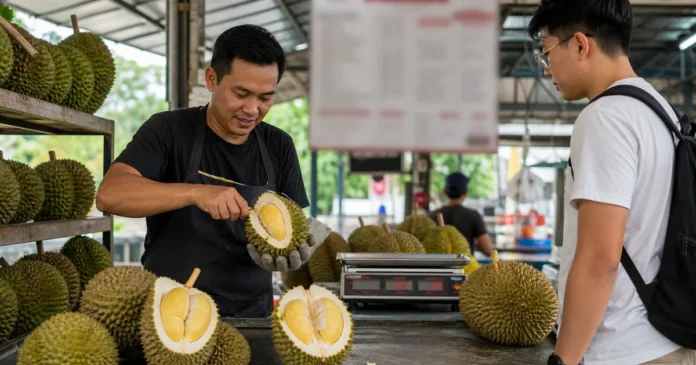

Durian is the one Malaysian food that people arrive with an opinion about before they have tried it. It is worth trying, it is not as difficult as its reputation suggests, and the main thing standing between most visitors and a good durian is timing rather than courage.
Turn up in the wrong month and you will pay a premium for cold storage fruit that does not represent the thing at all.
The short version
- There are two seasons. The main one runs roughly June to August, with a smaller second harvest around December and January
- Outside those windows the fruit is frozen, imported or poor, and it costs more for less
- Musang King is the famous one, but it is not automatically the one you will like best
- Agree the price per kilo and watch it weighed before it is opened. Once a durian is cut you have bought it
- 2026 has been an unusually cheap year because of a bumper harvest and oversupply
When durian is actually in season
Malaysia has two durian harvests and they are not equal.
The main season runs from around June to August, sometimes stretching into early September. This is when the roadside stalls appear, the prices fall, and the fruit is at its best. If your trip falls in this window, durian should be on your list.
There is a smaller second harvest around December and January. The fruit is genuine and fresh but the volume is lower and the choice narrower.
Outside those months you can still buy durian in Kuala Lumpur, but you are buying frozen fruit, cold storage stock or imports. It is not the same experience, and it is the reason some visitors conclude durian is overrated. They ate it in March.
Seasons shift with the weather each year, so if the timing matters to your trip it is worth checking the current state of the harvest rather than relying on the calendar.
The varieties, and which one to start with
Stalls sell by variety and the differences are real, not marketing.
Musang King is the famous one. Deep yellow flesh, bittersweet, custardy, and intense. It is the benchmark and it is priced accordingly. If you only try one, this is the one people mean.
Black Thorn is the current rival and often more expensive than Musang King. Creamier, sweeter, less bitter. A number of people who find Musang King too strong prefer this.
D24 is the older standard. Cheaper, milder, and a sensible first durian if you are unsure. Nothing wrong with it at all.
Red Prawn, or udang merah, has orange tinted flesh and a sweeter, less bitter profile. Another good starting point.
Kampung durian is unbranded village fruit, sold cheaply and variable in quality. Fine to try when it is in front of you, not worth seeking out.
A note on the bitterness. The premium varieties are prized for a bitter, almost alcoholic edge, which is exactly what a first timer may not want. If you want to find out whether you like durian at all, start with D24 or Red Prawn rather than paying most for the most challenging one.
What it costs
Durian pricing moves faster than almost any other food price in Malaysia, because it tracks the harvest week by week.
2026 has been an unusually cheap year. A bumper national harvest created a glut, and Musang King, which had been in the region of RM60 to RM80 per kilo in the 2025 season, fell to roughly RM20 to RM35 per kilo in January 2026 and stayed low through the mid year season. Retail stalls in the city and premium outlets charge more than the wholesale and roadside figures, so expect a spread rather than a single number.
The practical version, as of September 2026: expect roughly RM20 to RM40 per kilo for Musang King at a normal stall in season, more at a tourist facing premium outlet, and considerably less for D24 and kampung fruit. A whole fruit typically weighs one to three kilos.
Board prices change daily. Any figure in any guide, including this one, is a guide to the order of magnitude and not a quote.
How to buy without being overcharged
Durian is sold by weight and opened in front of you, and that combination is where visitors lose money. None of this is unique to tourists, but locals know the sequence and visitors do not.
Agree the price per kilo before anything else. Ask, and ask for the variety by name, because a stall may quote you the Musang King price and hand you something else.
Watch it weighed, before it is opened. This is the important one. Once the fruit is cut it cannot be sold to anyone else, so your negotiating position disappears the moment the knife goes in. Weigh first, agree the total, then open.
Buy where locals buy. A stall with Malaysian families sitting at plastic tables is pricing for them. A stall positioned outside a tourist attraction is not.
Eat it there. Most stalls have tables, gloves and water, and this is the normal way to do it. Which is just as well, because of the next point.
The rules nobody tells you
You cannot take durian into a hotel. Nearly every hotel in Malaysia bans it, and the signs are usually at the lift. This is not a suggestion, the smell genuinely lingers for days in an air conditioned room.
It is banned on public transport. The MRT, LRT and monorail all prohibit it, and the signage at the gates says so explicitly. You are not carrying an opened durian home on the train.
You cannot fly with it. Airlines do not permit durian in the cabin or the hold. Vacuum packed and frozen products sold at the airport are a different matter and are allowed.
Do not drink alcohol with it. Malaysians will tell you this and there is longstanding local belief behind it. Whether or not the folk explanation is accurate, plenty of people report feeling unwell after combining the two, and there is no reason to test it on holiday.
Where to try it in KL
In season, durian stalls appear along roadsides across the city and the Klang Valley, and the informal ones are often the best value.
SS2, Petaling Jaya
The best known cluster, with several stalls on the same stretch and proper seating so you can compare varieties side by side. SS2 Durian House on Jalan SS 2/61 is one of the long running ones and stays open from midday until around midnight, which is unusually late for durian. Durian SS2 nearby runs an all you can eat format.
It is in Petaling Jaya rather than central KL, so factor in a Grab ride each way.
Bukit Bintang, for convenience
Several durian shops operate around Bukit Bintang and Jalan Alor aimed squarely at visitors, including air conditioned ones with English signage such as Durian Bros near Pavilion.
You pay for the convenience and the gap is large. Bukit Bintang shops have advertised Musang King from around RM49 per kilo while ordinary stalls in season were closer to RM20 to RM35. That is not a scam, it is rent and air conditioning, but it is worth knowing you are paying roughly double for a shorter walk.
The buffet option
All you can eat durian is a real format here and it suits a specific person. You pay a fixed price, commonly from around RM168 an hour at the Bukit Bintang places as of September 2026, and eat as much as you like across a range of varieties.
It makes sense if you already know you like durian and want to try many types. It is poor value if you are testing whether you like it at all, because two or three seeds of something mild will tell you that for under RM30.
Wet markets and night markets
Cheaper again in season, and where locals buy. Our night markets guide covers which market runs on which night.
Supermarkets, if you want to try it privately
Pre packed durian in sealed plastic boxes is sold year round at most supermarkets. More expensive per gram and never as good as fresh in season, but it is a low commitment way to taste it, and it solves the problem of not wanting to eat your first durian in front of an audience.
Frequently asked questions
When is durian season in Malaysia?
The main season runs roughly June to August, occasionally into early September. There is a smaller second harvest around December and January. Outside those windows the durian on sale is generally frozen, cold stored or imported.
How much does Musang King cost in Kuala Lumpur?
It varies week by week with the harvest. 2026 has been unusually cheap because of a bumper crop, with Musang King falling to around RM20 to RM35 per kilo in January from roughly RM60 to RM80 the previous season. Expect a stall in season to sit somewhere in that lower range, and tourist facing outlets to charge more.
Which durian should a first timer try?
D24 or Red Prawn rather than Musang King. The premium varieties are prized for a bitter edge that is exactly what a newcomer may not enjoy, so starting milder tells you whether you like durian before you pay the most for the most challenging version.
Why is durian banned in hotels?
The smell is powerful and it lingers for days in an air conditioned room, which is why almost every Malaysian hotel prohibits it and posts signs at the lifts. It is also banned on the MRT, LRT and monorail, and airlines do not allow it on board.
Can I take durian home on the plane?
Not fresh. Airlines prohibit it in the cabin and the hold. Vacuum packed or frozen durian products sold at the airport are permitted, and that is the practical way to take some home.
Is it true you should not drink alcohol with durian?
It is longstanding local belief and Malaysians will warn you about it. Whether the traditional explanation holds up or not, enough people report feeling unwell after combining them that there is no good reason to try it while travelling.
Explore more
- Where to eat in Kuala Lumpur, the full food guide
- The Malaysian dishes worth seeking out
- Malaysian food explained
- Best time to visit KL, if you want to plan a trip around the season

