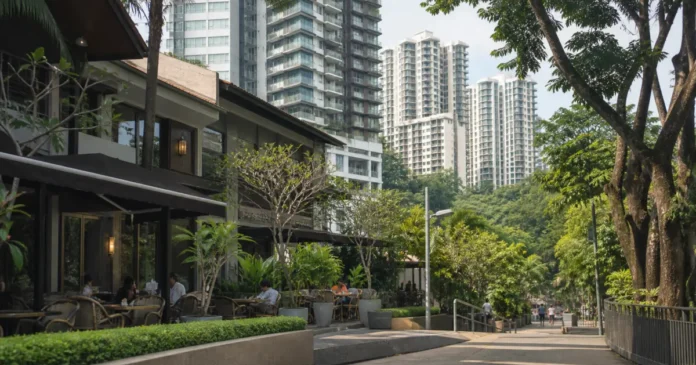

Mont Kiara turns up on every list of KL neighbourhoods, usually described as the expat district, and visitors often add it to an itinerary without quite knowing why. It is worth being straight about what it is. Mont Kiara is a dense cluster of high rise condominiums on a hill northwest of the city centre, built around international schools and a handful of malls. It is a place people live, not a place people sightsee.
That does not mean skip it. It means go for the right reason, which is almost always the food.
The short version
- Mont Kiara is residential. There are no landmark sights, and no reason to come if you are ticking off attractions.
- The Japanese and Korean food around Solaris is the genuine draw, and it exists because of the expat community rather than the tourist trade.
- Publika, technically next door in Solaris Dutamas, is the most interesting single destination in the area.
- There is no MRT or LRT station. Getting here means a car, a Grab or a bus, and the traffic is genuinely bad.
- Best as a half day trip built around lunch or dinner, not a full day.
The vibe
Modern, green, quiet and quite separate from the rest of KL. Towers sit among mature trees on a slope, most of them with pools and gyms behind gated entrances. Walking around, you hear more Japanese, Korean and English than Malay. There are international schools, imported groceries and a lot of prams.
The upside is real. It is calm, the air feels better than downtown, and it is one of the few parts of KL where you can walk between places under tree cover. Families with young children find it easy in a way that central KL is not.
The trade off is that it can feel like a bubble. If your picture of KL involves hawker stalls, street noise and old shophouses, none of that is here. Some people find it a relief and others find it sterile, and it is worth knowing which one you are before you plan a day around it.
Where is Mont Kiara?
Northwest of the city centre, on a hill between the Duta Ulu Kelang Expressway and the Sprint Expressway. On a map it looks close to KLCC, and in distance it is. In practice the journey depends entirely on the time of day.
The area people mean by Mont Kiara is compact, roughly the streets around Jalan Kiara and Jalan Mont Kiara, plus Solaris Mont Kiara at the bottom of the hill. Publika and Solaris Dutamas sit just outside it and get lumped in, which is fair enough since almost everyone treats them as part of the same trip.
What to eat
This is the reason to come, and it is a good one.
Mont Kiara has a large Japanese and Korean resident population, and the restaurants around Solaris Mont Kiara exist to feed them rather than to feed tourists. That changes what you get. Korean barbecue, izakaya, ramen and sushi here are cooked for people who will notice if it is wrong, and prices are aimed at residents eating on a Tuesday rather than at visitors on a night out.
Solaris is a grid of shoplots, so the practical approach is to walk it and look at who is inside. A full Korean restaurant at 8pm on a weeknight is a better signal than any review score. Many places here are small and popular enough to need a booking at weekends.
The honest caveat: this is not cheap Malaysian food, and it is not local food. If you have three days in KL and want hawker classics, spend the evening at Jalan Alor or in Chinatown instead. Mont Kiara earns its trip on a longer visit, or when you have had enough rice and noodles and want something else.
Beyond Solaris, the malls hold the usual cafe and chain restaurant mix, competent and unexciting. Publika is the exception and is covered below.
What to do
Set expectations first. There is no temple, no viewpoint and no museum. What there is:
Publika. An arts leaning mall in the Solaris Dutamas development on the edge of the area, and the one place here worth a visit in its own right. Galleries and exhibition space sit alongside independent shops and a strong food selection, and there is usually something on. It is more interesting than any conventional mall in the neighbourhood, and it is where locals take visitors. Check what is scheduled before going, since the events calendar is the main draw.
1 Mont Kiara and Plaza Mont Kiara. Ordinary shopping malls, useful for air conditioning, a coffee and a supermarket run. Plaza Mont Kiara hosts periodic markets in its open area, including craft and produce stalls at weekends. Schedules change, so check before making a trip specifically for one.
Bukit Kiara. The forested hill next door has walking and jogging trails and is popular in the early morning. This is the closest thing to an attraction in the area, and it is genuinely pleasant, but go early because it gets hot and busy. Trails are used heavily by local runners and cyclists.
Realistically, half a day covers it. Combine Publika with lunch or dinner at Solaris and you have used the area well. Anyone planning a full day here will be padding.
Getting there and around
This is the part most guides skip, and it is the part that will shape your visit.
There is no MRT or LRT station in Mont Kiara. For an area this dense and this affluent, that surprises people. The nearest rail is a drive away rather than a walk, so arriving by train and strolling in is not an option the way it is in Bangsar or Bukit Bintang.
Grab is the practical answer for most visitors. From KLCC or Bukit Bintang it is a short ride outside peak hours. Buses do serve the area from the city centre and are cheap, but they are slow and require more planning than most visitors want.
The traffic is the real constraint. A large number of high rise towers feed onto a small number of access roads, and the result is congestion that residents have complained about publicly for years, with local press reporting short journeys taking far longer at peak times. Avoid arriving between roughly 7am and 9.30am or 5pm and 8pm on weekdays, and be aware that the school run adds its own peaks. Mid morning, early afternoon and weekends are much easier.
Relief is a long way off. A station at Bukit Kiara is included in the proposed MRT3 Circle Line, but it is listed as provisional, construction is not expected to begin before 2027, and the line is not scheduled to be fully operational until the early 2030s. Treat it as a future possibility rather than a plan.
Once you are here, the core area is walkable, with the caveat that it is hilly and there is little shade on some stretches. Solaris to the malls is a manageable walk in the morning and an unpleasant one at 2pm.
Where to stay in Mont Kiara
For a short holiday, staying here is usually the wrong call. You will spend the trip commuting into the city and back, and the area has none of the evening atmosphere that makes Bukit Bintang or Chinatown fun to walk out into.
It makes much more sense for longer stays. If you are here for weeks rather than days, want a kitchen, a pool and a quiet night, and are relaxed about ordering a car when you go out, the calculation flips. Families in particular tend to prefer it to a city centre hotel room. There is a good supply of apartment style accommodation, since so much of the housing stock was built for exactly this. Browse Mont Kiara stays on Agoda.
If you are considering a stay of a month or more, our guide to serviced apartments in KL covers monthly rates and what to check before booking.
What it costs to live here
Mont Kiara is expensive by KL standards, and the figures are why people either commit to it or rule it out quickly.
Furnished two and three bedroom units commonly ask RM3,000 to RM6,000 a month as of August 2026, and core Mont Kiara condominiums trade around RM818 to RM1,045 per square foot to buy. Both sit at the top of the KL market outside KLCC itself.
Set that against Sri Hartamas next door, where apartment listings average nearer RM2,000, or Petaling Jaya where a two bedroom runs RM1,800 to RM3,200. You are paying a real premium, and what it buys is the international school cluster and the expat infrastructure rather than better transport, since neither Mont Kiara nor Hartamas has a rail station.
Mont Kiara at a glance
| Mont Kiara | |
|---|---|
| Best for | Families, longer stays, anyone wanting space and quiet |
| Worst for | Short visits, no car, nightlife |
| Rail access | None. This is the defining constraint |
| Getting to the centre | 15 to 20 minutes off peak by Grab, considerably worse at rush hour |
| Visitor accommodation | Serviced apartments rather than hotels |
| The character | High rise condos, international schools, Korean and Japanese food |
Mont Kiara vs Bangsar
These two get compared constantly, and they are genuinely different.
Bangsar is low rise, walkable, has a proper cafe and bar scene, and sits on the LRT. It feels like a neighbourhood, with a mix of residents rather than a single demographic, and you can spend an evening there without planning transport.
Mont Kiara is high rise, greener, quieter, more family oriented and better for Japanese and Korean food. It has more space and better facilities for the money, and no rail.
For a visitor, Bangsar wins almost every time. For a family staying several months, Mont Kiara often wins. If you are weighing them up as places to live rather than visit, our comparison of the best expat areas in KL goes through the trade offs in more detail.
Who it suits, and who should look elsewhere
Come to Mont Kiara if you are in KL for more than a few days and want a good Japanese or Korean meal, you like the mix of galleries and independent shops at Publika, you have children and want somewhere calm and green for an afternoon, or you are scouting neighbourhoods with a move in mind.
Skip it if you are on a short trip working through the main sights, you want street food and old KL, you are travelling without a budget for Grab rides, or you are here for nightlife. None of those are served well here, and there is no point pretending otherwise.
For families weighing up a longer stay, the international schools are the reason many people end up here in the first place, and our guide to international schools in KL is the place to start. School ownership and management do change, so check the current position directly with any school you are considering.
Frequently asked questions
Is Mont Kiara worth visiting for tourists?
Only for the food and for Publika. There are no sights, and on a trip of three or four days there are better uses of an afternoon. On a longer stay it is a worthwhile half day, particularly if you want a break from Malaysian food.
Is there an MRT station in Mont Kiara?
No. Mont Kiara has no MRT or LRT station, which is unusual for an area of its size. A station at Bukit Kiara features in the proposed MRT3 Circle Line, but it is provisional and years away. For now, plan on a car, a Grab or a bus.
What is Mont Kiara known for?
Being KL’s main expat residential district. High rise condominiums, international schools, a large Japanese and Korean community, and the restaurants that community supports.
How do I get to Mont Kiara from KLCC?
Grab is simplest, and outside peak hours it is a short ride. There is no direct rail link. Buses run from the city centre but take longer. Avoid weekday rush hours in both directions.
Explore more
- KL neighbourhoods guide, how the whole city fits together
- Bangsar guide, the walkable alternative on the LRT
- Bukit Bintang guide, where most visitors base themselves
- Best expat areas in KL, if you are choosing somewhere to live
- Cost of living in Kuala Lumpur, what a month here actually costs

