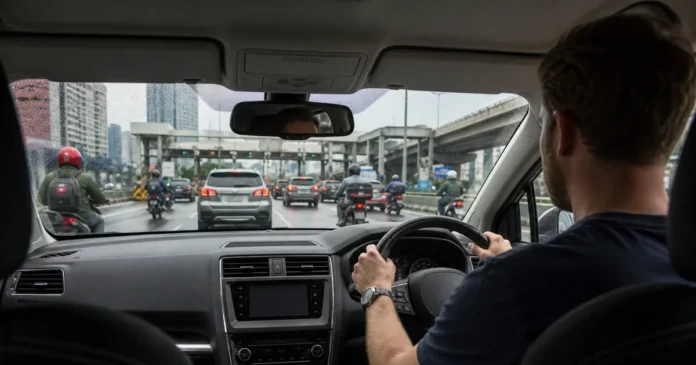

Getting a licence is paperwork. Deciding whether to own a car is arithmetic. This page is about neither, it is about what actually happens once you are driving here every day, which is the part nobody briefs you on and where the expensive surprises live.
The short version
- Do not buy a SmartTAG. They are being retired and the RFID sticker that replaces them is free.
- A police report within 24 hours is a legal requirement after any accident, however trivial. Miss it and your insurer can refuse the claim outright.
- Street parking machines are gone. Parking is paid through apps, so set one up before you need it.
- Summons discounts ended in 2026, and unpaid fines now blacklist you at road tax renewal.
- The driving itself is not aggressive so much as fluid. Motorcycles are the thing to recalibrate for.
Tolls: skip the SmartTAG, get the sticker
This is the first thing arrivals get wrong, usually on the advice of a colleague who has been here a while. Malaysia has run three toll systems in parallel for years, and two of them are on the way out.
SmartTAG, the in car device you clip to the windscreen, is being phased out and new units are no longer sold at most outlets. Buying one now is buying into a dead system. Paying by Touch n Go card at the booth is going the same way.
RFID is the answer. It is a sticker fitted to your windscreen or headlamp, linked to your Touch n Go eWallet, and the tag itself is free. No device, no battery, no winding the window down. Fitting is done at appointed centres and takes minutes.
The direction of travel is barrier free tolling. Multi lane free flow gantries are being rolled out on selected highways through 2026 and 2027, where you simply drive under a structure at speed and the charge is read off your tag. Physical booths are expected to disappear on the major routes after that.
The practical consequence for you is boring but important: keep the eWallet topped up. Under a barrier system an empty wallet means an embarrassing reverse out of a lane. Under a gantry system it means an unpaid toll you have to settle later, and the admin is worse than the money. Turn on auto reload and forget about it.
Parking, and why you cannot find a meter
New arrivals circle a street bay looking for a machine that is not there. Kuala Lumpur City Hall has removed its parking machines and moved street parking onto apps, so if you have not installed one, you cannot pay, and not paying is how you collect a compound.
Several apps and eWallets are accepted, including the city’s own smart parking app, Flexi Parking, the Touch n Go eWallet and Boost. Install one and register your plate the week you arrive, not the afternoon you first need it. Note that the city is zoned, with different rates in the central zones than the outer ones, so the app asks which zone you are in.
Mall and office parking is the easier world. Rates commonly sit around RM1 to RM3 an hour as of August 2026 with a daily cap, some malls give the first few hours free, and you pay by ticket or Touch n Go at the barrier. Confirm at the mall, since rates differ and weekend pricing is often higher.
Two habits worth forming. Photograph the level and bay number, because these car parks are enormous and identical. And in the older parts of town you will meet informal attendants who wave you into a space and expect a couple of ringgit. It is not official and it is not a scam either, it is simply how those streets work.
Summons, demerit points and the 2026 change
Enforcement in Malaysia used to have a reputation for softness, and long time residents will tell you about periodic discount campaigns where fines were settled at a fraction of face value. Do not plan around that. It has changed.
Speed and red light cameras feed an automated enforcement network that pushes the notice to your phone through the transport department app, often within minutes of the offence. The standard fine sits at RM300, and the discount campaigns on camera issued summonses were removed in 2026 to preserve the deterrent.
Behind the fine sits KEJARA, the demerit points system. Scheduled offences carry points, speeding attracts them on a sliding scale by how far over you were, and accumulating 20 points triggers suspension for a full licence holder.
The part that catches foreigners. Under the revamp taking effect from January 2026, points no longer wait for you to pay, and drivers who leave fines unsettled get blacklisted, with the system tied to licence and road tax renewal. So the old approach of ignoring a summons now surfaces months later at the moment you need your road tax, which is also the moment your insurance depends on it. Check for outstanding summonses through the official app rather than assuming none exist.
If you have an accident, the clock starts immediately
This is the single most important thing on this page, and almost no relocation briefing mentions it.
Section 52(2) of the Road Transport Act 1987 requires a driver to report an accident at the nearest police station as soon as reasonably practicable and in any case within twenty four hours. That applies to any accident, including the trivial car park scrape where both of you agree it is nothing.
Miss the window and your insurer can reject the claim outright. Not reduce it, reject it. People arriving from countries where a minor bump is settled privately between drivers get this badly wrong, exchange numbers, go home, and discover weeks later that they have no claim and no recourse.
What to do, in order:
- Photograph everything before anything moves. Both vehicles, both plates, the position on the road, and any damage.
- Exchange names, numbers, plate numbers and insurer details.
- Do not admit fault or apologise at the scene. A reflexive sorry is read as an admission, and the finding of fault is not yours to make.
- Lodge the police report within twenty four hours. An online reporting route exists for recent accidents, and the station is always available.
- Ask for a certified copy of the report. Your insurer will want it and getting it later is harder.
- Notify your insurer inside whatever window your policy specifies, which is separate from the police deadline.
If anyone is hurt, medical attention comes first and the report can be made at the police post inside the hospital.
What the driving is actually like
Malaysia drives on the left, which is the easy part if you are coming from the UK, Australia, Singapore, India or Japan, and the adjustment if you are not.
The reputation for chaos is overstated. Traffic here is not aggressive so much as fluid. Lane discipline is loose, gaps get filled rather than left, and indicators are used somewhat optimistically. Once you stop expecting the rules to be followed to the letter and start reading what cars are actually doing, it becomes predictable. Defensive rather than assertive is the posture that works.
Motorcycles are the thing to recalibrate for. They filter between lanes constantly, arrive from angles you are not checking, and will pass on either side including the left. Mirror checks have to become a reflex before every lane change, and the blind spot over your left shoulder matters far more here than it did at home. This is the adjustment that takes longest and the one where the accidents happen.
Two more local habits. Junctions and slip roads are where positioning matters most, because exits arrive with little warning and a missed one in this city can cost you fifteen minutes on a highway with no early turnaround. And navigation apps here are genuinely good and worth using even on routes you know, because they route around incidents you cannot see.
Traffic, rain and the two things that ruin a journey
Klang Valley congestion is concentrated rather than constant. The weekday peaks are the obvious problem, and the honest advice is to arrange your life so you are not in them, because no route choice beats leaving at a different time.
The less obvious one is rain. A heavy afternoon downpour does not just slow traffic, it can produce flash flooding on underpasses and low lying roads within minutes. Never drive into standing water of unknown depth, and if you can see it moving across the road, turn around. Our guide to the KL rainy season covers when this is most likely.
Festive periods are the third factor. Around the major holidays a large share of the Klang Valley drives home to other states on the same two days, and the highways out of the city become very slow while the city itself becomes wonderfully empty. Plan long drives around those dates rather than into them.
Before you drive at all
Three things need to be in order, and they are covered in more depth elsewhere on the site.
A licence you can legally use here. The rules on foreign licences, international permits and conversion changed recently and depend on your pass type, so read our guide to the Malaysian driving licence for expats before you assume your home licence covers you.
Valid road tax and insurance. Driving without them is not a paperwork slip, it is an offence, and an uninsured accident is a life changing amount of money.
An honest answer to whether you need a car at all. Plenty of people in KL do not, and where you live decides it more than anything else. Our guide to the best expat areas in KL and the wider transport guide are the places to work that out.
Frequently asked questions
Do I need a SmartTAG to use Malaysian tolls?
No, and you should not buy one. SmartTAG is being phased out and new units are no longer sold at most outlets. Get the RFID sticker instead, which is free, fitted at appointed centres, and linked to your Touch n Go eWallet. Barrier free gantry tolling is being rolled out through 2026 and 2027 and works off the same tag.
Do I have to make a police report after a minor accident in Malaysia?
Yes. Section 52(2) of the Road Transport Act 1987 requires a report at the nearest police station within twenty four hours of any accident, however minor. If you miss that window your insurer can reject the claim entirely, so settling a small bump privately at the roadside is a costly mistake here.
Is driving in Kuala Lumpur difficult?
Less than its reputation suggests. Traffic is fluid rather than aggressive, lane discipline is loose and gaps get filled. The real adjustment is motorcycles, which filter between lanes and pass on both sides, so mirror checks before every lane change have to become automatic.
What happens if I ignore a traffic summons in Malaysia?
It catches up with you. Under the revamped demerit points system taking effect from January 2026, unpaid fines lead to blacklisting, and the system is tied to licence and road tax renewal. Discount campaigns on camera issued summonses were also removed in 2026, so waiting for a sale is no longer a strategy.
How do I pay for street parking in KL?
Through an app. City Hall has removed its parking machines, so there is no meter to feed. Several apps and eWallets are accepted, including the city smart parking app, Flexi Parking, Touch n Go eWallet and Boost. Install one and register your plate before you need it.
Explore more
- Getting around Kuala Lumpur, the full transport picture
- Best expat areas in KL, since where you live decides whether you drive
- Cost of living in Kuala Lumpur
- The KL expat guide
Written in August 2026. Toll systems, enforcement rules, parking arrangements and fines are set by the Malaysian authorities and are revised. Confirm current requirements with the transport department, City Hall or your insurer before relying on any figure here.

