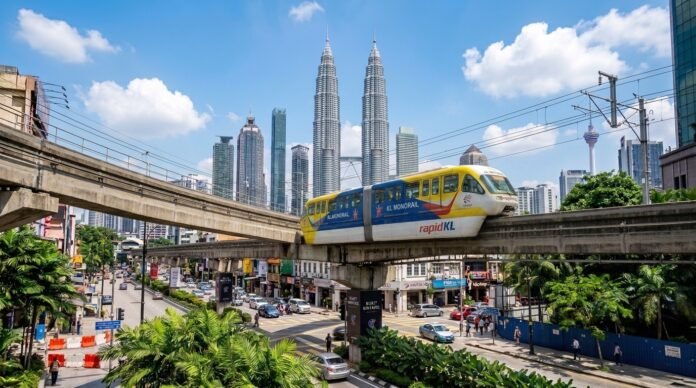

If you’re planning a first trip to Kuala Lumpur, one of the first things you’ll wonder is how hard it’ll be to get around. The good news: KL is one of the easier big cities in Southeast Asia to navigate, thanks to a clean, cheap rail network and ride-hailing that’s everywhere and inexpensive. There are a few honest caveats, mostly to do with heat, traffic and gaps in the rail map, but nothing that should worry a first-timer.
Here’s an honest overview of how you’ll actually get around, what makes it easy, what doesn’t, and a simple strategy that works for almost everyone.
The short answer
Yes, Kuala Lumpur is fairly easy to get around. Between the trains and Grab, you can reach almost everywhere cheaply and without stress, English is widely spoken and signs are in English, and payment is simple. The main things to accept are that KL is not a walking city in the tropical heat, traffic can be slow, and the rail network doesn’t quite reach everywhere. Get a transport card, put Grab on your phone, and you’re sorted.
How people get around KL
You’ll mostly use two things, the trains and Grab, with a bit of walking in between. Here’s the quick rundown, with links to our detailed guides for each.
- The trains (the backbone). KL’s rail network, the LRT, MRT, Monorail and KTM Komuter, is clean, air-conditioned, cheap and covers most areas visitors want. It’s the fastest way to beat traffic. Our rail guide explains the lines.
- Grab (ride-hailing). Malaysia’s answer to Uber is cheap, everywhere and app-based, so there’s no haggling and no cash needed. It’s your go-to for door-to-door trips and anywhere the trains don’t reach. See our Grab guide.
- Walking. Fine for short hops within an area, and some districts are pleasantly walkable, but the heat, humidity and patchy pavements mean you won’t want to walk long distances, especially at midday.
- Buses. RapidKL buses and the GoKL city buses are cheap and useful on some routes, with GoKL at RM1 a ride for foreign visitors rather than free, though slower and less tourist-friendly. You’ll need a transport card to ride.
- The airport train. The KLIA Ekspres links the airport to the city centre in about 28 minutes. See our airport to city guide.
For the full picture of every option, our getting around Kuala Lumpur guide is the complete resource.
What each option costs
The reason KL is easier than it looks is that almost everything is cheap enough that you stop optimising. Figures as of September 2026, so check before relying on them.
| Option | Typical cost | Use it for |
|---|---|---|
| MRT, LRT or monorail | RM 1 to RM 6 a journey | Most trips between central areas |
| Grab across the centre | RM 10 to RM 25 | Short hops, heat, rain, luggage |
| GoKL city bus | RM 1 a ride for visitors | Short central loops |
| KLIA Ekspres from the airport | RM 55, or RM 49.50 online | Getting in and out reliably |
| Rapid Bulanan monthly pass | RM 150 for 30 days | Long stays with heavy rail use |
A day of sightseeing on rail costs less than a coffee does in most Western cities, and a Grab when you cannot face the walk rarely breaks RM 25. That is what makes the city forgiving.
What makes KL easy
- Cheap, decent rail. The train network is modern, air-conditioned and inexpensive, and it links the airport, the main neighbourhoods and most big attractions.
- Grab is everywhere and cheap. This is the great equaliser. Even where the trains don’t reach, a cheap Grab is a couple of taps away, with the price fixed upfront, so you never negotiate or worry about being overcharged.
- English is widely spoken. Signs, station announcements and apps are in English, and most people you’ll deal with speak it, which removes a lot of the friction you might feel elsewhere in the region.
- It’s easy to pay. A single tap-and-go transport card covers the trains and buses. See our Touch n Go guide.
What makes it less easy: the honest caveats
- It’s not a walking city. The heat and humidity are serious, pavements can be broken or blocked, and big roads are hard to cross on foot. You can walk within an area, but don’t plan to stroll across town, especially midday.
- Traffic can be slow. KL has real congestion, so road trips by Grab or taxi can crawl at peak times. The trains exist precisely to skip this, so use them for longer hops.
- The rail map has gaps. The network is good but not comprehensive, and some places you’ll want to visit aren’t near a station, which is where Grab fills in.
- Interchanges aren’t always seamless. Changing between some rail lines can mean a walk between stations and tapping out and in again, which catches first-timers out.
- Rain. Sudden heavy downpours, especially in the wetter months, can scupper walking plans in minutes. See our KL rainy season guide.
How does it compare to other cities?
For a first-timer, KL is more manageable than many of its neighbours. The combination of a proper rail network and dirt-cheap, reliable Grab means you rarely feel stuck, and the widespread English smooths over the rest. It’s less overwhelming than somewhere like Jakarta, and the fixed-price ride-hailing removes the taxi-haggling stress you might expect in the region. It won’t feel as effortlessly walkable as a compact European city, but as Southeast Asian capitals go, it’s one of the gentler introductions.
The simple strategy that works
Almost every visitor is well served by the same easy approach:
- Buy a Touch n Go card on arrival and keep it topped up for the trains and buses.
- Download Grab and use it for door-to-door trips and anywhere off the rail map.
- Take the train for longer hops to skip traffic, and Grab for the short or awkward ones.
- Don’t over-plan walking in the midday heat. Group nearby sights and use the covered walkways where they exist.
- Allow extra time in traffic at rush hour, or take the train instead.
You’ll also want mobile data for maps and Grab, so sort a local eSIM early. See our best eSIM for Malaysia guide.
Who finds it easy, and who might struggle
Independent travellers, families and first-timers generally find KL straightforward once they have a card and Grab. The people who find it harder are those expecting to walk everywhere, since the heat and road layout make that tiring, and anyone trying to rely on a single mode. Mix the train and Grab and you’ll barely think about transport at all.
Frequently asked questions
Is Kuala Lumpur easy to get around for tourists?
Yes, generally. KL has a clean, cheap rail network covering most areas visitors want, plus Grab ride-hailing that’s inexpensive and available everywhere, so you can reach almost anywhere without stress. English is widely spoken and signage is in English. The main caveats are the tropical heat, which makes long walks tough, occasional traffic, and a few gaps in the rail map that Grab easily fills.
What is the best way to get around Kuala Lumpur?
A combination of the trains and Grab. Use the LRT, MRT and Monorail for longer trips to skip traffic, since they’re fast, cheap and air-conditioned, and use Grab for door-to-door journeys or anywhere the rail network doesn’t reach. Buy a Touch n Go card for the trains and buses, and put Grab on your phone, and you’ll be well covered.
Is Kuala Lumpur walkable?
Only in parts. Within a single district you can walk between sights, and some areas have covered walkways, such as the link between Bukit Bintang and KLCC. But the heat, humidity, patchy pavements and wide, hard-to-cross roads mean KL is not a walking city overall. For anything beyond a short stroll, take the train or a Grab, particularly in the midday heat.
Do I need to rent a car in Kuala Lumpur?
No, and most visitors are better off without one. Between the trains and cheap Grab rides, you can get everywhere easily, and a car mainly brings traffic and parking headaches in the city. A car only makes sense if you’re planning several out-of-town day trips, and even then, Grab or organised tours often work out simpler.
Is Grab or the train better in KL?
They complement each other. The train is best for longer trips because it skips traffic and is very cheap, while Grab is best for door-to-door convenience, groups, luggage, late nights, or reaching places off the rail map. Most visitors use the train for the main hops and Grab to fill the gaps, which is the most efficient and affordable combination.

