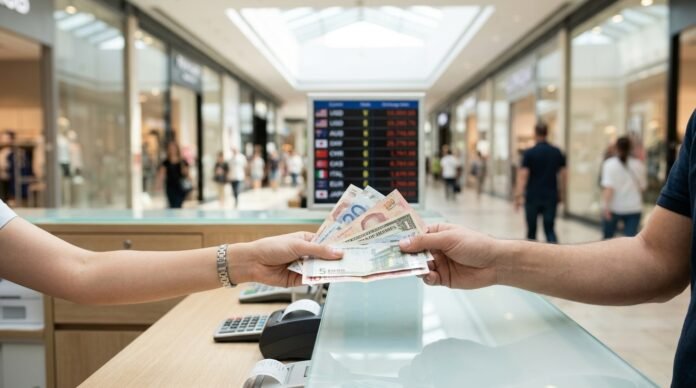

A little know-how about the local currency saves you real money in Kuala Lumpur, mostly by avoiding the worst places to change it. This guide covers the Malaysian ringgit itself, roughly what your money is worth, and where to get the best rate when you exchange cash or withdraw from an ATM. If what you really want to know is how to pay day to day, cards versus cash versus QR, see our companion guide to cash versus card in Malaysia.
The short version
- The currency is the Malaysian ringgit, written RM and coded MYR, divided into 100 sen.
- Best exchange rates come from licensed money changers in shopping malls and central areas, not the airport or your hotel.
- ATMs give a good rate but charge a per-withdrawal fee, so use a low-fee travel card and withdraw larger amounts.
- Bring clean, unmarked notes of a major currency like USD, EUR or GBP to exchange. Torn or marked notes may be refused.
- Don’t buy ringgit before you travel. Rates back home are usually poor. Change a little on arrival, then more in the city.
The Malaysian ringgit explained
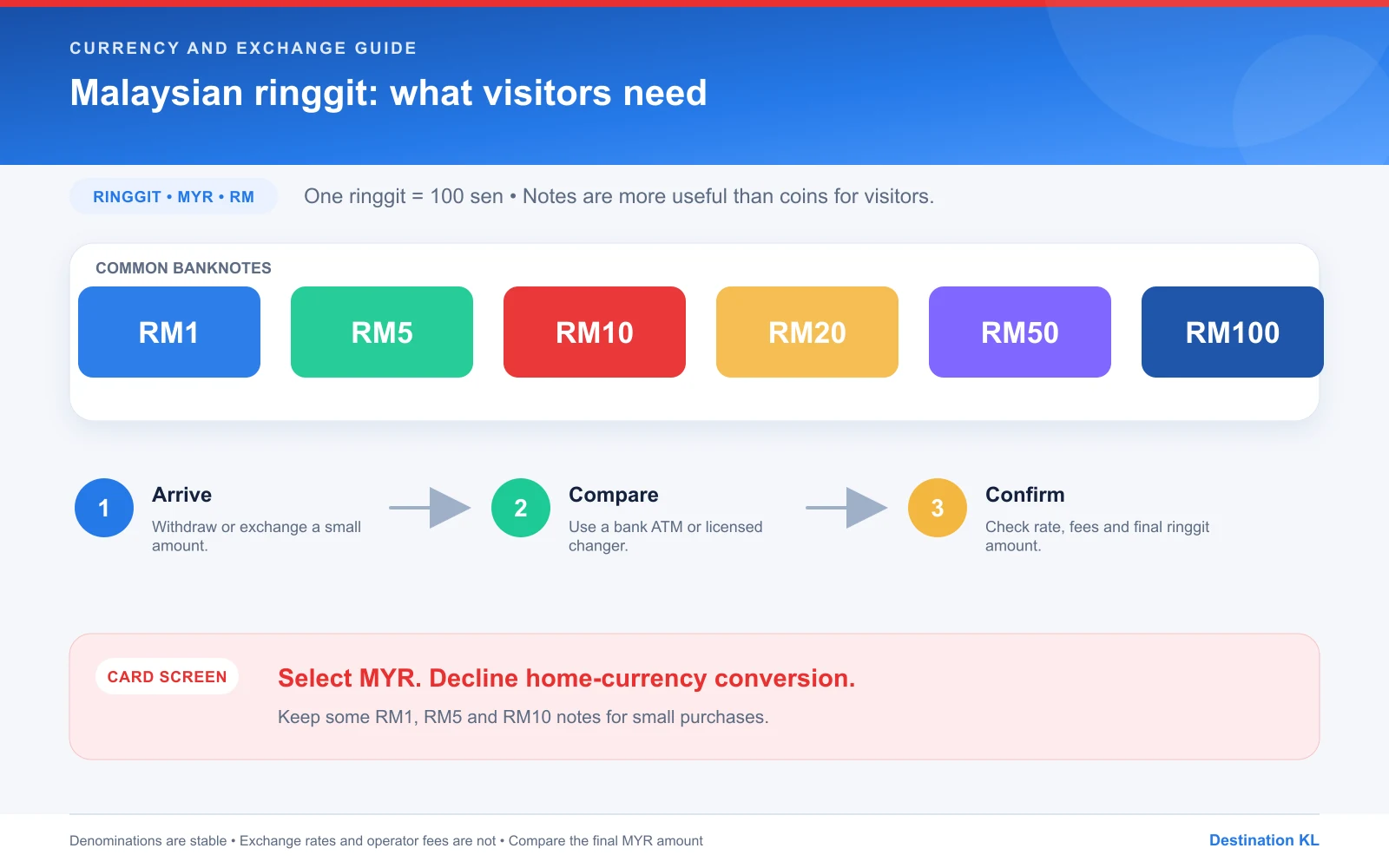
Malaysia’s currency is the ringgit, shown as RM before a price (for example RM10) and coded MYR internationally. One ringgit divides into 100 sen. In everyday use you’ll handle:
- Notes: RM1, RM5, RM10, RM20, RM50 and RM100, each a different colour and size.
- Coins: 5, 10, 20 and 50 sen. There’s no longer a RM1 coin in circulation.
A practical tip that matters more than it sounds: keep a supply of small notes, RM1, RM5 and RM10. Hawker stalls and small vendors often can’t break a RM100 note, so smaller denominations save awkward moments.
Exchange rates: roughly what to expect
Rates move daily, so treat the figures below as a rough, indicative guide at the time of writing in 2026, not a fixed quote. Always check a live converter or the central bank, Bank Negara Malaysia, before you travel or exchange a large sum.
| Currency | Roughly equals (indicative) |
|---|---|
| 1 USD | about RM4.2 to RM4.5 |
| 1 EUR | about RM4.6 to RM4.9 |
| 1 GBP | about RM5.3 to RM5.6 |
| 1 AUD | about RM2.8 to RM3.0 |
| 1 SGD | about RM3.3 to RM3.5 |
As a quick mental shortcut, many visitors find prices in KL pleasantly low once converted, especially for food and transport.
Where to change money in KL, and get a good rate
Where you change money makes a real difference, sometimes several percent, so this is the bit worth getting right.
Best value: licensed money changers in malls and central areas. These consistently offer the most competitive rates, usually with no fee, and they’re quick and safe. Reliable spots around the city include:
- Mid Valley Megamall, often cited as having some of the best rates in KL.
- Suria KLCC, with currency booths on the concourse.
- Sungei Wang Plaza in Bukit Bintang, whose ground-floor changers are competitive.
- The Ampang Park and Avenue K area, another cluster of well-rated changers.
Avoid, where you can: airport arrival counters and hotel front desks, which are convenient but give noticeably poorer rates, and changing money back home before you fly, which usually costs you in both rate and fees.
A few things to know before you hand over cash:
- Bring clean, unmarked, un-torn notes. Damaged or heavily marked foreign notes are often rejected or exchanged at a worse rate.
- Use licensed changers only. Legitimate ones display a Bank Negara Malaysia licence. Never change money with someone on the street.
- Compare a couple, but don’t obsess. Differences between good changers are usually a few ringgit, so it’s not worth trekking across town to save a little.
- Count your money before leaving the counter.
ATMs vs money changers
Both are good options, and many travellers use a mix.
- ATMs give a rate close to the interbank rate, which is excellent, but Malaysian machines charge foreign cards a fee of around RM10 to RM15 per withdrawal, on top of your home bank’s charges. To soften that, use a low-fee travel card and withdraw larger amounts less often. Our cash versus card guide covers the best cards for this.
- Money changers charge no per-transaction fee and can beat ATM rates, but you need to arrive with foreign cash to exchange.
A simple approach: change or withdraw a modest amount on arrival, then top up from a good money changer or ATM in the city as you go.
How much money to bring
You don’t need to arrive with a thick wad of ringgit. Bring some foreign cash to exchange for your first day or two, plus your cards, and sort the rest in the city. For planning, KL is affordable by most standards, and our guide to how much a KL trip costs breaks down daily budgets. Note that you can carry up to the equivalent of about USD 10,000 in and out of Malaysia without declaring it, which is far more than any tourist needs.
Paying once you’re here
In short: cards and QR payments work almost everywhere in the city, while cash is still best for hawker stalls and markets. Whenever a card terminal asks whether to charge you in ringgit or your home currency, always choose ringgit. For the full breakdown of paying by card, cash and QR, including the Touch ‘n Go eWallet, see our guides to cash versus card and Touch n Go for tourists.
Frequently asked questions
What currency is used in Malaysia?
Malaysia uses the Malaysian ringgit, written as RM and coded MYR, which is divided into 100 sen. Notes come in RM1, RM5, RM10, RM20, RM50 and RM100, and coins in 5, 10, 20 and 50 sen. Prices are shown with RM before the number, such as RM15. Keep small notes handy, as hawker stalls often can’t break a RM100 note.
Where is the best place to exchange money in Kuala Lumpur?
Licensed money changers in shopping malls and central areas give the best rates, usually with no fee. Reliable spots include Mid Valley Megamall, Suria KLCC, Sungei Wang Plaza in Bukit Bintang, and the Ampang Park area. Avoid airport counters and hotels, which offer poorer rates, and don’t change money before you travel, as home rates are usually worse. Bring clean, unmarked notes.
Should I exchange money at Kuala Lumpur airport?
Only a small amount, if any. Airport money changers are convenient but give noticeably worse rates than those in the city. If you need cash on arrival, change just enough for your first day or withdraw from an airport ATM, then use a mall money changer later for a better rate on the rest.
Do I need to exchange money before travelling to Malaysia?
No. Buying ringgit in your home country usually means a poorer rate and extra fees. It’s better to bring a small amount of a major currency like USD, EUR or GBP to change on arrival, or simply withdraw ringgit from an ATM when you land, then exchange or withdraw the rest in the city where rates are best.
Can I use US dollars in Malaysia?
Generally no. Shops, restaurants and transport in Malaysia expect payment in ringgit, not US dollars, so you’ll need to exchange foreign cash or pay by card. US dollars are useful mainly as a strong, widely accepted currency to bring and exchange at a money changer. Bring clean, newer notes, as old or damaged ones may be refused or exchanged at a lower rate.
Are ATMs or money changers better in Malaysia?
Both are good. ATMs give an excellent rate but charge around RM10 to RM15 per withdrawal plus any home bank fees, so use a low-fee card and withdraw larger amounts. Money changers charge no per-transaction fee and can beat ATM rates, but you need foreign cash to exchange. Many travellers use a mix of both.

