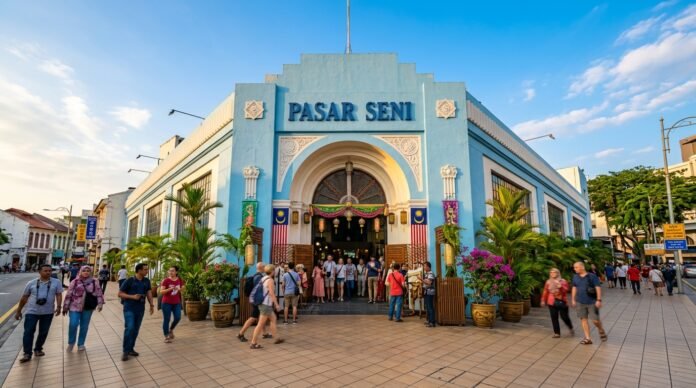

If you want to buy Malaysian crafts and souvenirs in one air-conditioned stop, Central Market is the place. Known locally as Pasar Seni, it’s a heritage craft market in a lovely 1937 Art Deco building right by Chinatown, packed with batik, wood carving, pewter and handmade art, with a covered street-food lane called Kasturi Walk running alongside. It’s free to enter, it’s a blessed escape from the heat, and it pairs perfectly with a wander around the old town.
Here’s what to buy, what else there is to do beyond shopping, how it differs from the Petaling Street market next door, and whether it’s worth your time.
Some links in this post are affiliate links. If you book through them, I earn a small commission at no extra cost to you. Thanks for supporting the blog.
The short version
- What it is: a heritage indoor craft and souvenir market, plus the outdoor Kasturi Walk food lane.
- Cost: free to enter.
- Hours: daily, roughly 10am to 10pm.
- Best for: handmade crafts and souvenirs, batik, a cool break from the heat, and cheap local food.
- Air-conditioned: yes, which makes it a great midday or rainy-hour stop.
- Time needed: about an hour, or two with food and the gallery.
- Location: right by Pasar Seni station, a few minutes’ walk from Chinatown.
On hours and prices: these are indicative and can change. Compare prices between stalls, and check current opening times before a late visit.
What Central Market is
Central Market has been a landmark since 1888, when it started life as the city’s main wet market. The current Art Deco building was completed in 1937, and it’s now a protected heritage site run as a centre for Malaysian culture, arts and handicrafts. So while it’s a shopping stop, it’s also a piece of old KL, and the building itself is worth a look.
Inside, it’s laid out a bit like an indoor bazaar, arranged into cultural zones that reflect Malaysia’s mix, with Malay, Chinese and Indian sections, plus a Straits Chinese and Malacca-themed area. It’s fully air-conditioned, which in the KL heat is a genuine selling point, and entry is free.
What to buy: the crafts
This is the best single place in the city for handmade Malaysian crafts and souvenirs, and the prices are among the lowest around. Look for:
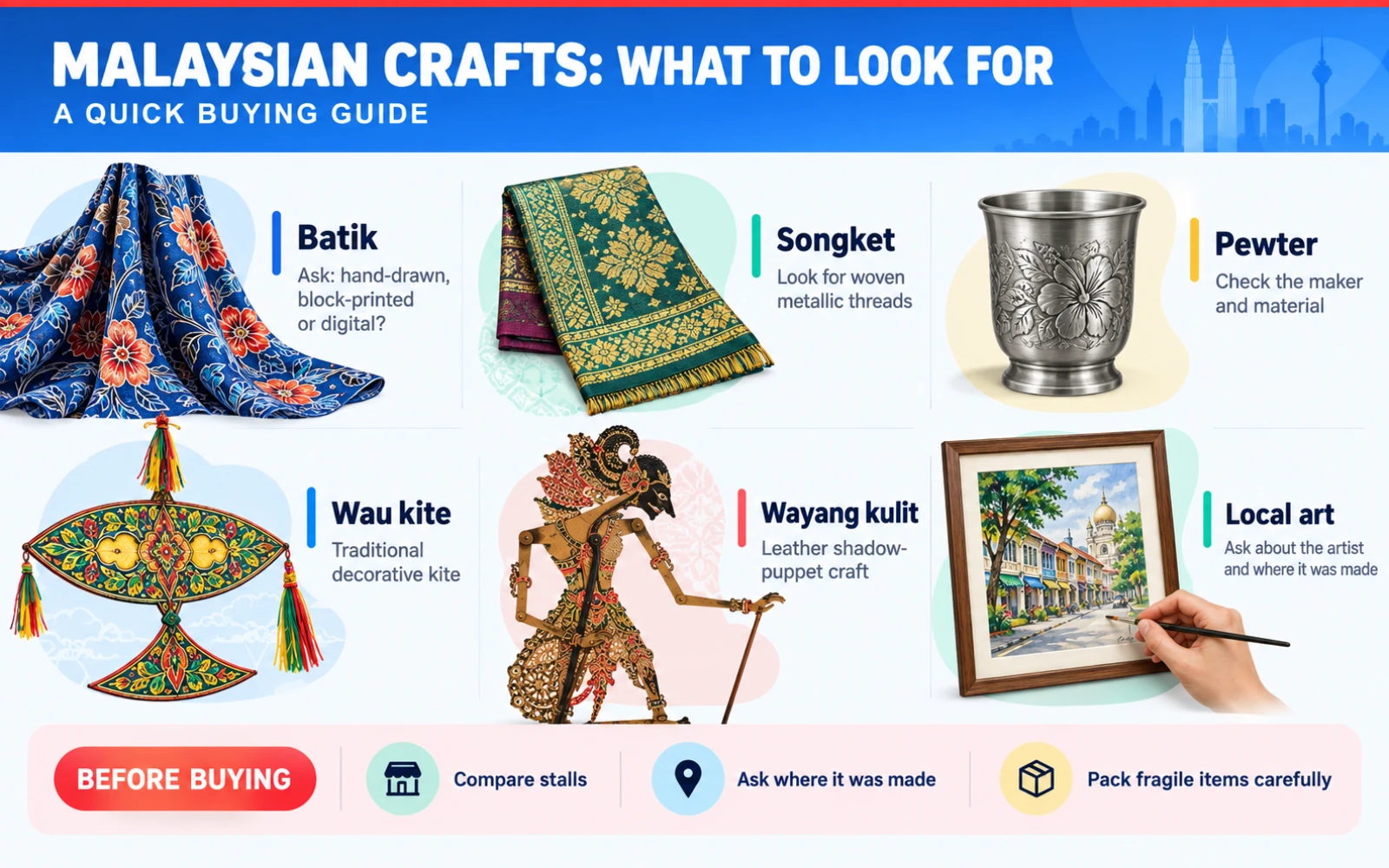
- Batik, hand-painted fabric, clothing, scarves and bags, one of the signature buys.
- Songket and kebaya, traditional woven textiles and clothing.
- Wood carving and pewter, Malaysia is well known for its pewter, from keychains to fine tankards.
- Wau kites and wayang kulit, the traditional Malay moon kite and shadow-puppet figures make distinctive gifts.
- Art and portraits, from local painters and illustrators.
- The usual souvenirs, fridge magnets, tower replicas and keychains, if that’s what you need.
A quick word on prices: haggling isn’t really the culture here the way it is on the street outside, but it’s still worth comparing a few stalls, since the same item can vary, and some vendors will give a little off for buying several. Most shops take cards or e-wallets, but carry some cash for small stalls.
Beyond shopping
Central Market is more than souvenir stalls, and the extras are what lift it from a quick errand to a proper stop.
- The Annexe Gallery and Art Lane: a more relaxed space with rotating exhibitions, small galleries and local artists. Don’t expect a grand museum, but it’s a nice change of pace after the shopping floor, and some of the work is genuinely good.
- DIY batik painting: workshops where you can paint your own batik to take home, a fun, hands-on souvenir, especially with kids.
- The food court: upstairs you’ll find a food court serving affordable Malay, Chinese and Indian dishes, a handy cheap lunch in the middle of sightseeing.
- Fish spa and a 3D art museum: a couple of quirky add-ons if you fancy them, the fish spa nibbling dead skin off your feet, the 3D museum good for playful photos.
Kasturi Walk
Running along the side of the main building is Kasturi Walk, a covered outdoor lane marked by a giant traditional wau kite archway. It’s lined with stalls selling street snacks, local fruit, drinks, accessories and more souvenirs, and it sometimes hosts cultural performances. It’s a good spot to graze on local bites like keropok, fresh coconut or seasonal fruit, and to browse a slightly more casual mix of stalls than the air-conditioned interior. If it’s raining, the covered walkway keeps you dry.
Because Central Market sits in the heart of the old town, it makes a natural stop on a guided heritage walk. A 3 Cultures Walking Tour links it with Merdeka Square, Chinatown, Jamek Mosque and the nearby temples, if you would like the history explained as you go.
Central Market vs Petaling Street: what’s the difference?
People often mix these two up, because they’re a five-minute walk apart in the old town. They’re quite different, and the good news is you can easily do both.
- Central Market (Pasar Seni) is indoor, air-conditioned and more about genuine handmade crafts, batik and art, with mostly fixed or lightly negotiable prices. Calmer, cooler, more heritage.
- Petaling Street, the heart of Chinatown, is an outdoor street market where the game is bargaining hard over copy watches, bags, sunglasses and souvenirs, with fresh produce and hawker food mixed in. Livelier, hotter, more chaotic.
The ideal plan: browse the crafts and cool off at Central Market, then step over to Petaling Street for the buzz and the bargaining. Our Chinatown and Petaling Street guide covers that side in full.
Is it worth it? An honest take
Yes, for what it is. If you want to bring home real Malaysian crafts rather than just fridge magnets, Central Market has the best concentration of handmade goods in the city, at fair prices, in a cool and pleasant setting, for free. As a break from the heat or an easy stop on an old-town walk, it’s an easy yes.
Keep your expectations right, though. A lot of it is still souvenir stalls, and after a while the magnets and scarves blur together. It’s touristy, it can get crowded at weekends, and it isn’t a deep cultural experience on its own. Treat it as an hour of pleasant craft shopping with a food court and a gallery attached, ideally rolled into a wider Chinatown wander, and you’ll enjoy it. Go expecting a grand museum and you’ll be underwhelmed.
Getting there
Central Market is one of the easiest attractions to reach in KL. It sits right by Pasar Seni station, an interchange on the LRT Kelana Jaya line and the MRT, so you can step off the train and walk over in a couple of minutes. The GoKL City Bus also stops nearby on its Pasar Seni to Bukit Bintang route, RM1 a ride for foreign visitors and free for Malaysians with a registered MyKad, and a Grab drops you at the door. Our rail guide has the details.
Because it’s minutes from Chinatown, Petaling Street and the river, it slots neatly into a walk around the old town.

Practical tips
- Use it to beat the heat or rain. The air-conditioned interior is a perfect midday or wet-weather stop between outdoor sights. See our rainy-day guide.
- Compare prices before buying. Similar items appear at several stalls, and prices vary.
- Bring some cash for small stalls and Kasturi Walk food, though many shops take cards and e-wallets.
- Weekdays are quieter than weekends and festival periods, when it gets packed.
- Pair it with Chinatown and a cheap lunch at the food court or on Kasturi Walk for a relaxed half-day in the old town.
Frequently asked questions
Is there an entry fee for Central Market Kuala Lumpur?
No, entry to Central Market is free. You only pay for what you buy, or for optional extras like the fish spa, a batik workshop or the 3D art museum. It’s open daily, roughly 10am to 10pm, and it’s air-conditioned, which makes it a good free stop in the heat of the day.
What can you buy at Central Market?
Central Market is the best place in KL for handmade Malaysian crafts and souvenirs: batik fabric and clothing, songket textiles, wood carvings, pewter, traditional wau kites, shadow-puppet figures, local art and portraits, alongside the usual magnets and tower replicas. Prices are among the lowest in the city, though it’s worth comparing a few stalls.
What is the difference between Central Market and Petaling Street?
Central Market is an indoor, air-conditioned heritage market focused on handmade crafts and art with mostly fixed prices. Petaling Street, in the heart of Chinatown, is an outdoor street market where you bargain hard over copy goods, souvenirs and street food. They’re a five-minute walk apart, so it’s easy and rewarding to visit both.
What time does Central Market open and close?
Central Market and Kasturi Walk are open daily from roughly 10am to 10pm, though some sources list a 9:30pm close, so check before a late visit. Weekdays are quieter than weekends and festival periods like Hari Raya, Deepavali and Chinese New Year, when it gets busy with shoppers.
How do you get to Central Market?
It’s right next to Pasar Seni station, an interchange on the LRT Kelana Jaya line and the MRT, so it’s a two-minute walk from the train. The GoKL City Bus stops nearby, RM1 a ride for visitors, and a Grab drops you at the door. It’s also a few minutes’ walk from Chinatown and Petaling Street.
Is Central Market worth visiting?
Yes, if you want handmade Malaysian crafts and souvenirs in one cool, free, easy stop. It has the best concentration of batik, pewter and handicrafts in the city at fair prices, plus a food court and gallery. It is touristy and souvenir-heavy, so treat it as an hour of pleasant craft shopping rolled into a Chinatown wander rather than a deep cultural attraction.

