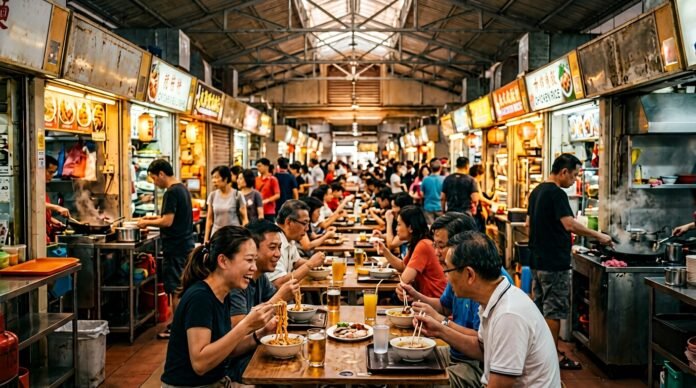

If you want to understand KL through its food, head for a hawker centre or food court, where dozens of specialist stalls each cook one or two dishes brilliantly and a few ringgit buys some of the best food in the city. KL has two flavours of this: traditional open air hawker centres where locals eat, and curated, air conditioned food courts that gather famous stalls under one roof. Below are the ones worth knowing, what each is best for, and how the system works so you can order like you belong.
Some links below are affiliate links. If you book through them I earn a small commission at no extra cost to you. Stalls inside these places come and go and prices change, so check current details before a special trip.
Quick recommendations
- Best easy on ramp (air conditioned, famous stalls): Lot 10 Hutong, Bukit Bintang
- Best central non halal food court: Malaysia Boleh, near KLCC
- Best deep end local experience: ICC Pudu
- Best old school Chinatown hawker alley: Madras Lane
- Best for sheer variety: a big neighborhood food court like K88
The venues are well established, but the specific stalls inside them, their prices, and opening hours change, so treat those as things to verify before relying on them.
KL hawker centres and food courts at a glance
| Place | Area | Type | Best for |
|---|---|---|---|
| Lot 10 Hutong | Bukit Bintang | Air con food court | Famous stalls, easy first try |
| Malaysia Boleh | Jalan Ampang / KLCC | Air con food court | Central, non halal Chinese |
| ICC Pudu | Pudu | Open air centre | Authentic local, breakfast |
| Madras Lane | Chinatown | Open air alley | Old school hawker classics |
| K88 / big food courts | Various | Food court | Variety, evenings |
Detail on each below, then how to actually order.

1. Lot 10 Hutong (Bukit Bintang)
Best for: first timers who want famous hawker stalls in air conditioned comfort.
In the basement of the Lot 10 mall in Bukit Bintang, Hutong is a curated food court that gathers many of KL’s most famous old hawker stalls under one cool, clean roof, which makes it the easiest possible introduction to the local food scene, especially at the end of a hot day. Names long associated with it include Kim Lian Kee, known for KL’s dark, smoky charcoal Hokkien mee and claiming to have invented the style over generations, plus Imbi Road Original pork noodles and Soong Kee beef noodles. The honest trade off: prices are a bit higher than the original street stalls and it gets crowded at peak times, but the quality is close to the real thing and the convenience is unbeatable. Roughly RM8 to RM15 a dish. A great pairing with the nearby Jalan Alor food street.
2. Malaysia Boleh (Jalan Ampang, near KLCC)
Best for: a central, comfortable spread of Chinese hawker favourites near the towers.
A popular food court on Jalan Ampang near KLCC, Malaysia Boleh gathers authentic Malaysian and Chinese hawker dishes in one convenient, air conditioned spot, handy when you are sightseeing around the towers and want proper local food rather than mall chains. Expect the usual roster of noodles, rice dishes, and regional specialities. It is non halal, so it leans Chinese hawker fare. Confirm current stalls and hours before a special trip. See where to eat near the Petronas Towers for more in this area.
3. ICC Pudu (Pudu)
Best for: the deep end, an authentic local breakfast among the crowds.
ICC Pudu is a large, no frills cooked food complex with a huge number of stalls, sitting alongside a wet market, and it is where locals actually eat rather than tourists. It is non air conditioned and can be hot, busy, and a little chaotic, which is exactly the point, since this is traditional KL hawker eating in its natural habitat. Come early in the morning for breakfast when it is at its best, try the pork noodle soups, Nyonya kuih, and kaya toast with coffee, and accept that food presentation is not the priority, freshness and flavour are. Mornings to early afternoon is the window (check hours). This is the one to do once you have your confidence up.
4. Madras Lane (Chinatown)
Best for: classic open air hawker dishes in the heart of Chinatown.
Tucked behind the Petaling Street market in Chinatown, Madras Lane is a classic narrow hawker alley known for old school stalls doing dishes like curry laksa, assam laksa, yong tau foo, and chee cheong fun, the kind of long running, single dish specialists that built KL’s reputation. It is open air, gritty, and atmospheric, best in the morning to midday, and pairs perfectly with exploring Chinatown. Stalls here are institutions but can keep their own hours and days, so go earlier rather than later. See the Chinatown guide to build it into a wander.
5. Big neighborhood food courts (K88 and others)
Best for: sheer variety, evenings, and eating where residents do.
Beyond the famous names, KL is full of large neighborhood food courts that locals rely on, such as K88, which packs in dozens of stalls covering mostly Chinese dishes plus Malaysian and Indian options, with the handy quirk of waiters taking drink orders at your table. These come alive in the evening when all the stalls are open, can be quieter at lunch, and offer huge variety at fair prices. They are less about a single must try and more about wandering and grazing. The Brickfields food courts, like the one at Restoran Money’s Corner known for its pork noodles and egg tarts, are another good local cluster. Which to pick often just comes down to which is near you (check hours, since some are evening focused).
Don’t forget kopitiams and night markets
Hawker food is not only in dedicated centres. The open air coffee shops (kopitiam) on almost every street do excellent single dish stalls, and the night markets (pasar malam) that pop up on set evenings in different neighborhoods are some of the best, most local eating in the city. If you are staying in an area like Bangsar or a residential neighborhood, ask where the nearest pasar malam is and which night it runs.
How a hawker centre works
The system is simple once you have done it once. Find an empty table and claim it, often by leaving a friend or a packet of tissues on a seat, the local way to reserve. Then walk the stalls, order what you want from as many as you like, and tell them your table number or point to where you are sitting. Each stall brings your dish over and you pay them then, or sometimes on the spot. Drinks come from a separate drinks stall, whose owner usually has the run of the tables, so order your drinks from whoever comes round. There is no single bill, you settle with each stall. Air conditioned food courts like Hutong sometimes use a single cashier or card system instead, so check the signage.
How to order like a local
A few habits make it smooth. Follow the queues, since the stall with locals lined up is where the good stuff is. Order across several stalls so your table becomes a spread, that is the whole joy of it. Do not be shy about pointing if there is a language gap, it is completely normal. Keep small notes and coins handy, as many stalls deal in cash and small change. And come at a busy mealtime, when turnover is high and everything is freshest.
What to eat
Look for char kway teow and other fried noodles, Hokkien mee, wonton mee, chicken rice, char siu and roast meats, laksa, yong tau foo, rojak, satay, and Indian Muslim dishes like roti canai, plus regional specialities depending on the place. Finish with cendol or ais kacang to cool down. Order a few small things from different stalls rather than one big plate. For the dish by dish rundown see the best Malaysian dishes to try.
Is hawker food safe and clean?
Yes, with the same common sense you would use anywhere. Busy stalls with high turnover cook fresh and sell out fast, which is your best signal, so the crowd is the quality check. Stick to food cooked to order and hot, go where locals go, and you will eat brilliantly. Tap water is not for drinking, so stick to bottled or the stall drinks, but the food itself at a busy hawker centre is one of the safest and best value things you will eat in the city. For the wider picture see is KL safe.
Common mistakes
Trying to order everything from one stall, when the point is to mix across several. Waiting for a single bill that never comes at a traditional centre, since you pay each stall separately. Sitting down without claiming a table first at busy times. Going late in the afternoon when the best stalls have sold out. And being put off by a basic looking setup, when the scruffiest stall with the longest queue is often the best food in the place.
Frequently asked questions
What is the best hawker centre in KL?
For an easy first experience, Lot 10 Hutong in Bukit Bintang gathers famous stalls in air conditioned comfort. For an authentic local one, ICC Pudu and the Chinatown alley Madras Lane are classics, and Malaysia Boleh near KLCC is a handy central food court. The best one depends on whether you want comfort or authenticity.
What is the difference between a hawker centre and a food court in KL?
Traditional hawker centres like ICC Pudu and Madras Lane are open air, local, and a bit rough around the edges, where you pay each stall separately. Curated food courts like Lot 10 Hutong are air conditioned and gather famous stalls in one comfortable place, usually a little pricier. Both serve the same kinds of dishes.
How do you order at a hawker centre in KL?
Claim a table first, then order from as many stalls as you want, telling them your table or pointing to your seat. Each stall brings your food and you pay them then. Drinks come from a separate drinks stall. At traditional centres there is no single bill, though some air conditioned food courts use one cashier.
Is hawker food in KL safe to eat?
Yes, with normal sense. Busy stalls with high turnover cook fresh, so follow the crowds and eat food that is hot and cooked to order. Drink bottled water rather than tap. Hawker food is among the best value and safest eating in the city.
How much does hawker food cost in KL?
Very little at traditional centres, often just a few ringgit a dish, while curated food courts like Lot 10 Hutong charge a bit more, roughly RM8 to RM15 a dish, for the comfort and convenience. Bring small cash, as many stalls do not take cards.
Explore more
- Kuala Lumpur food and where to eat
- Best Malaysian dishes to try
- Best nasi lemak in KL
- Jalan Alor food guide
- Chinatown guide
Want a head start?
A food tour on your first day is a great way to learn the stalls and dishes before exploring solo. Browse KL food tours on Klook.

