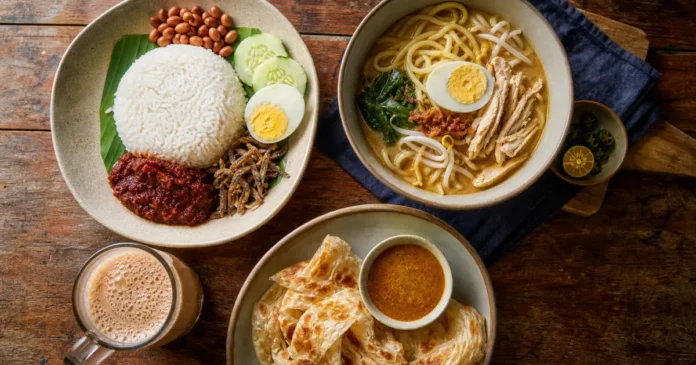

Malaysian food is not one cuisine. It is three that grew up next to each other, plus a fourth that came out of them marrying, and the reason eating here is so good is that all four are available on the same street at the same time for very little money.
That also makes it confusing to arrive into. Menus assume knowledge you do not have, the same dish name means different things in different states, and nobody explains the difference between a kopitiam and a mamak because to a Malaysian it is too obvious to mention. This page fills that gap.
The four traditions behind everything you will eat
Almost every dish you encounter traces back to one of these, and knowing which tells you a lot about what will arrive.
Malay
The base layer. Coconut milk, chilli, lemongrass, galangal, turmeric, shrimp paste, tamarind. Expect rich, aromatic and often sweet-hot rather than sharply spicy. Nasi lemak, rendang, satay and the sambal that accompanies half the country come from here. Malay food is halal by default, which matters for how you navigate the rest.
Chinese
Predominantly southern Chinese roots, especially Hokkien, Cantonese, Hakka and Teochew, carried by migrants over generations and then adapted to local ingredients. Wok cooking, noodles, roast meats, clay pot dishes, and a strong pork tradition. Char kway teow, bak kut teh, Hokkien mee and the whole kopitiam breakfast culture sit here.
Indian
Mostly Tamil and South Indian, reflecting a community that makes up roughly seven percent of Malaysians. Banana leaf rice, dosa, thosai, vegetarian curries and rich gravies. Distinct from what you would eat in India, having developed here for well over a century.
Sitting alongside it is mamak, which is Indian-Muslim and specifically Malaysian, rooted in Tamil Muslim heritage. Roti canai, nasi kandar, mee goreng mamak, murtabak and teh tarik. Mamak is not a generic label for Indian food and Malaysians would never use it that way.
Peranakan, also called Nyonya
The interesting one. From roughly the fifteenth century, Chinese migrants settling in Penang, Malacca and along the strait intermarried with local Malay women. Their descendants are the Peranakans, the men called baba and the women nyonya, and the cooking that emerged combines Chinese technique with Malay spice work, plus Javanese and South Indian influence.
The foundation is rempah, a spice paste pounded by hand to a specific texture. Nyonya food is more labour-intensive than anything else on this list, which is why it is more often a sit-down restaurant meal than street food.
The laksa problem, and why it explains the whole country
Here is the single most useful thing on this page.
“Laksa” is not one dish. Order it in Penang and you get asam laksa: sour, tamarind-heavy, fish-based, no coconut milk, with a Thai influence that comes from proximity to the border. Order it in Kuala Lumpur or further south and you are far more likely to get curry laksa, sometimes called laksa lemak: rich, coconut-based, closer to a curry noodle soup. Sarawak laksa is different again.
These are not variations on a theme. Someone who loves one may actively dislike the other. A great many visitors try asam laksa expecting something creamy, decide laksa is not for them, and never order it again.
The broader lesson: a dish name in Malaysia often tells you less than where you are standing. Ask what is in it before assuming.
Regional differences worth knowing
| Region | Known for | Character |
|---|---|---|
| Penang | Asam laksa, char kway teow, nasi kandar, Nyonya | Sour, tamarind-forward, Thai influence |
| Kuala Lumpur | Everything, being the melting pot | Broadest range, less regional identity |
| Melaka | Nyonya cooking, chicken rice balls | Coconut-heavier, Indonesian influence |
| East coast | Nasi kerabu, keropok lekor | Noticeably sweeter, strongly Malay |
| Ipoh and Perak | Bean sprout chicken, white coffee | Chinese-leaning |
| Borneo | Sarawak laksa, kolo mee, indigenous dishes | Distinct again, worth its own trip |
If you are only in Kuala Lumpur, you can eat versions of nearly all of it without leaving the city, which is one of KL’s genuine advantages. It will not always be the definitive version, and a Penangite will tell you so at length, but it will be good.
Where people actually eat
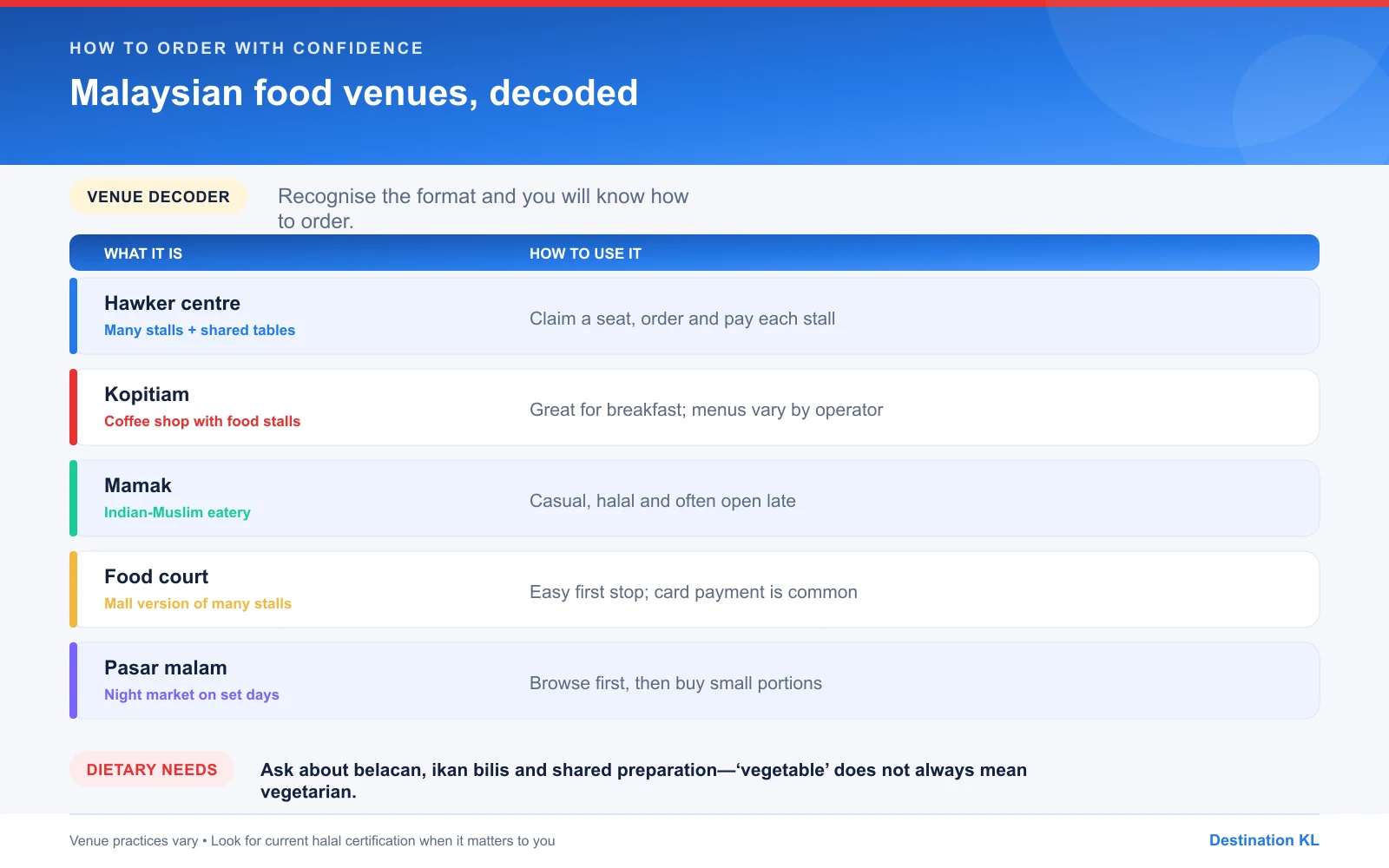
The venue types matter more than restaurant names, and they are rarely explained.
| Type | What it is | Good to know |
|---|---|---|
| Hawker centre | Many independent stalls, shared seating | Order per stall, pay each one separately |
| Kopitiam | Traditional coffee shop, a few stalls around tables | Usually Chinese-owned, may serve pork |
| Mamak | Indian-Muslim eatery, often open very late | Halal, cheap, the default late-night option |
| Food court | The mall version of a hawker centre | Air conditioned, slightly pricier, very reliable |
| Restaurant | Conventional table service | Where Nyonya and banana leaf are best experienced |
| Night market, pasar malam | Rotating weekly street market | Different neighbourhood each night of the week |
Our guide to the best hawker centres in Kuala Lumpur covers specific venues, and Jalan Alor is the street most visitors are pointed to first, for better and worse.
How ordering works
Three things that trip people up.
At a hawker centre, find a table first. Take note of the number, then order at individual stalls and tell them where you are sitting. You pay each stall separately, usually on delivery. Drinks are ordered from a separate drinks stall, and someone will often come to you for that.
Nasi kandar is point-and-choose, and the bill depends entirely on what you pointed at. You walk the line of curries and sides, indicating what you want ladled over rice. Ask for banjir, meaning flood, and they will pour several gravies over everything, which is how it is meant to be eaten. Be aware that pointing enthusiastically at three meat dishes produces a bill several times what you expected.
Nasi campur works similarly, a Malay buffet of dishes over rice, priced by what you take. Both are excellent value if you order like a local and expensive if you treat them like a buffet.
Halal, and how to check properly
Malaysia is a Muslim-majority country and halal food is abundant, but the picture is more nuanced than most guides admit.
JAKIM, the Department of Islamic Development Malaysia, issues official certification. The logo carries a certificate number and expiry date, and both can be checked on the JAKIM portal. Certification covers preparation hygiene and handling, not only ingredients.
The honest complication: a considerable number of mamak and nasi kandar outlets operate without formal certification, relying on the widespread assumption that Muslim ownership guarantees halal status. Some display Quranic verses as an implied signal without holding certification at all. For many travellers that is acceptable; for those who require certified status it is worth knowing that the assumption is not always backed by paperwork.
- Check at the individual stall, not just the food court entrance. Certification is per business.
- Malay-run and mamak establishments are halal in practice, whether or not certified.
- Chinese hawker centres and kopitiams frequently serve pork. Look for certification or ask.
- Ask “halal ke?” It is a normal question and nobody will be offended.
- Major international chains in Malaysia are certified.
Vegetarian, vegan and other dietary needs
Easier than most of Southeast Asia, largely thanks to the Indian community and to Chinese Buddhist vegetarian restaurants, which are common and often signposted with a swastika symbol used in its original Buddhist sense.
The catch is belacan, fermented shrimp paste, which appears in sambal and therefore in a great many dishes that look vegetarian. Anchovies, or ikan bilis, turn up similarly, including in the standard nasi lemak. If you are strict, say so explicitly rather than assuming a vegetable dish is meat-free.
Nut allergies deserve real caution. Peanuts are everywhere, in satay sauce, as garnish, in rojak, and cross-contamination at a busy stall is realistic.
How spicy is it, honestly?
Moderate by regional standards. Malaysian food is generally less aggressively hot than Thai food, and heat is usually built into a rich base rather than delivered as raw chilli burn.
The exception is sambal, which is served alongside almost everything and can be genuinely fierce. Because it is usually on the side, you control the dose. Asking for less spice is normal and stalls will accommodate you, though “not spicy” still tends to mean mildly spicy.
Small things that make you look less lost
- Eating with your right hand is normal for Malay and Indian food, particularly banana leaf rice. Cutlery is always available and nobody expects you to manage it.
- Fold the banana leaf towards you when finished to signal you enjoyed the meal. Folding it away is traditionally the opposite.
- Teh tarik, tea pulled between two containers until frothy, was added to UNESCO’s Intangible Cultural Heritage list in December 2024. Order it at any mamak.
- Kopi means coffee with condensed milk by default. Kopi O is black with sugar, kopi kosong is without sugar. The system is worth learning.
- Tipping is not expected. Many restaurants add a service charge.
- Queues are the best signal. A long local queue at an unremarkable-looking stall is more reliable than any review site.
Where to start
If you want a ranked list of what to order first, that is a separate job and we have done it: see the Malaysian dishes worth trying, which goes dish by dish. For where to eat them in the capital, the Kuala Lumpur food guide covers the areas and the practicalities, and the nasi lemak guide goes deep on the national dish alone.
A reasonable first day: roti canai and teh tarik at a mamak for breakfast, a hawker centre lunch where you order from two different stalls, and banana leaf rice or a Nyonya restaurant for dinner. That covers three of the four traditions before you have unpacked properly.
Is a food tour worth it?
For this cuisine specifically, more than usual. The barrier here is not finding food, it is knowing what you are looking at and how to order it, and a guide collapses that learning curve into one evening.
The honest case against: it is far more expensive than eating the same food yourself, and after a day or two of paying attention you will not need one. The sensible approach is an early tour to orient yourself, then eat independently for the rest of the trip. You can compare food tours and experiences on Klook, which has the strongest inventory in this part of Asia.
Official & useful resources
Frequently asked questions
What is Malaysian food?
Malaysian food is not one cuisine but several sharing a country. Malay, Chinese and Indian cooking traditions developed alongside each other, and a fourth, Peranakan or Nyonya, emerged from intermarriage between Chinese migrants and local Malays. Most Malaysians eat across all four in a normal week.
What is the national dish of Malaysia?
Nasi lemak, rice cooked in coconut milk served with sambal, fried anchovies, peanuts, cucumber and egg, usually with a protein added. It is eaten at any time of day, most traditionally at breakfast, and is sold everywhere from roadside stalls to hotel buffets.
What is the difference between a kopitiam and a mamak?
A kopitiam is a traditional coffee shop, usually Chinese-owned, with a handful of stalls around shared seating, and it may serve pork. A mamak is an Indian-Muslim eatery serving roti canai, nasi kandar and teh tarik, is halal, and often stays open very late. They are not interchangeable.
Why does laksa taste different in different places?
Because they are genuinely different dishes sharing a name. Penang asam laksa is sour and tamarind-based with no coconut milk. Curry laksa, common in KL and further south, is rich and coconut-based. Sarawak laksa is different again. Ask what is in it before ordering.
Is Malaysian food halal?
Much of it is. Malay and mamak establishments are halal in practice, and JAKIM certification is displayed at certified premises with a checkable certificate number. Chinese hawker stalls and kopitiams frequently serve pork. Note that many mamak outlets operate without formal certification despite being Muslim-owned, so verify at the individual stall if certified status matters to you.
Is Malaysian food very spicy?
Generally moderate, and less fierce than Thai food. Heat is usually built into a rich, aromatic base rather than delivered as raw chilli. Sambal, served on the side of most meals, is where the real heat sits, and because it is separate you control how much you use.
Is it easy to eat vegetarian in Malaysia?
Easier than in much of the region, thanks to Indian restaurants and Chinese Buddhist vegetarian eateries. The main pitfall is belacan, fermented shrimp paste, which appears in sambal and therefore in many otherwise vegetable dishes, along with dried anchovies. State your requirements explicitly rather than assuming.
Related reading
- The Kuala Lumpur food guide, where to eat in the city
- Malaysian dishes worth trying, dish by dish
- Best hawker centres in Kuala Lumpur
- Where to find the best nasi lemak
- Jalan Alor food street guide

