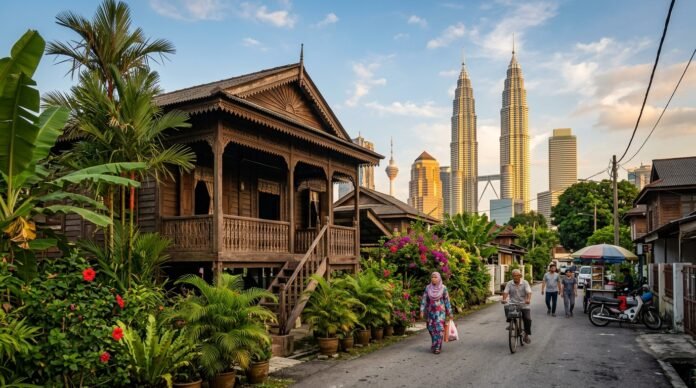

Less than two kilometres from the Petronas Towers, on land worth a fortune, sits a village of wooden houses on stilts, banana trees and free-range chickens. This is Kampung Baru, KL’s old Malay village, a low-rise pocket of traditional kampung life that has somehow survived in the middle of a city of skyscrapers. Stand on one of its quiet lanes and look up, and you’ll see timber homes framed by the glittering towers behind. It’s the most surprising, and quietly poignant, neighbourhood in Kuala Lumpur.
This guide covers what Kampung Baru is and why it exists, the authentic Malay food to seek out, the honest truth about its famous market, and how to visit respectfully, because this is a living community, not a theme park.
Some links in this post are affiliate links. If you book through them, I earn a small commission at no extra cost to you. Thanks for supporting the blog.
The short version
- What it is: a historic, protected Malay village of traditional wooden houses, right beside the modern city centre.
- Best for: authentic Malay food, culture, history, and photographing the old-meets-new contrast with the towers.
- The draw: village life in the literal shadow of the Petronas Towers, a scene you won’t find anywhere else.
- The food: some of the most authentic home-style Malay cooking in the city.
- Respect it: this is a residential Malay community, so visit thoughtfully.
- Getting there: the Kampung Baru LRT station is right at its edge.
What Kampung Baru is, and why it exists
Kampung Baru, meaning “new village”, was established in 1899 and formally set aside as a Malay Agricultural Settlement in 1900 by the British colonial administration. The idea was to give rural Malays a place to keep their way of life as Kuala Lumpur grew around them. It’s actually a cluster of seven villages laid out on a rough grid, spread over around 225 acres of prime land.
The reason it still looks the way it does comes down to one unusual rule: the land is protected, and ownership is largely restricted to Malay landowners, passed down through families. That legal protection, and generations of community resistance to redevelopment, is why a village of stilt houses has survived in a spot where developers would dearly love to build towers. It’s governed today by the Kampung Baru Development Corporation.
Village in the shadow of the towers
This contrast is the whole reason to come. Wander the narrow lanes and you’ll pass traditional timber houses raised on stilts, gardens of banana, papaya and frangipani, sleepy cats and free-range chickens, and old wooden shopfronts, all remarkably quiet and slow. Then you look up, and the Petronas Towers and the rest of the KLCC skyline rise straight behind the coconut palms.
It’s a photographer’s dream and a genuinely moving sight: two versions of Kuala Lumpur, a century apart, in a single frame. The best contrast shots come from the lanes on the KLCC-facing side of the village, especially in the softer light of early morning or late afternoon. For the towers themselves, see our Petronas Towers guide.
The food: authentic Malay home cooking
Kampung Baru is one of the best places in the city for genuine, home-style Malay food, the kind of cooking that’s harder to find amid the malls and food courts. The main food street is Jalan Raja Muda Musa, lined with stalls and simple restaurants serving nasi lemak, satay, grilled fish, rendang, rojak and colourful kuih (traditional Malay cakes). It’s affordable, authentic and delicious, and the area is famous for its nasi lemak in particular. See our best nasi lemak guide and the wider KL food guide.
The Sunday Market: an honest word
You’ll read a lot about the Kampung Baru Sunday Market, also called the night market, which historically ran from Saturday evening into the early hours of Sunday. Here’s the honest, current picture: it has declined significantly in recent years. Vendor numbers have dropped, there’s been confusion over relocation, and some visitors now find it a shadow of its former self, mostly a handful of food stalls rather than the bustling bazaar of old. You can still find a late-night bite, but don’t build your trip around it expecting a huge, vibrant market.
The real highlight: the Ramadan bazaar
If your visit falls during the Muslim fasting month of Ramadan, the Kampung Baru Ramadan bazaar is one of the best in the whole city. In the late afternoon, before the breaking of the fast, the streets fill with stalls selling an incredible spread of Malay dishes, drinks and sweets. It’s a genuine food event and, for many, the single best time to experience the village. Timing shifts each year with the Islamic calendar, so check the dates.
What the food costs
Kampung Baru is one of the cheapest places to eat well in central Kuala Lumpur, and the prices are worth stating because visitors assume anywhere this central will be marked up. Bands as of September 2026.
| What | Price |
|---|---|
| Nasi lemak bungkus, wrapped to take away | RM3 to RM7 |
| Nasi campur, rice with three dishes | RM8 to RM14 |
| Satay, per stick | RM1.50 to RM2, usually ten minimum |
| Nasi kandar at a 24 hour place | RM10 to RM20 |
| Teh tarik or air bandung | RM2.50 to RM4 |
Two people can eat very well here for RM30 to RM50, which is roughly what one mall food court lunch costs a few minutes away.
Bring cash in small notes. Some stalls take DuitNow QR now, plenty do not, and a RM100 note at a stall selling RM5 nasi lemak is a problem for both of you.
The area transforms during Ramadan, when the bazaar along Jalan Raja Alang becomes the most traditional of the big ones in the city. If your trip falls in that month this is where to come, and the trick is arriving around 4pm rather than in the crush before sunset.
Things to see
Beyond the food and the atmosphere, a few specific sights are worth seeking out on a wander:
- The traditional wooden houses, some generations old, with carved details, verandas and stilts. They’re the heart of the village, though remember they’re private homes.
- Masjid Jamek Kampung Baru, the historic village mosque and a community focal point.
- The Sultan Sulaiman Club (Kelab Sultan Sulaiman), a historic Malay club with traditional architecture, one of the oldest of its kind in the country.
- Vintage and bundle shops, tucked among the lanes, good for cheap second-hand and vintage finds.
Visit KL sometimes runs a free guided walking tour into the heart of Kampung Baru, taking in the mosque, the club and the old houses, a good way to understand what you’re seeing.
See it while you can
There’s an elegiac quality to a visit here, because Kampung Baru’s future is uncertain. For decades there have been proposals to redevelop the land, and given its value, change of some kind feels inevitable. A gleaming residential tower already rises over the LRT station as a sign of things to come. Efforts continue to preserve at least part of the village’s character, but no one can say how much of the old kampung will remain in a decade or two.
That’s not said to be gloomy, but to be honest: if seeing a living slice of old Malay Kuala Lumpur appeals to you, it’s worth doing sooner rather than later. Few cities still have anything like it this close to their centre.
Visiting respectfully
This matters, so it gets its own section. Kampung Baru is not an attraction, it’s a living residential neighbourhood and a relatively conservative Malay community. A few simple courtesies go a long way:
- Dress modestly, covering shoulders and knees, especially near the mosque.
- Treat homes as homes. Admire the houses, but don’t wander into gardens or peer through windows, and don’t photograph people or private homes up close without asking.
- Keep it low-key, this is a quiet place where people live their daily lives, so keep noise down and be considerate.
- Support the community by buying food and drinks from the local stalls.
Our cultural etiquette guide has more on visiting mosques and Malay areas.
Best time to visit
- Early morning or late afternoon for cooler air, soft light and the best photos of the houses against the towers.
- Evening for the Malay food stalls and a gentle stroll.
- Ramadan for the outstanding Ramadan bazaar, the single best food experience here.
- Avoid the harsh midday heat, as the village is exposed and there’s little shade.
Getting there
It’s very easy. The Kampung Baru LRT station on the Kelana Jaya line sits right at the edge of the village, so you step off the train into it. It’s also about a 20-minute walk from KLCC and the Petronas Towers, a walk that itself dramatises the contrast as the towers give way to timber houses. A Grab is simple too, and our rail guide covers the network.
Is it worth it? An honest take
For the right traveller, absolutely. If you love authentic food, history, culture or photography, and you want to see a side of Kuala Lumpur most visitors miss, Kampung Baru is one of the most rewarding and distinctive places in the city. The old-meets-new contrast alone is unforgettable, and the Malay food is the real thing.
But set your expectations honestly. This is a quiet, low-key residential neighbourhood, not a polished attraction with signposts and ticket booths. The famous night market has faded, so outside Ramadan the buzz is gentle. If you’re after big sights and lively crowds, you may find it sleepy. Come instead for atmosphere, a good Malay meal and that extraordinary view of village life beneath the towers, and it’s genuinely special, and a piece of KL that may not be here forever.
Frequently asked questions
What is Kampung Baru known for?
Kampung Baru is Kuala Lumpur’s old Malay village, known for its traditional wooden stilt houses, authentic home-style Malay food, and its striking contrast with the modern skyline, sitting less than two kilometres from the Petronas Towers. Established as a Malay Agricultural Settlement in 1900, it’s a rare surviving pocket of village life in the heart of a modern city.
Is the Kampung Baru night market still worth visiting?
Honestly, it’s a shadow of what it was. The famous Sunday or night market, once a bustling bazaar from Saturday evening into Sunday, has declined a lot in recent years, with far fewer vendors. You can still grab a late-night Malay bite, but don’t expect a big market. The area’s standout food event now is the Ramadan bazaar during the Muslim fasting month.
How do you get to Kampung Baru?
The easiest way is the Kampung Baru LRT station on the Kelana Jaya line, which sits right at the edge of the village. It’s also about a 20-minute walk from KLCC and the Petronas Towers, and a Grab is straightforward. The walk from KLCC is a lovely way to feel the contrast between the gleaming towers and the old village.
Is Kampung Baru worth visiting?
Yes, if you enjoy authentic food, culture, history or photography and want to see a rare, disappearing side of KL. The wooden houses framed by the skyline are unforgettable and the Malay food is excellent. Just know it’s a quiet residential neighbourhood rather than a polished attraction, so come for atmosphere and a good meal rather than big-ticket sights.
Can tourists visit Kampung Baru?
Yes, visitors are welcome to walk the streets, eat at the stalls and admire the houses and mosque. Just remember it’s a living residential Malay community, so dress modestly, keep noise down, don’t intrude on private homes, and ask before photographing people. Buying food from the local stalls is a nice way to support the community.

