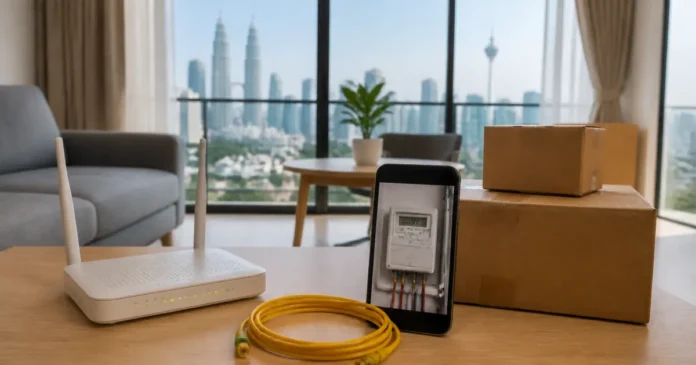

Most guides to setting up utilities in Malaysia are written for someone who has just bought a property and taken vacant possession. If you are renting a furnished condo, which is what most expats arriving in KL actually do, your situation is different and usually much simpler.
The one thing that genuinely catches people out is internet, and it catches them out because of timing rather than paperwork.
The short version
- Renting furnished usually means electricity and water accounts stay in the landlord name. Check before assuming you need to open anything.
- Book fibre installation one to two weeks before you move in. Same day connection is rare in condos.
- Electricity is TNB nationwide. Water depends on the state, and in KL and Selangor that is Air Selangor.
- Deposits are refundable but tie up cash on top of your rental deposits.
- Photograph the meter readings on the day you move in, whoever the account belongs to.
First, work out whose name things are in
This is the question that determines how much work you actually have to do, and it is the one most guides skip because they assume you own the place.
In a furnished rental, it is common for the electricity and water accounts to remain in the landlord name, with you either reimbursing them or paying the bills directly as they arrive. Some buildings also bill certain services through management rather than through the utility. In that case you open nothing, and the whole exercise takes five minutes.
In an unfurnished long lease, or where the landlord wants the accounts transferred, you will do a change of tenancy instead. That is a real process with forms, deposits and identification.
Ask your landlord or agent to state plainly, in writing, which accounts you are responsible for and whose name each sits in. Get it into the tenancy discussion rather than discovering it from a bill six weeks later. Our guide to renting an apartment in KL covers the agreement itself.
Whatever the answer, photograph the meters on move-in day and keep the picture. If a dispute arises later about consumption before you arrived, that photograph is the entire argument.
Internet is the one to sort first
If you take one thing from this page, take this. Book your fibre installation one to two weeks before you move in, not on the day.
Same day or next day connection is rare, particularly in condominiums, where the provider often needs building management access and a slot in the technician schedule. People arrive expecting to be online that evening, discover the earliest appointment is ten days away, and spend a fortnight working off mobile data.
Two things make this easier. Ask the building management or the landlord which providers are already wired into the building, because that is often a shorter list than the national one and it determines what you can realistically get. And ask whether the unit already has a working point, since a previously connected apartment is usually much quicker to activate than one needing fresh cabling.
Expect a one time setup or activation charge on top of the monthly plan. It is small but it is rarely shown in the advertised price, so read the contract before signing, along with the minimum term and what leaving early costs. Contract lengths matter more than usual for expats, since a two year commitment can outlast your posting.
For the gap between landing and installation, mobile data is the bridge. An eSIM covers you from the moment you arrive, and a local prepaid or postpaid line with a generous data allowance will keep you working until the engineer turns up.
Electricity and water
Straightforward once you know who the provider is.
Electricity is TNB across Peninsular Malaysia, handled through the myTNB portal or in person at a Kedai Tenaga service centre. A change of tenancy needs the application form, identification and the current declaration form, and there is a refundable deposit calculated from the expected usage of the premises, plus stamp duty and a processing fee. Amounts vary with the type of property, so check the current schedule rather than budgeting from a number in an article.
Water is state by state, which surprises people who expect a single national utility. In Kuala Lumpur and Selangor it is Air Selangor. Elsewhere in the peninsula you will be dealing with a different operator entirely, each with its own deposit, admin fee and transfer process. Some require the landlord to co-sign the transfer, so line that up before you go rather than making two trips.
As a foreigner you will generally need your passport, your valid pass, and often a letter from your employer. A copy of the tenancy agreement is usually wanted as proof of your right to the address. Bring originals, since copies are frequently refused.
Budget for the deposits. They come back when you close the accounts, but they land in the same month as your rental deposits, and that month is expensive enough already.
What the bills actually come to
Electricity is the one that matters, and the tariff changed. TNB replaced the old five block tiered structure with a flat rate plus separate charges from 1 July 2025, and most guides still describe the old bands.
Domestic usage is billed at 27.03 sen per kWh up to 1,500 kWh a month and 37.03 sen above that, with capacity, network and retail charges on top, giving an all in rate of roughly 44 sen per kWh for most households as of August 2026. A monthly fuel adjustment moves it slightly either way.
One threshold is worth knowing. The RM10 monthly retail charge is waived if consumption stays at or below 600 kWh, so a household hovering just above that has a small extra reason to trim.
In practice, air conditioning is the whole bill. Two 1.5 horsepower non inverter units running the way most households run them draw somewhere near 576 kWh a month, which is about RM250 to RM260 for the cooling alone before anything else in the flat.
Water is close to a rounding error. Malaysian domestic water is heavily subsidised and a normal household bill runs in the low tens of ringgit a month. Do not budget for it as a line worth worrying about.
Internet sits in a predictable band. Fibre packages cluster around RM100 to RM160 a month for speeds most people will not exhaust. Contracts are typically 24 months, which matters if your posting is shorter.
The third bill nobody expects
Sewerage is billed separately in Malaysia, by Indah Water Konsortium, and it behaves unlike the others in two ways that reliably cause confusion.
It is billed roughly twice a year rather than monthly. So a bill appears months after you move in, for a period you may have half forgotten, which is exactly when a new arrival assumes it is a mistake or a scam.
The account stays with the property owner and does not transfer to a tenant. That does not automatically mean it is the landlord who pays it. The occupier is generally liable for the charge, with the owner jointly liable if it goes unpaid, which is a recipe for an argument at the end of a tenancy if nobody agreed anything at the start.
Settle it in the same conversation as the other utilities. Ask plainly who pays the sewerage charge, get the answer in writing with the rest of it, and if it lands on you, note that the bill will arrive on its own schedule rather than with the monthly ones. Charges are set by category of premises and are revised periodically, so check the current rate rather than budgeting from a figure in an article.
Mobile: prepaid first, postpaid once you can
Covered in more depth in our banking guide, because the two are connected, but the short version belongs here.
You can register a prepaid SIM on arrival with your original passport. Registration is a legal requirement rather than a formality, and copies or photographs of your passport are not accepted.
Move to a postpaid line once your pass is issued. Rules registered in February 2026 cap non citizens at two prepaid SIMs per provider, and tourist prepaid lines are subject to a validity period of up to three months before automatic termination. If your bank and e-wallet are registered against a number that then dies, recovering access is tedious. Update the number everywhere before the prepaid line lapses.
A move-in order that works
- As soon as the tenancy is agreed, ask which utility accounts you are responsible for and book the fibre installation.
- Buy a prepaid SIM with your original passport so you have a local number for every signup that follows.
- On move-in day, photograph every meter before you unpack.
- Transfer any accounts that need transferring, with passport, pass, tenancy agreement and employer letter in hand.
- Once your pass is issued, switch to postpaid and update the number on your bank and e-wallet accounts.
Closing everything down when you leave
Worth planning, because the deposits you paid at the start only come back if you close the accounts properly, and by then you are usually distracted.
Give notice to close rather than simply stopping payment, since an abandoned account keeps accruing and the deposit gets consumed by it. Take final meter readings and photograph them, the same way you did on arrival, so the closing bill can be checked against something. Settle outstanding balances before the final bill, because refunds are usually netted against what you owe.
Keep your Malaysian bank account open until the refunds arrive. Utility deposits are returned by transfer or cheque, and both need a live local account. Closing the bank first is the most common way people forfeit money they were owed. Broadband contracts deserve the same attention, since leaving inside a minimum term usually triggers an early termination charge, and that is worth checking before you sign rather than when you resign.
Frequently asked questions
Do I need to open utility accounts if I am renting in KL?
Often not. In furnished rentals the electricity and water accounts frequently stay in the landlord name and you reimburse or pay the bills directly. Confirm in writing which accounts are yours before you move in.
How long does fibre internet installation take in KL?
Plan for one to two weeks and book before you move in. Same day connection is rare in condominiums, where the provider usually needs building access and a technician slot. Ask which providers are already wired into the building, since that narrows your options.
Who supplies water and electricity in Kuala Lumpur?
Electricity is TNB across Peninsular Malaysia. Water is state by state, and in Kuala Lumpur and Selangor it is Air Selangor. Other states have their own operators with their own deposits and transfer processes.
Explore more
- Renting an apartment in KL, the tenancy agreement and deposit chain
- Moving to Kuala Lumpur, the wider relocation checklist
- Best eSIM for Malaysia, for data from the moment you land
- Cost of living in Kuala Lumpur, what these bills come to
- The KL expat guide, everything else on settling in
Deposits, fees and provider processes change. This was written in August 2026. Check current requirements with TNB, your state water operator and your internet provider before budgeting.

