
Visitors deal with KL heat for two weeks and go home. Residents deal with it every day for years, and that is a different problem with different answers.
This is not about when to visit or what the rainy season does, both of which we cover elsewhere. It is about what a permanently hot, permanently humid climate does to your home, your routine and your things once you live in it.
The short version
- There is no season to wait out. It is like this all year, which is the adjustment.
- Air conditioning becomes your largest utility bill and shapes how you use your home.
- Humidity, not temperature, is what damages your belongings. Mould is the real enemy.
- Your daily rhythm shifts to early mornings and evenings, permanently.
- Most people acclimatise within a few months, then find 25 degrees cold.
Air conditioning and the bill that follows
The single biggest difference between a cheap month and an expensive one in KL is how you run your aircon, and new arrivals almost always get this wrong at first.
The tariff changed, and most guides have not caught up. TNB replaced the old five block tiered structure with a flat rate plus separate charges from 1 July 2025. Domestic usage is billed at 27.03 sen per kWh up to 1,500 kWh a month and 37.03 sen above that, with capacity, network and retail charges on top, giving an all in rate of roughly 44 sen per kWh for most households as of August 2026. A monthly fuel adjustment moves it slightly either way.
What that means in ringgit. Two 1.5 horsepower non inverter units running the way a typical household runs them draw somewhere near 576 kWh a month, which is about RM250 to RM260 of electricity for the cooling alone, before anything else in the flat. There is also a threshold worth knowing: the RM10 monthly retail charge is waived if your consumption stays at or below 600 kWh, so a household hovering just above it has a small extra reason to trim.
\n\n\n\nWhat works in practice is cooling the room you are in rather than the flat, using fans alongside the aircon so you can set a higher temperature for the same comfort, and closing doors rather than trying to cool an open plan space. Setting it to 24 or 25 rather than 18 makes a large difference and you will not notice the gap once acclimatised.
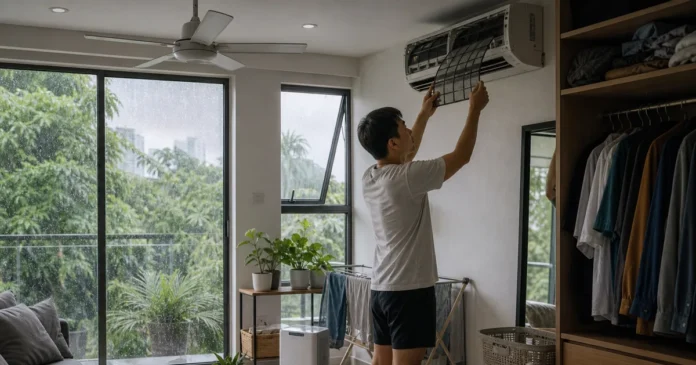
Servicing matters more here than in a temperate country. Units run constantly, filters clog, and a neglected unit costs more to run while cooling less. Quarterly cleaning is the usual advice and it pays for itself.
Our cost of living guide puts the bill in context.
Humidity is what actually damages things
Heat is uncomfortable. Humidity is expensive, and this is the part visitors never encounter.
Mould is the main event. Leather goes first, then anything else organic. Shoes, belts, handbags, jackets and camera bags left in a closed wardrobe will grow a fine layer within weeks, particularly in a room you rarely cool. People arrive, unpack expensive leather items into a dark cupboard, and discover them ruined a month later.
The fixes are cheap and boring. Keep air moving through wardrobes rather than sealing them, use moisture absorbers or silica in enclosed spaces, do not store leather in plastic, and run the aircon or a fan occasionally in rooms you do not otherwise use. A dehumidifier is worth it if you have a room that never gets cooled.
Electronics and paper suffer too. Camera lenses can develop fungus, books curl, and anything stored in a cupboard for a year comes out smelling of the cupboard. Musicians here keep instruments in cooled rooms for a reason.
Laundry does not dry outdoors reliably, which surprises people from hot dry climates. Air that is already saturated cannot take much more, so washing left on a balcony can sit damp for a day and start to smell. Most households here use a dryer or a cooled room.
Your day reorganises itself
Within a few months most people stop fighting the middle of the day and start working around it, which is what everyone who grew up here already does.
Outdoor exercise moves to early morning or after dark. Errands get done before eleven or after five. Anything involving walking gets planned around covered walkways and malls, and you learn which routes have shade. None of this feels like deprivation after a while, it just becomes how the day is shaped.
Clothing changes too. Natural fibres over synthetics, loose over fitted, and a second shirt in the bag if you have anything to be smart for. Offices, malls and cinemas are aggressively air conditioned, so a light layer for indoors is standard, which strikes new arrivals as absurd until their first over cooled meeting.
Hydration is not optional and takes longer to learn than it should. You lose fluid constantly here without obviously sweating, and the first sign is usually a headache rather than thirst. Most long term residents drink far more water than they did at home, without thinking about it.
Acclimatisation is real and takes roughly two to three months. After that the same temperature that floored you on arrival becomes unremarkable, and you will find air conditioned rooms cold. The reverse also happens, which is that going home in winter becomes genuinely hard.
What actually fails, and what to buy
The casualty list is fairly predictable once you have seen it happen a few times. Leather goes first. Then anything with a lens or a sensor, so cameras, binoculars and older lenses grow fungus inside the glass where you cannot clean it. Then paper, so books, photographs and documents cockle and spot. Musical instruments, particularly anything wooden with glued joints, are worth taking seriously.
Three purchases cover almost all of it. A dry cabinet, a sealed box with a small dehumidifying element, for cameras, lenses and anything else you would be sad to lose. A room dehumidifier if the flat is genuinely damp, which pulls a surprising amount of water out of the air and costs less to run than cooling the same room. And cheap moisture absorber tubs in every wardrobe.
Low floor units are worse than high ones, and a flat that sat empty and unaired before you moved in needs a week of aircon and fans before it stops smelling like a cupboard. When viewing, look for mould marks on ceilings and in bathroom corners. That tells you about the ventilation more reliably than anything the agent says, and our renting guide covers what else to check.
Frequently asked questions
Do you get used to the heat in Malaysia?
Mostly, and it takes around two to three months. After that the same conditions that floored you on arrival feel ordinary, and air conditioned rooms start to feel cold. There is no cooler season to wait for, so the adjustment is to a constant rather than a phase.
How do I stop mould growing on my things?
Keep air moving. Do not seal leather goods in closed wardrobes or plastic, use moisture absorbers in enclosed spaces, and occasionally cool or ventilate rooms you otherwise never use. Leather, camera equipment and books are the first casualties.
How much does air conditioning cost in KL?
Enough to be your largest utility line if you run it carelessly. Electricity is billed on a tiered structure, so heavy use costs disproportionately more. Cooling one room rather than the whole flat, using fans alongside, and setting a higher temperature all make a real difference. Check current tariffs with your supplier.
Explore more
- The KL rainy season, for the weather pattern itself
- Cost of living in Kuala Lumpur
- The KL expat guide

