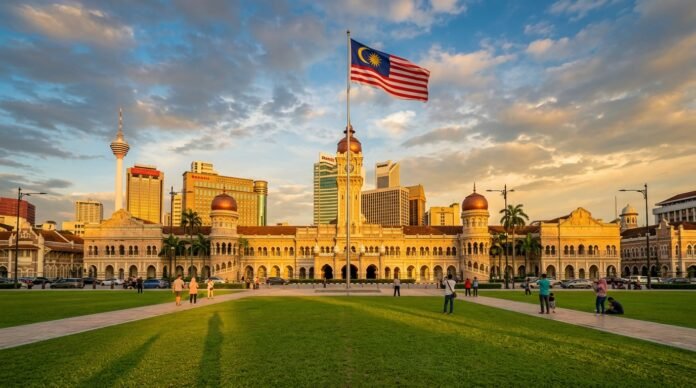

This is where Malaysia was born. On 31 August 1957, the British flag came down and the Malayan flag went up for the first time on Merdeka Square, and the country became independent. Today the square, known as Dataran Merdeka, is the grand heart of colonial Kuala Lumpur, ringed by some of the most beautiful old buildings in the city and free to explore on foot.
The thing to understand is that the square itself is really the starting point of a walk, not a standalone sight. Around it lies KL’s colonial old town: Moorish government buildings, a Tudor cricket club, heritage museums, and the very river confluence that gave the city its name. Here’s how to walk it, what to look for, and how to make the history come alive.
Some links in this post are affiliate links. If you book through them, I earn a small commission at no extra cost to you. Thanks for supporting the blog.
The short version
- What it is: the historic square where Malaysian independence was declared, and the heart of a free colonial old-town walk.
- Cost: free to visit the square and admire the buildings. A couple of museums charge a small fee.
- The icon: the Sultan Abdul Samad Building, a striking 1897 Moorish landmark facing the square.
- Best for: history and architecture lovers, photographers, and anyone wanting to understand KL’s origins.
- Best time: early morning for cool light, or late afternoon into evening when the buildings are illuminated.
- Time needed: 2 to 3 hours for a relaxed walk.
On details: opening hours for the museums and any events on the square can change, so check before a special trip.
The square and the birth of a nation
Before it was a symbol of independence, this was the Selangor Club Padang, a cricket ground where the British colonial elite played and socialised. That history is written into the space: at one end stands a 95-metre flagpole, one of the tallest in the world, marking the exact spot where the Union Jack was lowered at midnight and the Malayan flag raised for the first time as the country became free.
It’s worth pausing at the base of that flagpole. The mosaics there tell the story, one depicting Kuala Lumpur when it was still a cluster of villages, the other the moment the first prime minister proclaimed “Merdeka!”, meaning freedom, three times to the crowd. The square was officially named Dataran Merdeka, Independence Square, in 1990, and it still hosts the National Day parade every 31 August.
The square itself is a large, open, manicured green with fountains and paths. On its own it’s pleasant rather than spectacular, so the trick is to treat it as the stage and give your attention to the remarkable buildings framing it, and the walk beyond.
The buildings around the square
The Sultan Abdul Samad Building
The star of the square, and one of the most photographed buildings in the country. Completed in 1897 and designed by A.C. Norman with inspiration from northern Indian architecture, it’s a glorious red-and-white brick confection of Moorish arches, copper domes and a 41-metre clock tower that locals affectionately compare to Big Ben. It once housed the British colonial administration and later the courts. You admire it from the outside rather than tour it, and it’s at its most beautiful in the evening, when it’s floodlit against the night sky.
The Royal Selangor Club
Directly across the green stands the Royal Selangor Club, a black-and-white mock-Tudor building from the late 19th century where British officials met, drank and played cricket. It’s still a private members’ club today, so again you view it from outside, but it’s a striking contrast to the Moorish grandeur opposite, and it tells you a lot about who used to run this square.
Kuala Lumpur City Gallery
In February 2026 the City Gallery moved into the restored Sultan Abdul Samad Building, which means you can now go inside the square’s most famous landmark. It is a good place to start or end the walk. The paid gallery traces the city’s history and is cashless, so bring a card, while the Royal Selangor Gallery, Heritage Room and Collector’s Chamber are free. It opens 9am to 6pm, with last paid entry at 5pm.
Look out too for the small “zero mile stone” near the field, the point from which distances in colonial Kuala Lumpur were once measured.
The colonial old town walk
This is where the square earns its place. Fanning out from Dataran Merdeka is a compact, walkable cluster of heritage sights. A natural loop:
- Kuala Lumpur City Gallery for context, now inside the Sultan Abdul Samad Building.
- National Textile Museum, housed in another handsome colonial building nearby, tracing Malaysia’s weaving, songket and batik traditions. Free or low-cost and often overlooked.
- Masjid Jamek, one of KL’s oldest mosques, a lovely 1909 Moorish building set among palms at the meeting of two rivers. Visitors are welcome outside prayer times if dressed modestly, with robes provided at the entrance. Our cultural etiquette guide covers mosque manners.
- The River of Life, the beautified riverfront at the confluence beside Masjid Jamek, which comes alive after dark with illuminated fountains and a glowing blue walkway.
- The old Kuala Lumpur Railway Station, a short walk or ride south, a spectacular white Moorish fantasy from 1910 that’s one of the finest colonial buildings in the country.
The story hidden in plain sight
Here’s the detail that makes the walk click. Kuala Lumpur means “muddy confluence”, and the exact confluence it’s named after is right here, where the Gombak river flows into the Klang, beside Masjid Jamek. This is literally where the city began, as a muddy tin-mining trading post in the 1850s.
Stand at that confluence and you can read the whole colonial layout: Dataran Merdeka was the tidy administrative side, all government offices and cricket, while the market district just across the river, today’s Chinatown and Central Market, was the people’s side, where goods came off the boats and trains and the real commerce happened. Seeing the two together, the grand offices and the market lanes, tells you more about old KL than any single building.
As a bonus contrast, glance up: the soaring Merdeka 118, now among the tallest buildings in the world, rises right behind the old town, so you get Malaysia’s past and future in a single view.
Best time and how to walk it
The old town is best in the cooler, prettier hours at either end of the day.
- Early morning is cool, quiet and great for photos of the Sultan Abdul Samad Building without crowds or harsh midday glare.
- Late afternoon into evening is the other sweet spot: you beat the heat, catch the buildings lit up, and see the River of Life glowing after dark. If you only go once, this is my pick.
- Avoid the midday heat. The square is open and shadeless, and it gets punishing around noon. Bring water, a hat and sunscreen.
The full loop is a relaxed two to three hours on foot. If you’d like the history brought to life, a guided old-town heritage walk adds the stories and context that are easy to miss on your own.
Getting there
It’s very central and easy to reach. The nearest stations are Merdeka on the MRT and Masjid Jamek on the LRT, both a short walk away, with Masjid Jamek putting you right at the river confluence. A Grab is simple too. Our rail guide has the details. Since it’s a few minutes’ walk from Central Market and Chinatown, it slots straight into an old-town day.
Is it worth it? An honest take
For anyone interested in history, architecture or photography, absolutely. This is the most atmospheric, storied corner of Kuala Lumpur, and walking it, ideally at golden hour, is one of the more rewarding free things you can do in the city.
Set your expectations right, though. The square itself is just an open field, so if you turn up expecting a dramatic monument you may wonder what the fuss is about. The magic is in the surrounding buildings, the walk and the story behind them, not the lawn. Most of the grand buildings are admired from the outside, since they’re offices or a private club. The exceptions are the Sultan Abdul Samad Building, now home to the City Gallery, and the Textile Museum. Come for the architecture and the history, walk the loop, and it’s a genuine highlight.
What to combine it with
The old town sits right next to several other sights, so it’s easy to build a half or full day:
- Central Market and Chinatown, the market side of old KL, a few minutes’ walk across the river. See our Central Market guide and Chinatown guide.
- Perdana Botanical Gardens and KL Bird Park, a short ride away, for a green contrast. Our Bird Park and Lake Gardens guide covers them.
- Merdeka 118, if you want to go from the colonial past to a record-breaking skyscraper in one afternoon.
Frequently asked questions
Why is Merdeka Square important?
Merdeka Square, or Dataran Merdeka, is where Malaysia’s independence from British colonial rule was proclaimed on 31 August 1957, when the Malayan flag was raised for the first time. A 95-metre flagpole marks the spot. Once a British cricket ground, it’s now a national symbol and the setting for the annual National Day parade, surrounded by grand colonial-era buildings.
Is there an entrance fee for Merdeka Square?
No, the square is a free, open public space, and admiring the surrounding buildings like the Sultan Abdul Samad Building costs nothing. A couple of nearby attractions, such as the Kuala Lumpur City Gallery and the National Textile Museum, charge a small entry fee, but the walk itself is essentially free.
What is the Sultan Abdul Samad Building?
It’s the striking Moorish-style landmark facing Merdeka Square, completed in 1897 and once the centre of British colonial administration. With its red-and-white brick, copper domes and 41-metre clock tower, it’s one of the most photographed buildings in Kuala Lumpur. You admire it from the outside, and it looks its best in the evening when it’s floodlit.
What time is best to visit Merdeka Square?
Early morning is cool and quiet with lovely light for photos, while late afternoon into the evening lets you beat the heat, see the buildings illuminated and catch the River of Life fountains glowing after dark. Avoid midday, when the open square is hot and shadeless. Allow two to three hours for the full old-town walk.
How do you get to Merdeka Square?
It’s very central. The nearest stations are Merdeka on the MRT and Masjid Jamek on the LRT, both a short walk away, and a Grab is easy. It’s also just a few minutes on foot from Central Market and Chinatown, so it’s simple to combine them into one old-town outing.

