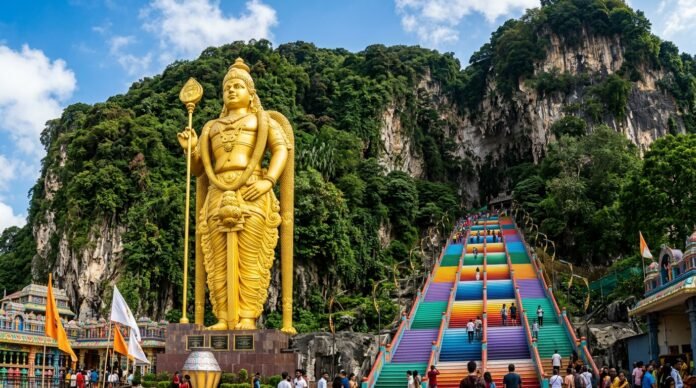

A giant golden god, a flight of 272 rainbow-painted steps, and a vast cave temple hollowed out of a 400-million-year-old limestone hill: Batu Caves is the most striking sight in the Kuala Lumpur area, and it’s completely free to visit. It’s also a living Hindu temple, not just a photo backdrop, and knowing that changes how you experience it.
This guide covers what Batu Caves actually is, what you’ll see, the dress code that’s genuinely enforced, the cash-only catch that trips people up, the best time to go, and an honest take on the crowds and the monkeys. For the full detail on getting there from the city, we have a separate Batu Caves from KL transport guide.
Some links in this post are affiliate links. If you book through them, I earn a small commission at no extra cost to you. Thanks for supporting the blog.
The short version
- What it is: A Hindu cave temple complex about 13 km north of central KL, dedicated to Lord Murugan.
- The icon: A 42.7m gold Murugan statue beside 272 rainbow-coloured steps up to the main Temple Cave.
- Cost: The Temple Cave, steps and statue are free. Side caves like the Ramayana Cave charge a small cash fee.
- Hours: Roughly 6am to 9pm daily. Go before 9am to beat crowds and heat.
- Dress code: Enforced. Shoulders and knees covered. Sarongs rented at the entrance.
- Bring cash. Nothing in the complex takes cards.
- Time needed: 1.5 to 2 hours for the main sights.
On prices and hours: these are indicative and can change. Bring cash and check current details before you go.
What Batu Caves actually is
Batu Caves is one of the most important Hindu temples outside India, and the focal point of Tamil Hindu worship in Malaysia. The limestone hill it sits in is around 400 million years old, and the caves within it have been used as a shrine to Lord Murugan, the Hindu god of war, since the late 1800s. It is, first and foremost, a place of worship, and on any given day you’ll see families praying, priests conducting rituals, and pilgrims climbing the steps barefoot.
That matters for your visit in a practical way. This isn’t a theme park or a viewpoint, it’s a working temple, so a bit of awareness, modest dress and quiet respect go a long way, and they’re part of what makes the place special rather than just photogenic. Once a year it becomes the stage for Thaipusam, one of the most dramatic religious festivals in the world, which I’ll come to below.
The complex has a few distinct parts: the giant golden statue and the rainbow staircase at the front, the main Temple Cave at the top of the steps, and a couple of smaller side caves at ground level. Here’s what each is actually like.
The statue and the 272 rainbow steps
The first thing you see is the 42.7-metre golden statue of Lord Murugan, completed in 2006 and the tallest statue of a Hindu deity in Malaysia. It stands guard at the foot of the staircase, and it’s genuinely imposing up close.
Behind it rise the famous 272 steps, painted in bright rainbow colours in 2018, which turned an already dramatic site into one of the most photographed spots in the country. The climb takes most people 15 to 20 minutes at a steady pace, and it’s steep, so take it slowly in the heat and pause on the landings. The best photo of the statue and the rainbow steps together is from the forecourt at the bottom, looking up. An escalator has been proposed for years, but as of October 2026 no opening date had been announced, so plan on climbing.
The caves, one by one
Temple Cave (Cathedral Cave)
At the top of the steps is the main event: a vast cavern with a soaring, open ceiling, sunlight pouring through gaps in the rock, and shrines to Lord Murugan inside. It’s free, it’s the spiritual heart of the site, and standing in that huge natural space is the moment that makes the climb worth it.
Ramayana Cave
Often missed, and worth not missing. Off to the left of the main complex, the Ramayana Cave is a network of chambers filled with colourful, LED-lit dioramas telling the story of the Hindu epic the Ramayana. It charges a small cash entry fee, around RM5, and takes 20 to 30 minutes. It’s quieter than the Temple Cave and good fun if you like caves and a bit of theatre.
Dark Cave (closed)
You’ll still see the Dark Cave mentioned in older guides as a conservation and caving experience, but be aware it has been closed to visitors since 2019 and remains so. Don’t plan around it.
Cave Villa (skippable)
Near the base is the Cave Villa, a separate paid attraction (around RM15 for foreigners) with a couple of small caves and caged animals and birds. I’d give it a miss. The animal enclosures sit uneasily with a lot of visitors, and it isn’t a patch on the free Temple Cave or the Ramayana Cave. Your money and time are better spent elsewhere.
Dress code and temple etiquette
This is the thing most visitors get caught out by, because it’s genuinely enforced at the base of the stairs, for men and women alike.
- Cover your shoulders and knees. No vests, no short shorts, no short skirts. If you turn up in them, you’ll be stopped.
- Sarongs are rented at the entrance for around RM10 to RM15 if your outfit doesn’t pass. It’s easiest to just dress appropriately from the start.
- Remove your shoes before entering the inner shrine areas, as you would at any temple.
- Be respectful around worship. People are praying. Don’t photograph ceremonies or individuals up close without asking, keep your voice down inside the shrines, and don’t climb on things for photos.
None of this is onerous, and it’s simply good manners at a sacred site. Our guide to cultural etiquette in KL has more on temple manners.
Bring cash: the complex takes no cards
Here’s the practical tip that saves real hassle: nothing in the Batu Caves complex accepts cards. Not the side-cave entries, not the sarong counter, not the food stalls, not the toilets. It’s cash only, everywhere. There are ATMs near the train station and the base, but the simplest approach is to arrive with RM50 to RM100 in small notes and not have to think about it. Getting stuck at the sarong counter with only a card is a classic Batu Caves moment.
Watch the monkeys
The 272 steps are home to troops of long-tailed macaques, and they are bold, quick and completely unbothered by people. They will snatch food from your hand, open an unzipped bag, and grab sunglasses, phones or drink bottles if you’re careless.
- Don’t carry visible food or drinks on the stairs. That’s what triggers them.
- Never feed them. It makes them more aggressive and it’s bad for the animals.
- Keep bags zipped and phones secure. Don’t dangle anything loose.
- Don’t try to grab back a stolen item. It isn’t worth a bite.
They’re part of the experience and fun to watch, just treat them as the opportunists they are.
The best time to visit
- Early morning, before 9am, on a weekday. This is the answer. Cooler air for the climb, softer light, and far thinner crowds. Arrive around 7am and you can have the rainbow steps almost to yourself for photos.
- Avoid 10am to 4pm, especially at weekends, when tour buses arrive and the steps get packed.
- Mind the weather. The climb is hot and exposed, and afternoon storms are common in monsoon season. Mornings dodge both. See our best time to visit KL guide.
Thaipusam: the festival that defines Batu Caves
Once a year, Batu Caves hosts Thaipusam, a Tamil Hindu festival honouring Lord Murugan, and it’s one of the most extraordinary religious events you can witness. Over the festival period the site draws well over a million people. Devotees carry ornate frames called kavadi, many piercing their skin, cheeks and tongues with hooks and skewers as acts of devotion and penance, then climb the 272 steps to the Temple Cave.
It falls in late January or early February, set by the lunar calendar, with the next falling in early 2027, so check the exact date if you want to plan around it. If you go, expect enormous crowds, an intense and moving atmosphere, and a very different experience from a normal visit. Entry stays free even then. It’s not a relaxed sightseeing trip, but for many travellers it’s unforgettable.
Getting there, in brief
Batu Caves is genuinely easy to reach on your own, so you don’t need a tour. The simplest way is the KTM Komuter train from KL Sentral, which runs straight to Batu Caves station, the end of the line, right at the temple entrance. It takes around 30 minutes and costs a couple of ringgit. A Grab is quicker at around RM20 and drops you at the gate.
For the full breakdown of every option, timings and the do-it-yourself versus tour question, see our dedicated Batu Caves from KL transport guide. If you’d rather have the logistics and cultural context handled, a guided Batu Caves tour often combines it with other sights north of the city.
Is it worth it? An honest take
Yes, without hesitation. Batu Caves is the most iconic sight around Kuala Lumpur, it’s free, it’s easy to reach, and the combination of the golden statue, the rainbow steps and that soaring cave temple is genuinely unforgettable. For most visitors it’s a highlight of their trip.
Be realistic about a few things, though. It gets crowded and hot in the middle of the day, the 272 steps are a real climb with no wheelchair access to the top, the monkeys are cheeky, and the vendors at the base can feel touristy. None of that outweighs the experience, but going early, dressing right and bringing cash turns a potentially frustrating visit into a smooth, memorable one. Skip the Cave Villa, do the free Temple Cave and the Ramayana Cave, and you’ve seen the best of it.
What to combine it with
Batu Caves is a half-day at most, so it pairs well with something else north of the city. The Kanching rainforest waterfalls sit on the same road and make a natural morning double: do the caves first, then cool off at the falls. Otherwise, head back into town for lunch and pair it with the Petronas Towers or a wider KL itinerary.
Frequently asked questions
Is there an entry fee for Batu Caves?
No, the main Temple Cave, the 272 steps and the giant Murugan statue are all free to visit, with no ticket or booking. Some side attractions charge a small cash fee, such as the Ramayana Cave at around RM5 and the Cave Villa at around RM15 for foreigners. Everything in the complex is cash only.
What is the dress code for Batu Caves?
Shoulders and knees must be covered, for both men and women, and it’s enforced at the base of the stairs. If your clothing doesn’t meet the code, you can rent a sarong at the entrance for around RM10 to RM15. Shoes come off before entering the inner shrine areas. It’s an active Hindu temple, so modest, respectful dress is expected.
How many steps are there at Batu Caves, and are they hard?
There are 272 steps, painted in rainbow colours, leading up to the Temple Cave. They’re steep, and the climb takes most people 15 to 20 minutes at a steady pace, with landings to rest on. It’s manageable for anyone reasonably mobile, but there’s no wheelchair access to the top. Going early means a cooler, less crowded climb.
What time should I visit Batu Caves?
Early morning on a weekday, ideally before 9am, is best. The air is cooler for the climb, the light is better for photos, and the crowds are thin. Arrive around 7am and the rainbow steps can be almost empty. The busiest, hottest window is 10am to 4pm, especially at weekends when tour buses arrive.
Is the Dark Cave at Batu Caves open?
No. The Dark Cave, which used to offer conservation and caving tours, has been closed to visitors since 2019 and remains closed, despite still appearing in many older guides. The caves you can visit are the free Temple Cave and the paid Ramayana Cave.
How long do you need at Batu Caves?
Around 1.5 to 2 hours covers the staircase, the Temple Cave and photos at the statue. Add about an hour if you also visit the Ramayana Cave. It’s a half-day trip at most, which is why many people pair it with another sight north of the city, like the Kanching waterfalls.
Explore more
- Batu Caves from KL, the full transport and day-trip guide
- Things to do in Kuala Lumpur
- Petronas Towers visiting guide
- Cultural etiquette in KL
- Kuala Lumpur in 3 days

