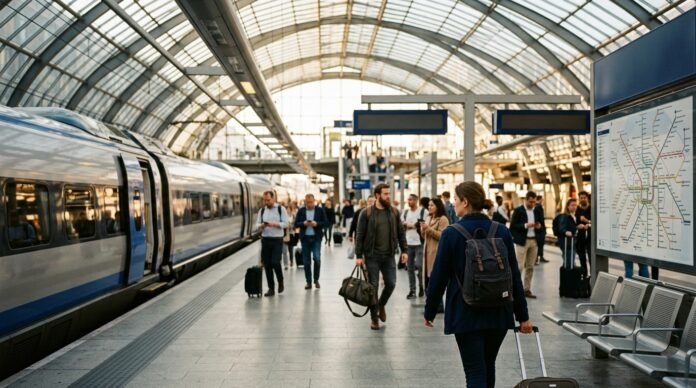

KL’s rail network is genuinely one of the easier ways to get around the city: fast, cheap, air-conditioned, and largely above the traffic. The catch for first-timers is that there are several different systems (MRT, LRT, Monorail, plus separate commuter and airport trains), and the names blur together. Here is how it all fits, and how to just use it without overthinking.
The short version
- MRT, LRT and the Monorail are run by Rapid KL on one integrated fare, you can transfer between them on a single tap.
- Get a Touch ‘n Go card, tap in and tap out at the gates. It is the simplest way to ride everything (and pay tolls and convenience stores too).
- KL Sentral is the main hub; Pasar Seni (Chinatown), Masjid Jamek and Bukit Bintang are the interchanges you’ll use most.
- The airport trains (KLIA Ekspres/Transit) and the KTM Komuter are paid separately, they connect by walkway but are not on the integrated fare.
- Fares are roughly RM1 to 10 by distance; trains run from about 6am to midnight; signage is in English.
MRT vs LRT vs Monorail: the difference at a glance
In one line each: the MRT is the newer, faster, partly underground backbone; the LRT is the older, mostly elevated network and the one that stops at KLCC; the Monorail is a single short elevated line through Bukit Bintang. All three take the same Touch ‘n Go card, and transfers between them are free at most interchanges, with Bukit Bintang the notable exception.
| MRT | LRT | Monorail | |
|---|---|---|---|
| What it is | The modern backbone, driverless, partly underground | Mostly elevated, older, four lines | One short elevated line, 11 stations |
| Best for | Bukit Bintang, Chinatown, TRX, Muzium Negara | KLCC and the Petronas Towers | Hopping along Bukit Bintang and Jalan Sultan Ismail |
| Weatherproof? | Yes through the centre | No, elevated platforms | No |
| Crowding | Roomy | Busy at peak | The most crowded, small four car trains |
| Women only coach | Yes, pink | Yes on some lines | No |
| Use it when | Almost always the first choice | You are going to KLCC | Short hops the MRT does not cover |
The three networks side by side
MRT (the backbone)
Two driverless MRT lines, modern, fast, and partly underground through the city centre (so weatherproof). The Kajang Line is the one tourists use most, it runs through Bukit Bintang (walkway to the Monorail), Pasar Seni (for Chinatown), Muzium Negara (by KL Sentral), and TRX. The Putrajaya Line heads out to the administrative capital and shares a handy same-platform interchange with the Kajang Line at TRX. Both have a pink women-only coach.
LRT
Four mostly-elevated LRT lines. The one you are most likely to use is the Kelana Jaya Line, which stops at KLCC (Petronas Towers) and connects to the MRT at Pasar Seni. The Ampang and Sri Petaling lines cover other corridors and meet the Kelana Jaya line at Masjid Jamek.
The fourth is new and behaves differently. The Shah Alam Line, usually written LRT3, opened on 29 June 2026 with 20 stations running west from Bandar Utama through Shah Alam to Johan Setia in Klang. It is a commuter line rather than a tourist one, and almost no visitor will need it. The reason it matters here is the fare, covered below: it is the one Rapid KL line that is not fare integrated with the rest of the network.
Monorail
A single elevated line of 11 stations threading through the heart of the city, KL Sentral, Brickfields, Bukit Bintang, Chow Kit. It is smaller and slower than the MRT but often the most convenient hop for tourists staying centrally, especially between KL Sentral and the Bukit Bintang hotel zone.
The separate ones: KTM Komuter and the airport trains
Two things to know are not on the integrated Rapid KL fare. The KTM Komuter is the older commuter rail covering the wider suburbs. The airport trains (KLIA Ekspres and KLIA Transit) run between the airport and KL Sentral, fast but priced separately, see KLIA to KL city for that journey. Both connect to the network by walkway at interchange stations, but you pay for them as their own trips.
Fares, hours and frequency compared
The three networks feel different to ride, and those differences are what decide your day.
| MRT | LRT | Monorail | |
|---|---|---|---|
| Typical fare | About RM1.10 to RM6.40 | About RM1.10 to RM6.40 | About RM1.20 to RM2.50 |
| Trains | Four cars, driverless | Two to six cars | Four small cars |
| Capacity | Highest | Middling | Lowest by a distance |
| Roughly runs | 6am to around midnight | 6am to around midnight | 6am to around midnight |
The Monorail is the weak link at rush hour. Four small cars against the MRT’s much larger trains means that between about 5pm and 7pm you can watch two or three go past before there is room to board at Bukit Bintang. If you are on a schedule, walk to the MRT instead.
Nothing runs all night. Services wind down around midnight, earlier on some lines, so a late dinner in Bangsar or a night out on Changkat means a Grab home. Check the last train on the platform display rather than assuming.
The lines tourists actually need
Do not let the full network intimidate you. As a visitor staying centrally, you will realistically only touch three lines, and between them they cover almost everything you came to see:
- MRT Kajang Line, Bukit Bintang, Pasar Seni (Chinatown), Muzium Negara (KL Sentral), TRX.
- Kelana Jaya LRT Line, KLCC (Petronas Towers), connects to the MRT at Pasar Seni.
- Monorail, KL Sentral, Brickfields, and the Bukit Bintang hotel zone.
Learn those three and you can reach KLCC, Bukit Bintang, Chinatown, KL Sentral, and TRX without ever thinking about the rest of the map.
How to pay
You have a few options, in rough order of convenience:
- Touch ‘n Go card (recommended). A reloadable stored-value card, tap in and tap out at the gates. Buy and top up at station counters, reload machines, and 7-Elevens. It works across MRT, LRT, Monorail, most buses, KTM, tolls, and parking, so it is genuinely useful beyond the trains.
- Single-trip token. Buy at the station machine for a one-off ride; fine for the occasional trip, but you queue each time.
- Contactless / mobile. Contactless bank cards and mobile wallets are increasingly accepted on parts of the network; coverage is growing but not universal, so the physical card is still the safe bet.
Keep a little balance on the card, the gates won’t let you in below the minimum for your trip. For more on the card and other tourist payments, see our Grab guide for ride-hailing as the complement to rail.
Interchanges worth knowing
| Station | What connects | Useful for |
|---|---|---|
| KL Sentral | LRT, MRT, Monorail, KTM, airport trains | The main hub; arrivals from the airport |
| Pasar Seni | LRT ↔ MRT | Chinatown, Central Market |
| Masjid Jamek | LRT ↔ LRT | Old town, central transfers |
| Bukit Bintang | MRT, walkway to Monorail | Shopping and hotel district |
| Titiwangsa | LRT, Monorail, MRT | Northern transfers |
| TRX | MRT ↔ MRT (same platform) | TRX mall; Kajang/Putrajaya line swap |
Which transfers are free, and which cost you twice
This is the part almost nothing online tells you, and it is worth a minute because it is real money and real walking.
A line on the rail map is not always a free transfer. Some stations are integrated, meaning both lines share one paid area and you simply walk from platform to platform on a single fare. Others are connecting stations, where the two lines sit in separate buildings or separate paid areas, so you tap out, walk at street or mall level, and tap in again. That second tap starts a new fare.
| Station | Transfer | One fare or two |
|---|---|---|
| Masjid Jamek | LRT to LRT | One, integrated since 2011 |
| Pasar Seni | LRT to MRT | One, integrated |
| Titiwangsa | LRT, Monorail, MRT | One, integrated |
| Tun Razak Exchange | MRT to MRT | One, same platform |
| Chan Sow Lin, Maluri, Sungai Besi | LRT to MRT | One, integrated |
| Bukit Bintang | MRT to Monorail | Two. Tap out, walk past Lot 10, tap in |
| KL Sentral | Rapid KL to KTM or airport trains | Two. Different operators |
| Bandar Utama, Glenmarie | LRT3 to anything | Two. LRT3 is not integrated |
For a tourist the practical upshot is small but worth knowing. The Bukit Bintang MRT to Monorail hop is the one you are most likely to hit, and paying twice for it is a couple of ringgit rather than a disaster. The bigger cost is the walk, because a route planner showing a two minute interchange will not tell you that you are leaving one station and entering another at street level.
If a journey planner offers you two routes and one has fewer transfers, take that one even if it looks a minute slower.
Tips for first-time riders
- Use Google Maps. Its transit directions for KL are accurate and tell you the line, platform, and where to change.
- Avoid the rush. Weekday mornings and roughly 5 to 8pm get packed, especially on the Kelana Jaya line.
- Tap in AND out. Fares are distance-based, so you tap at both ends; forgetting to tap out can cost you a maximum fare.
- Walkway transfers can be long. Some “connected” stations involve a five-minute covered walk; allow for it.
- Women-only coaches (pink signage) are available on the MRT and some lines if you prefer them, especially at busy times.
When the train isn’t the answer
Rail is great along its lines, but KL is spread out and some areas (parts of Bangsar, Mont Kiara, the deep suburbs) are not near a station. For those, a Grab is cheap and easy, and often the better call late at night or in heavy rain. The smart approach is to mix the two: rail along the corridors, Grab for the last mile or the awkward cross-town hop. For the bigger picture, see getting around Kuala Lumpur.
A quick rule of thumb for train versus Grab:
| Trip | Better choice |
|---|---|
| KLCC to Bukit Bintang | Rail (or a short walk) |
| KL Sentral to Chinatown | Rail (MRT to Pasar Seni) |
| Across town to Bangsar or Mont Kiara | Grab (not directly on the tourist lines) |
| Late at night | Grab (trains stop around midnight) |
| Airport to city | KLIA Ekspres train |
| Heavy rain / lots of luggage | Grab, door to door |
Frequently asked questions
Is the KL MRT easy to use for tourists?
Yes. Signage is in English, stations are modern and clean, and Google Maps gives accurate directions. Get a Touch ‘n Go card, tap in and out, and it is genuinely simple, much easier than dealing with traffic.
What’s the difference between the MRT and LRT?
Both are urban rail, and on the Kajang, Putrajaya, Kelana Jaya, Ampang and Sri Petaling lines they share one integrated fare, so a transfer inside a shared paid area does not start a new charge. The exception is the Shah Alam Line, LRT3, which runs on a separate fare system. The MRT is newer, faster, higher-capacity and partly underground; the LRT is older and mostly elevated. For most tourist trips it doesn’t matter which you’re on, you just follow the route Google Maps gives you and transfer where needed.
Do I need a Touch ‘n Go card?
Not strictly, you can buy single-trip tokens, but a Touch ‘n Go card saves queuing every ride and works across trains, buses, tolls, and shops. For more than a couple of days in KL, it’s worth getting one.
Are the airport trains part of the same system?
No. The KLIA Ekspres and KLIA Transit connect to the network at KL Sentral but are paid separately from the integrated Rapid KL fare. See KLIA to KL city for that trip.
Is the KL rail network safe?
Yes, it’s clean, well-lit, monitored, and widely used at all hours. Women-only coaches are available if preferred. For the wider picture see is Kuala Lumpur safe for tourists.
Can I get to the Petronas Towers by train?
Yes. Take the Kelana Jaya LRT line and get off at KLCC station, which comes up right by the Petronas Towers and Suria KLCC mall. It is one of the easiest sights to reach by rail.
How much will I spend on public transport per day?
Most tourists spend around RM5 to 15 a day on trains, since individual fares are only about RM1 to 10 by distance. If you ride a lot, a day or period pass can work out cheaper. It is one of the smallest lines in any KL budget.
Will one card work on all of them?
Yes for payment. A Touch n Go card is accepted on the LRT, MRT, Monorail, BRT, the buses, KTM Komuter and the airport trains, so one card covers everything. What it does not do is make every journey a single fare. Payment coverage and fare integration are two different things, and the table above shows where a transfer starts a new charge.
Is the new LRT3 Shah Alam Line useful for visitors?
Almost certainly not. It opened on 29 June 2026 with 20 stations running west from Bandar Utama through Shah Alam to Klang, which is commuter territory rather than a sightseeing route. The thing worth knowing is that it runs on its own fare system, so changing between LRT3 and any other line means tapping out and paying a second fare.
Explore more
- KLIA to KL city: every option compared
- Grab in Malaysia: how it works for tourists
- Getting around Kuala Lumpur
- Is Kuala Lumpur safe for tourists?
Official & useful resources

