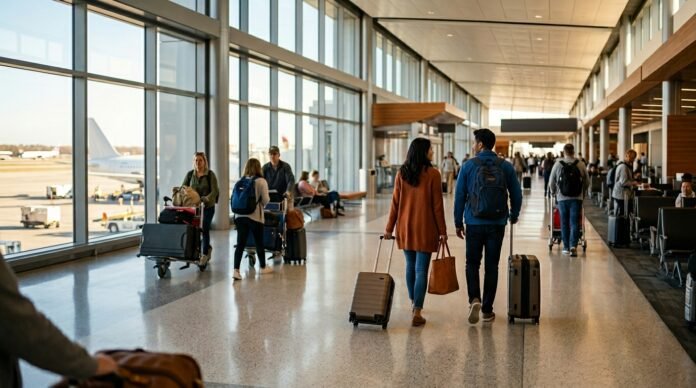

This trips up more travellers than it should, partly because the airport quietly rebranded. Kuala Lumpur’s airport (KUL) has two terminals that work almost like separate airports. Here is the one rule that saves you: if you are flying AirAsia, you want Terminal 2. Everyone else, almost certainly Terminal 1. The rest is detail.
The short version
- The terminals are now officially KLIA Terminal 1 and KLIA Terminal 2. Most people, booking sites and locals still say the old names: KLIA (Terminal 1) and KLIA2 (Terminal 2).
- Terminal 1 = full-service airlines (Malaysia Airlines, Emirates, Singapore Airlines, Qatar, etc.).
- Terminal 2 = low-cost carriers, above all AirAsia and AirAsia X, plus Scoot and Cebu Pacific. Not every budget airline is here: VietJet and Air Arabia use Terminal 1.
- They are about 2km apart, not walkable, and each has its own immigration. Allow real time to switch.
- Both connect to KL Sentral by the same KLIA Ekspres/Transit train, and both have Grab and taxis.
Which terminal am I flying into?
It is decided by your airline, not your destination:
- Flying AirAsia or AirAsia X? Terminal 2 (KLIA2), always, no matter what a third-party booking site shows. This is the single most common mix-up.
- Flying a full-service carrier (Malaysia Airlines, Emirates, Singapore Airlines, Qatar, British Airways, etc.)? Terminal 1.
- Another budget airline? Scoot and Cebu Pacific use Terminal 2, but VietJet, Air Arabia and Batik Air Malaysia use Terminal 1, so check the table below.
If in doubt, your airline determines the terminal, so search your specific carrier rather than guessing from the booking confirmation, which sometimes just says “KUL”.

Which terminal is my airline?
Mostly, Terminal 1 is the full service terminal and Terminal 2 is the budget terminal. But not every budget airline uses Terminal 2, so find your airline below rather than guessing from the price of your ticket.
| Airline | Terminal | Worth knowing |
|---|---|---|
| AirAsia, plus Thai, Indonesia and Philippines AirAsia | Terminal 2 | AirAsia moved its Subang domestic flights to Terminal 2 in April 2025 |
| AirAsia X | Terminal 2 | Long haul, still the budget terminal |
| Scoot | Terminal 2 | |
| Cebu Pacific | Terminal 2 | |
| Malaysia Airlines | Terminal 1 | Its hub |
| Batik Air Malaysia | Terminal 1 | Often mistaken for a Terminal 2 airline |
| VietJet | Terminal 1 | A budget airline that does not use Terminal 2 |
| Air Arabia | Terminal 1 | Same, budget but Terminal 1 |
| Singapore Airlines, Emirates, Qatar Airways, Cathay Pacific, Turkish Airlines, KLM, Japan Airlines, British Airways and other full service carriers | Terminal 1 |
The names changed, which is most of the confusion. KLIA and klia2 were renamed KLIA Terminal 1 and KLIA Terminal 2 in 2023, and the airport train stations are now called KLIA T1 and KLIA T2. The old name for Terminal 2, klia2, is still used on booking sites, older maps and by locals. They are the same building. If your ticket says klia2, KUL T2 or Terminal 2, go to the same place.
Is klia2 only for AirAsia? No, but AirAsia and AirAsia X are most of it. Scoot and Cebu Pacific fly from there too. The bigger trap runs the other way: budget airlines such as VietJet and Air Arabia fly from Terminal 1, so a cheap ticket does not mean Terminal 2.
Batik Air is the one that catches people out. Batik Air Malaysia flies from Terminal 1, but its fares often sit close to budget airline prices, so people head to Terminal 2 by mistake. Check the terminal printed on your own booking confirmation, and if it is not there, check the airline app on the day.
Whoever you are flying, the terminal is on your boarding pass and in the airline app. That is the only source that is right for your specific flight, and it takes ten seconds to check. Getting it wrong costs you an hour, because the two terminals are separate buildings a few kilometres apart.
What’s different between them?
| Terminal 1 (KLIA) | Terminal 2 (KLIA2) | |
|---|---|---|
| Airlines | Full-service (Malaysia Airlines, Emirates, etc.) | Low-cost (AirAsia, AirAsia X, Scoot) |
| Feel | More premium, lounges, less crowded | Big, busy, mall-like (gateway@klia2) |
| Food & shopping | Good, more upscale | Huge range, food courts, retail |
| Train to KL Sentral | KLIA Ekspres/Transit | KLIA Ekspres/Transit |
| Grab & taxi | Yes | Yes |
| Connected hotel | Nearby airport hotels | Budget hotels connected to the mall |
Functionally both are modern and easy to use. Terminal 2 just feels more like a giant shopping mall with planes attached, which is handy if you have a long wait. Getting from either into the city is the same process either way, covered in KLIA to KL city.
Transferring between the two terminals
This is where people get caught out, especially with a self-transfer between, say, a Malaysia Airlines long-haul into Terminal 1 and an AirAsia hop out of Terminal 2. The terminals are separate buildings about 2km apart, and you clear immigration and re-check-in, so it is a proper transfer, not a walk down the corridor. Your options:
- KLIA Ekspres/Transit train, fastest at about 3 minutes between terminals (a small fare, around RM2).
- Free shuttle bus, runs 24/7, roughly every 10 minutes, takes about 10 minutes. No cost, but less frequent than the train.
- Airport Liner bus, another bus option for a small fare (around RM2.50).
Crucial for self-transfers: if your tickets are separate (you booked the two flights independently), your bags are not through-checked, you collect them, change terminals, and re-check-in. Give yourself a generous buffer, at least 90 minutes, more if you have not pre-cleared. AirAsia closes check-in 60 minutes before departure, and missing that window because you underestimated the terminal transfer is a classic, avoidable mistake.
As a rough guide to how much buffer to leave for a terminal switch:
| Transfer type | Suggested buffer |
|---|---|
| Same airline, single ticket (bags through-checked) | Follow the airline minimum; build in extra at peak times |
| Separate tickets (you self-transfer) | At least 90 minutes, ideally more |
| International arrival to an AirAsia departure | 3 to 4 hours (immigration, bags, re-check-in) |
| AirAsia arrival to an international departure | 3 to 4 hours |
These are cautious buffers, not minimums, but missing an AirAsia check-in (which closes 60 minutes before departure) because you cut a self-transfer too fine is a classic, avoidable mistake.
Getting into the city from either terminal
Good news: it is the same from both. The KLIA Ekspres train runs to KL Sentral in about 28 minutes, Grab and taxis are available at each, and the options are identical in practice. The full breakdown, train vs Grab vs bus vs taxi, plus how to avoid airport touts, is in KLIA to KL city: every option compared. To get around once you are in town, see the KL MRT, LRT and Monorail guide.
Frequently asked questions
Is KLIA2 the same airport as KLIA?
Same airport (KUL), different terminals, now officially Terminal 1 and Terminal 2. They share runways but are separate buildings about 2km apart, each with its own immigration, so you cannot just walk between them.
Is KLIA Terminal 2 the same as klia2?
Yes. klia2 was renamed KLIA Terminal 2 in 2023, so klia2, KLIA T2 and Terminal 2 all mean the same building. KLIA, the old name for the main terminal, is now KLIA Terminal 1.
Is klia2 only for AirAsia?
No. AirAsia and AirAsia X make up most of its flights, but Scoot and Cebu Pacific use it too, as listed in October 2026. Not every budget airline is there: VietJet, Air Arabia and Batik Air Malaysia fly from Terminal 1.
Which terminal does AirAsia use in KL?
Terminal 2 (KLIA2), always. Every AirAsia and AirAsia X flight uses Terminal 2, regardless of what a third-party booking site displays.
How do I transfer between KLIA Terminal 1 and Terminal 2?
Take the KLIA Ekspres/Transit train (about 3 minutes), the free 24/7 shuttle bus (about 10 minutes), or the Airport Liner bus. For a self-transfer with separate tickets, allow at least 90 minutes because you collect bags, change terminals, and re-check-in.
Is it far from KLIA2 to the city?
No further than Terminal 1, in practice. Both run the same KLIA Ekspres train to KL Sentral (about 28 minutes) and both have Grab and taxis. See KLIA to KL city.
Can I walk between KLIA Terminal 1 and Terminal 2?
No. They are separate buildings about 2km apart, so you cannot walk between them. Use the KLIA Ekspres/Transit train (about 3 minutes), the free shuttle bus, or the Airport Liner bus.
What if I go to the wrong terminal?
You will need to transfer to the correct terminal before checking in. By train it is only about 3 minutes, but with the walk, waiting, and queues it can realistically add 20 to 45 minutes or more, so it is worth getting it right first time. If you fly AirAsia, it is always Terminal 2.
Explore more
- KLIA to KL city: every option compared
- KL MRT, LRT & Monorail guide
- Grab in Malaysia: how it works for tourists
- Getting around Kuala Lumpur
Official & useful resources

