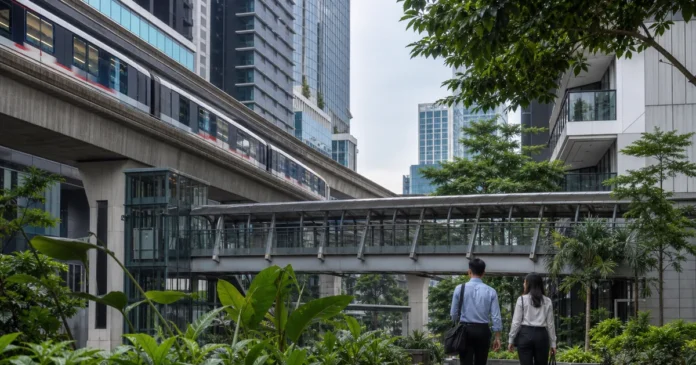

Start with the thing that confuses every new arrival. Bangsar South is not in Bangsar, and the LRT station you want is not called Bangsar South.
That sounds like a trivial naming quirk. It is not, because it changes what you should expect from the area, what you should pay for it, and how you get home.
The short version
- Bangsar South is a developer name for Kampung Kerinchi. It is a separate area from Bangsar proper.
- The station is Kerinchi on the Kelana Jaya LRT line. Searching a rail map for Bangsar South will not find it.
- KL Eco City sits next door at Abdullah Hukum, with a pedestrian bridge across to Mid Valley and The Gardens.
- This is one of the few genuinely rail connected areas expats choose, which is the whole argument for living here.
- It is corporate and modern rather than characterful. If you want a neighbourhood, look at Bangsar itself.
The name, and why it matters practically
The area was Kampung Kerinchi, named for settlers of Kerinchi descent from Sumatra. The name Bangsar South was approved by city hall around 2008 and attached to the redevelopment, a fairly transparent attempt to borrow the value of an established address next door.
Local feeling about that never entirely settled. The Kampung Kerinchi name was formally restored in 2019 following a campaign by the area’s member of parliament. Bangsar South was not erased, so both names are now in use, which is exactly the sort of thing that makes an address confusing when you are new.
Three things follow from that. Listings and maps use both names, so search both when flat hunting or you will miss half the stock. The LRT station is Kerinchi, so a rail map search for Bangsar South returns nothing. And do not price the area against Bangsar, because it is a different place with a different feel, and paying Bangsar money to live here is the most common mistake made by people who assumed the name meant proximity.
Our guide to Bangsar itself covers what the original actually is, which is a useful comparison before you commit.
Bangsar South at a glance
| Question | Answer |
|---|---|
| Also called | Kampung Kerinchi, the original name, formally restored in 2019. Both are in use |
| Nearest LRT | Kerinchi, Kelana Jaya line. There is no station called Bangsar South |
| One stop away | Abdullah Hukum, KTM Komuter interchange, pedestrian bridge to Mid Valley and The Gardens |
| Average listing | Around RM2,290 a month as of August 2026, skewed low by small serviced units |
| Two bedroom, 800 to 1,000 sq ft | RM2,500 to RM3,500 |
| Car needed | No, and that is the main reason to be here |
| Best for | Professionals working nearby, couples and singles, anyone going car free |
| Weakest point | Atmosphere. It is a business district and empties at weekends |
The transport case, which is the real argument
Most areas expats gravitate towards in KL have a rail problem. Mont Kiara has no station at all. Sri Hartamas has none. Much of Damansara depends on a car. Against that, this corner is unusually well served, and that is the honest reason to consider it.
Kerinchi sits on the Kelana Jaya LRT line, which runs through KLCC and the city centre in one direction and out towards Petaling Jaya in the other. It is a driverless line with high frequency, so it does not require timetable planning.
Abdullah Hukum, one stop along, serves KL Eco City and is an interchange with KTM Komuter. A pedestrian bridge across the Klang River connects it to Mid Valley and The Gardens Mall. That bridge opened in November 2019 after roughly two decades of delays, and it changed the area, because it turned a short but genuinely unpleasant road crossing into a covered walk.
The practical result is that you can live here, commute to the city centre, and do a full weekly shop without owning a car. Very few areas that expats actually consider can claim that. If being car free matters to you, this and Bangsar are the shortlist.
The caveat is that walkability here is local rather than general. Within the development it is fine. Getting between Bangsar South and neighbouring areas on foot is not pleasant, because the surrounding road layout was built around expressways rather than pedestrians.
What living here is actually like
Modern, vertical and corporate. This is a planned development of office towers, serviced apartments and podium retail, not a neighbourhood that grew.
The upside is convenience and newness. Buildings are recent, facilities are good, and the retail podiums put food, groceries, gyms and a co-working space within a lift ride. A large technology and corporate employment base means a weekday population of professionals, and a lot of residents work within walking distance of home, which in this city is close to a luxury.
The honest downside is character. It empties at weekends in the way business districts do, the food is competent rather than exciting, and there is no street life to speak of. People who move here from Bangsar usually cite convenience. People who move away usually cite atmosphere.
It also sits directly against a genuine kampung and older low income housing. That contrast is part of the area’s history rather than a flaw, but it does mean the surroundings are more mixed than the marketing photographs suggest, and it is worth walking the area at street level before deciding.
Who it suits
Good fit: professionals working in or near the area, couples and singles who want a new building and a short commute, anyone determined to live without a car, and people who value a lift down to groceries over a walk to a good coffee shop.
Look elsewhere if you want a neighbourhood with its own life at weekends, you have children and want space and international schools on the doorstep, or you came to Malaysia for something that does not look like the business district you left. Our comparison of the best expat areas in KL puts it against the alternatives.
What it costs, and what you get for it
Rents here sit below Bangsar and generally below KLCC for equivalent space, which is much of the appeal, though the newest towers narrow the gap. The figures are in the next section.
What you are buying is newness and convenience. Buildings are recent, so facilities and management tend to be better than in older stock, and the podium retail puts a supermarket, a gym, food and a pharmacy within the building rather than a drive away.
Two things worth checking before signing. Serviced apartment titles are common in this kind of development, and utility tariffs on a commercial title can be higher than on a residential one, which shows up on the electricity bill rather than the rent. And ask what the maintenance charge covers and who pays it, since it varies and is easy to overlook when comparing two otherwise similar units.
Our guide to renting an apartment in KL covers the tenancy agreement and the deposit structure, both of which apply here as anywhere else in the city.
What it costs to rent
Listings across Bangsar South average around RM2,290 a month as of August 2026, with a two bedroom of roughly 800 to 1,000 square feet asking RM2,500 to RM3,500. That average is dragged down by the smaller serviced units, so treat it as a floor rather than a typical family figure.
The comparison that matters is with Mont Kiara, where furnished two and three bedroom units commonly ask RM3,000 to RM6,000. You are paying meaningfully less here and getting a rail connection Mont Kiara does not have, which is the whole case for the area. What you give up is the school cluster and the established expat social infrastructure.
Frequently asked questions
Is Bangsar South part of Bangsar?
No. Bangsar South is a development name applied to Kampung Kerinchi around 2008. The Kampung Kerinchi name was formally restored in 2019 and both are now in use. Bangsar proper is a separate, older and quite different area.
Which LRT station is Bangsar South?
Kerinchi, on the Kelana Jaya line. There is no station called Bangsar South, which catches out people reading a rail map. KL Eco City is served by Abdullah Hukum, one stop away, which also connects to KTM Komuter.
Can you live in Bangsar South without a car?
More easily than in most areas expats choose. The LRT covers commuting, and the pedestrian bridge at Abdullah Hukum reaches Mid Valley and The Gardens on foot. Walking between this area and its neighbours is less pleasant, since the surrounding roads were designed around expressways.
Explore more
- Best expat areas in KL, how this compares with the alternatives
- Bangsar guide, the original, and a useful contrast
- Renting an apartment in KL, the tenancy process
- Cost of living in Kuala Lumpur
- The KL expat guide, everything else on settling in

