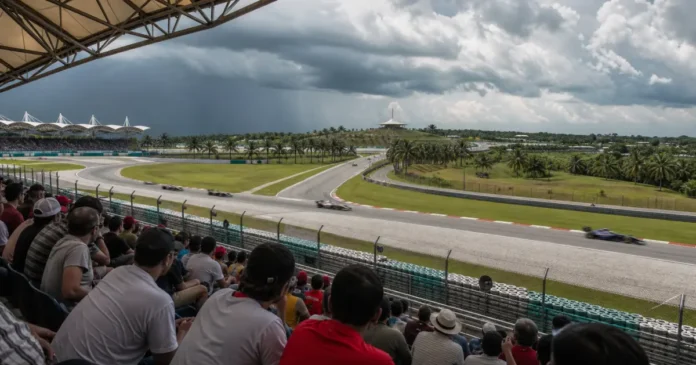

Formula 1 returns to Sepang from 2 to 4 October 2026, nine years after Malaysia last hosted a race. If you are flying in for it, or you are already in Kuala Lumpur and wondering whether to go, this covers the practical side: what the weekend actually involves, what to expect from the circuit and the weather, and how to plan around it.
One thing to get straight first. The event is officially the Formula 1 Gulf Air Bahrain Grand Prix, held in Malaysia. That is not an error, and it matters when you go looking for tickets. We explain why the Bahrain Grand Prix is being held in Malaysia separately.
The short version
- Race weekend runs Friday 2 October to Sunday 4 October 2026 at Sepang International Circuit.
- The circuit is about 45km south of central KL and roughly 10 to 15km from the airport. Allow an hour from the city.
- Stay in Kuala Lumpur unless your trip is built purely around the race, in which case stay near the airport.
- Expect heat, humidity and a real chance of a thunderstorm. Sepang has a history of weather affected races.
- Search official sources under Bahrain Grand Prix, not Malaysian Grand Prix.
Is it worth going?
If you have any interest in motorsport and you are anywhere near Southeast Asia in early October, yes, and with an unusual amount of confidence.
Sepang is a genuinely good spectator circuit. It was designed for the purpose rather than adapted from something else, the main grandstand looks across to a long straight and a heavy braking zone, and the layout gives decent sightlines from a lot of the venue. Compared with street circuits where most seats see one corner, it offers more racing for the money.
The bigger argument is scarcity. This is a one off arrangement to rescue a cancelled race, and nothing has been announced about Malaysia returning permanently. If you have been waiting for F1 to come back here, treat 2026 as the opportunity rather than the first of a run.
The honest case against: it is hot in a way that people from temperate climates consistently underestimate, there is a real chance of sitting through a downpour, and the journey in and out eats a chunk of each day. None of that is a reason not to go, but it is worth knowing before you commit three days to it.
The weather, which is not a footnote here
Early October at Sepang falls in the inter-monsoon period. Expect daytime temperatures around 32 degrees, humidity above 80 percent, and afternoon thunderstorms that arrive fast and heavily.
Sepang has a long reputation for weather disrupted races. The most extreme example came in 2009, when a downpour brought out the red flag and the race was stopped early with half points awarded, and it is still cited as one of the wettest races in Formula 1 history. Rain here is not a light shower that passes.
Practically: bring a poncho rather than an umbrella, since umbrellas are awkward in a grandstand and often restricted. Bring more water than you think. Cover up rather than relying on sunscreen alone, because the sun is directly overhead and shade is limited outside the covered stands. Our guide to the KL rainy season explains the wider pattern.
Getting there
There is no train to the circuit, which catches people out. Every route ends with a road transfer.
The most predictable option from the city is the KLIA Ekspres from KL Sentral to the airport, which takes under half an hour on a dedicated line and is unaffected by road traffic, then a short transfer from there. Dedicated shuttle buses from central KL are the usual arrangement for big Sepang events, though the 2026 routes and fares had not been published at the time of writing. Grab works but the queue and the surge pricing after a session are the single most common complaint. Our separate guide to getting to Sepang circuit covers all four options in detail, including how to handle the journey home.
Whichever you choose, allow more time than the distance suggests. Security queues and the walk from the drop off to your grandstand add up.
Where to stay
Central Kuala Lumpur for most people, near the airport if the trip is purely about the race. There is very little accommodation immediately around the circuit, because the area is airport and industrial land rather than a resort town.
KL Sentral is the smartest city base for this particular weekend, since the airport train leaves from directly beneath it. Our guide to hotels near KL Sentral covers the area, and our separate article on where to stay for the F1 weekend compares the city, the airport and the circuit in full. Book earlier than you normally would, because this race was confirmed at short notice and the market is still adjusting.
Making a trip of it
Flying this far for three days at a circuit is a waste of the airfare. Kuala Lumpur is a good city and it is right there.
A sensible shape for the weekend: arrive Thursday, spend Friday morning in the city and go out for afternoon practice, do the full days on Saturday and Sunday, then keep Monday and Tuesday for KL itself. That gives you the race without the trip being only the race.
Our guide to things to do in Kuala Lumpur covers what is worth your time, and the Kuala Lumpur travel guide handles the rest of the planning. If the heat at the circuit has finished you off, KL is a very comfortable city to do nothing in for a day.
Practical things worth knowing
- Entry requirements are Malaysia’s. You are travelling to Malaysia, not Bahrain, so check the current rules for your passport with Malaysian immigration, including the digital arrival card.
- Get a Touch n Go card. Useful for public transport and essential if you drive, since expressway tolls are cashless.
- Book the Sunday night. Leaving the circuit takes a long time and a same day flight is optimistic.
- Search under Bahrain Grand Prix. Official ticketing and schedules use that name, and searching for the Malaysian Grand Prix will surface pre 2018 archive material.
- Expect to be outside all day. Sun protection, water and a poncho are worth more than anything else you pack.
Frequently asked questions
When is the 2026 F1 race in Malaysia?
2 to 4 October 2026 at Sepang International Circuit, with practice on Friday, qualifying on Saturday and the race on Sunday. It is officially the Bahrain Grand Prix, held in Malaysia.
Is Sepang a good circuit to watch F1 at?
Yes. It was purpose built for spectators, with good sightlines from much of the venue and a main grandstand overlooking a long straight and heavy braking zone. You see more racing than at most street circuits.
What should I bring to the race at Sepang?
Sun protection, a hat, more water than you expect to need, and a poncho. It is hot and humid, shade is limited outside the covered stands, and heavy afternoon rain is common in early October. Check the circuit’s current rules on what you can bring in.
Explore more
- The Kuala Lumpur travel guide, everything else about the trip
- Things to do in Kuala Lumpur, for the days either side
- KLIA to KL city, arriving and getting around
- KL rainy season, what October weather really does
Written in August 2026, while ticketing and session details were still being confirmed. Formula 1 and Sepang International Circuit are the authoritative sources.
Which grandstand to pick
Shade is the deciding factor here in a way it is not at European circuits. A covered seat is worth more than a marginally better view.
The Main Grandstand runs along the start finish straight and looks across at the grid, the pit lane, the team garages and the podium. Its umbrella shaped roof shelters spectators from both sun and rain, which at Sepang matters enormously. It is the most in demand seating for a reason.
Within the Main Grandstand, pay for the upper tier. The lower tier sits behind catch fencing that intrudes on the view, and the roof overhang is low enough to cut off sightlines. The upper tier is smaller and gives a far more open view of the circuit. This is the single most useful thing to know before choosing a seat here, and it is not something a ticket page will tell you.
The K1 Grandstand sits at the end of the main straight overlooking turns one and two, and it is also covered. This is where the first corner happens, so it is the best seat in the venue for the race start and for wheel to wheel overtaking into the braking zone. If you care more about racing than about the podium ceremony, K1 over the Main Grandstand.
General admission is the cheapest way in and works if you are happy to move around and find your own vantage points, but understand that you are committing to a day with limited shade. Check current ticket categories and what each includes with the circuit, since the layout of offerings changes between events.
Why 2026 is an unusually interesting year to watch
This is worth knowing even if you follow the sport loosely, because 2026 is not a normal season.
Formula 1 introduced its biggest technical reset in years for 2026. The cars are narrower, dropping from two metres wide to 1.9, with a shorter wheelbase and around 30kg less weight, so they are more agile than the generation before them.
The power units changed more dramatically. The electrical side jumped from 120kW to 350kW, giving roughly an even split between combustion and electric power, the MGU-H was dropped entirely, and the sport moved to sustainable fuel.
Most visibly from a grandstand, the cars now run active aerodynamics. Front and rear wings move between a high downforce setting for corners and a low drag setting for straights, and DRS has been replaced by an overtake mode available to every driver rather than only to a car within a second of the one ahead.
What that means for a spectator at Sepang: a circuit with two very long straights and heavy braking zones at either end is close to the ideal place to see whether the new overtaking rules actually work. Rule reset years also tend to spread the field out, so the racing order can be less predictable than usual.

