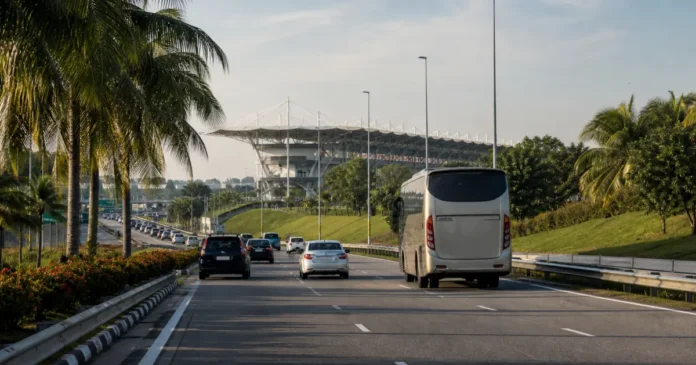

Sepang International Circuit sits about 45km south of central Kuala Lumpur, close to the airport rather than the city. There is no train to the circuit gates, which surprises people who assume a venue this size must have one. Getting there is straightforward once you know the options, but it does need planning on race day.
Sepang hosts two major race weekends in late 2026. Formula 1 runs from 2 to 4 October, and the MotoGP Malaysian Grand Prix follows from 30 October to 1 November. MotoGP is confirmed at Sepang annually through 2031, so the advice below applies well beyond this year.
The short version
- No rail line runs to the circuit itself. Every route ends with a road transfer.
- Two rail services run this corridor and most guides recommend the wrong one. The KLIA Transit stops at Salak Tinggi, roughly 4km from the circuit. The KLIA Ekspres does not stop there at all.
- Dedicated race shuttle buses usually run from central KL on event weekends. Confirm the 2026 arrangements once they are published.
- Grab works and is simple, but expect surge pricing and long waits when a session ends.
- Leaving after the race is slower than arriving. Plan for it rather than being surprised by it.
Option 1: take the train, but pick the right one
The most reliable route, and the one least affected by traffic.
The KLIA Ekspres runs from KL Sentral to the airport in under half an hour on a dedicated line, so it is immune to the congestion that builds on the highway south on race day. From the airport the circuit is only about 10 to 15km, covered by shuttle, taxi or Grab.
The advantage is predictability. You know exactly how long the long leg takes, which is worth a great deal when qualifying starts at a fixed time. The disadvantage is that it is two steps rather than one, and the second step still depends on road conditions near the circuit.
Here is the part most guides get wrong. Two separate services run this line from KL Sentral. The KLIA Ekspres is non stop to the airport terminals and reaches KLIA in about 28 minutes. The KLIA Transit is a commuter service on the same tracks that stops at Bandar Tasik Selatan, Putrajaya and Cyberjaya, and Salak Tinggi before reaching the terminals.
Salak Tinggi is roughly 4km from the circuit. The airport is 10 to 15km away. So the Transit puts you materially closer than the Ekspres does, on a distance based fare that costs less than riding to the terminals, and it is the last stop before the airport so the journey is only slightly longer. From Salak Tinggi it is a short Grab to the gates.
Most guides recommend the Ekspres to the airport and a longer transfer, because the Ekspres is the service visitors have heard of. If you are heading to the circuit rather than to a flight, check the Transit timetable first, and confirm current times and fares with the operator since race weekend services can differ.
What each rail option actually costs
The fares make the argument better than the map does. These are Express Rail Link’s published adult fares as of September 2026, and both services take 10 percent off if you book through the operator app or website.
| Journey | Adult | Child 6 to 15 | Distance left to the circuit |
|---|---|---|---|
| KL Sentral to Salak Tinggi, on KLIA Transit | RM 18.30 | RM 8.20 | About 4km |
| KL Sentral to KLIA T1 or T2, either service | RM 55 | RM 25 | About 10 to 15km |
| KLIA T1 to Salak Tinggi, if you are already at the airport | RM 4.90 | RM 2.20 | About 4km |
So the stop almost every guide skips is RM 36.70 cheaper and three times closer. Salak Tinggi costs RM 18.30 against RM 55 to the terminals, and leaves you 4km out rather than 10 to 15km. For two adults that is a saving of over RM 70 each way, before you have paid for the road transfer at the other end.
The one thing to weigh against it is frequency. KLIA Transit runs every 15 minutes at weekday peak and every 30 minutes off peak and at weekends, which is when race days fall. Check the timetable against the session you are trying to reach, because a missed connection costs you half an hour rather than fifteen minutes. Under 6s travel free on both services.
Option 2: race weekend shuttle buses
Direct coaches from the city to the circuit are the standard arrangement at Sepang events, and at past race weekends they have run from central points including KL Sentral and the Bukit Bintang and KLCC areas, with a return fare cheaper than a one way Grab. If you are still deciding where to base yourself, our guide to where to stay for a Sepang race weekend compares the city, the airport and the circuit.
Treat past arrangements as a guide, not a plan. This race was confirmed at short notice and the official shuttle routes, pick up points, fares and timetables for 2026 were not published when this was written. Check the Sepang International Circuit website and the official ticketing channels closer to the date, and book in advance if pre booking is offered, because these sell out.
When they run, shuttles are usually the best value option and remove the parking problem entirely. The catch is the queue home, since several thousand people want the same bus at the same moment.
Option 3: Grab or taxi
Simplest door to door, and the most likely to frustrate you on the way home.
Getting there is easy. Grab covers the whole Klang Valley and a car from central KL to the circuit is a straightforward hour or so outside peak times. Split between three or four people it compares reasonably with the train and shuttle combination.
Getting back is the problem. When a session ends, tens of thousands of people open the same app within the same fifteen minutes, in a location with limited road access, and surge pricing does what surge pricing does. Drivers also become reluctant to enter the congestion. This is the most common way for a good day at Sepang to end badly.
The practical mitigation is to walk away from the circuit for fifteen or twenty minutes before requesting a car, or to stay put, eat something and let the crowd clear. Both beat standing in a car park watching the price climb.
Option 4: driving
Reasonable if you already have a car, unnecessary if you do not.
The circuit is served by expressways and has extensive parking, so the drive itself is easy. Note that Malaysian expressways are tolled and the tolls are cashless, so you need a Touch n Go card or an electronic tag. Turning up with only cash is a genuine problem rather than an inconvenience.
Arrive early on race day. Traffic builds well before the first session, parking fills from the outside in, and the walk from the far car parks is long and hot. Leaving is slow whatever time you go.
What to expect on the day
A few things that catch first time visitors to Sepang.
The heat is the main event. Early October is hot and humid, typically around 32 degrees with humidity above 80 percent. There is shade in the covered grandstands and very little anywhere else. Water, sun protection and a hat matter more here than at most circuits.
Rain is likely at some point. Late October and November fall in the inter-monsoon period and afternoon thunderstorms are common, which affects both the F1 and MotoGP weekends. Sepang has a long history of weather affected races, most famously in 2009 when a downpour forced a red flag and the race was ended early with half points awarded. Bring a poncho rather than an umbrella, which is easier in a crowd and usually more welcome at the gate.
Give yourself more time than feels necessary. Between the distance, the security queues and the walk from parking or the bus drop off to your grandstand, the last mile takes longer than the map suggests.
Frequently asked questions
What is the nearest train station to Sepang circuit?
Salak Tinggi, on the KLIA Transit line from KL Sentral, sits roughly 4km from the circuit. That is much closer than the airport at 10 to 15km. Note that the KLIA Ekspres does not stop at Salak Tinggi, only the Transit does. No line reaches the circuit gates, so every route ends with a short road transfer.
How long does it take to get to Sepang from KL?
Around an hour door to gate from the city centre outside peak times. Allow considerably more on race day, and expect the journey home to take longer than the journey out.
Are there shuttle buses to Sepang circuit?
Dedicated shuttles from central KL are the usual arrangement for major Sepang events, and they run for both F1 and MotoGP weekends, but routes, fares and timetables are published per event and were not available at the time of writing. Check the circuit and official ticketing channels, and pre book if that option is offered.
Explore more
- The full F1 at Sepang spectator guide, tickets, grandstands and whether the weekend is worth it
- Where to stay for a Sepang race weekend, the city, the airport and the circuit compared
- KLIA to KL city, the full breakdown of the route you will use
- KLIA vs KLIA2, which terminal you actually need
- KL rainy season, what early October weather really does
- The Kuala Lumpur travel guide, for the rest of the trip

