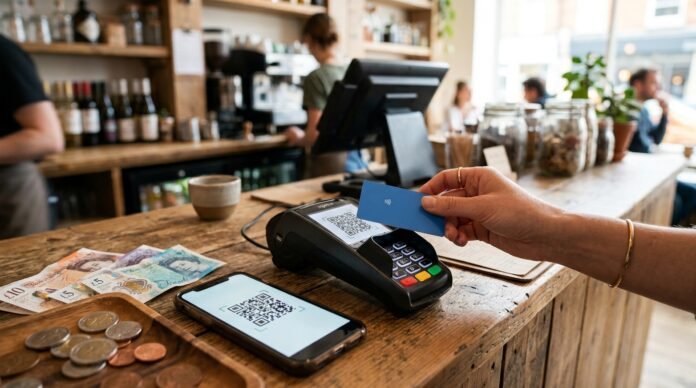

Do you need cash in Malaysia, or is a card enough? The honest answer is: bring both, but lean on a card. Kuala Lumpur is a very card and QR-friendly city where you can pay by tapping or scanning almost everywhere, yet cash still rules at hawker stalls, wet markets and small vendors. Get the balance right and you’ll rarely think about money at all.
Here’s exactly where cards work, where you’ll still want cash, how to avoid needless fees, and the one travel card that makes paying in Malaysia genuinely easy.
Some links in this post are affiliate links. If you sign up through them, I earn a small commission at no extra cost to you. Thanks for supporting the blog.
How tourists pay in Kuala Lumpur, at a glance
A rough guide to how you’ll pay in common situations:
| Situation | Card | Cash | QR |
|---|---|---|---|
| Malls and department stores | Yes | Optional | Often |
| Hotels | Yes | No need | Sometimes |
| Sit-down restaurants | Yes | Optional | Often |
| Convenience stores (7-Eleven) | Yes | Optional | Yes |
| Food courts | Sometimes | Yes | Often |
| Hawker stalls and street food | Rarely | Yes | Often |
| Wet and night markets | Rarely | Yes | Sometimes |
| Grab rides | Yes (in app) | Yes | No |
| Buses | No | No | No, transport card only |
| Temple donations | No | Yes | Sometimes |
The pattern is clear: card or QR for anything indoors and established, cash for the street.
The short version
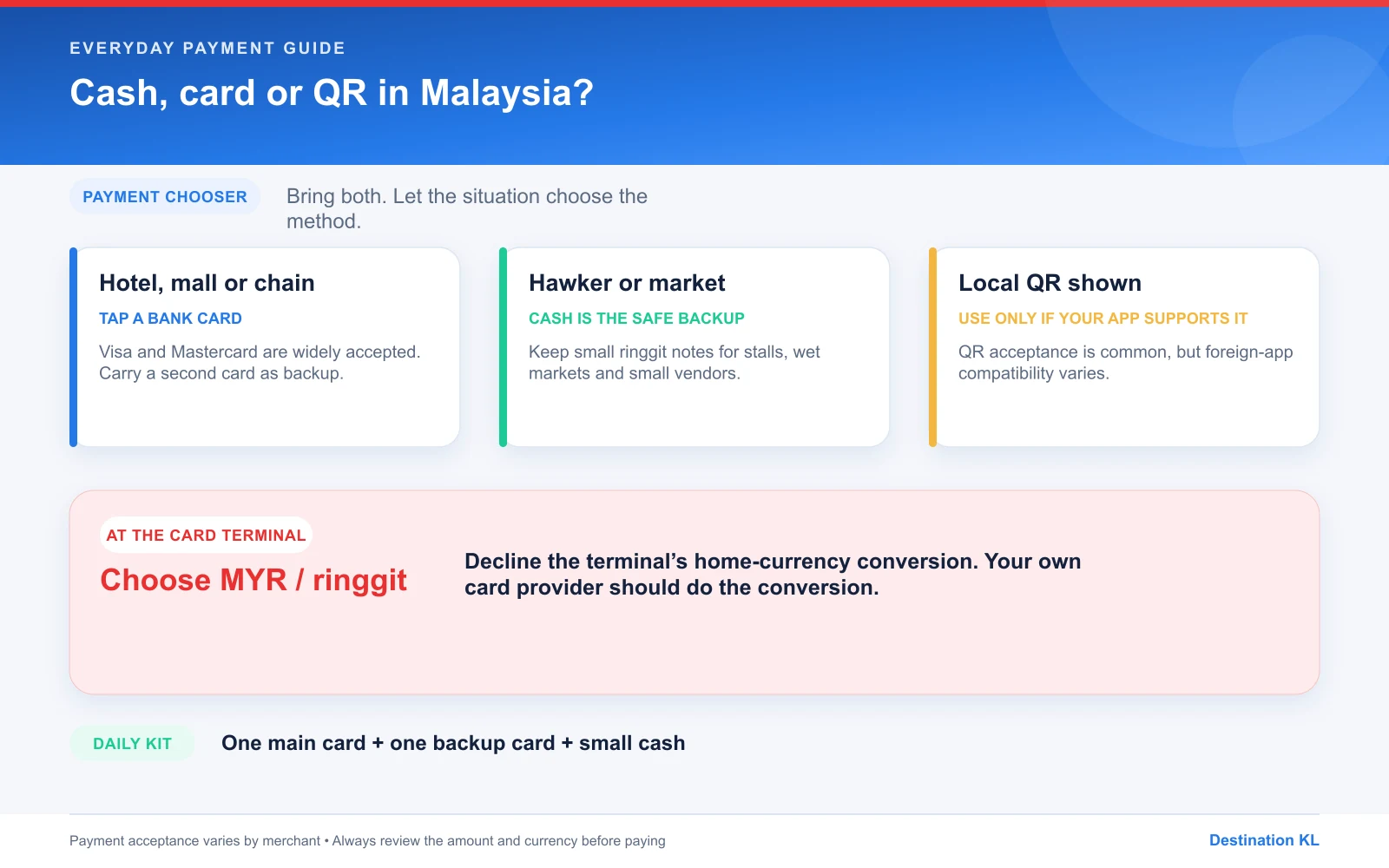
- Cards work in most urban places, hotels, malls, chains, supermarkets and sit-down restaurants. Visa and Mastercard are widely accepted.
- Cash is still king for street food, hawker stalls, wet markets, small shops and buses. Carry small notes.
- QR payments are everywhere. The pink DuitNow QR appears even on stalls, and a card like Wise can scan many of them.
- Use ATMs and mall money changers, not airport or hotel counters, for the best value.
- The sweet spot: a low-fee travel card plus a bit of cash covers everything.
Where cards work, and where they don’t
Cards are widely accepted at hotels, shopping malls, supermarkets, chain stores, sit-down and mid-range restaurants, and most tourist attractions. Visa and Mastercard are the safe bets, contactless is common, and you’ll tap or insert as you would at home. American Express is accepted in fewer places, so don’t rely on it alone.
Cash or QR is the norm at hawker centres, street-food stalls, wet markets, small family shops, and on RapidKL buses, which don’t take cash at all and need a transport card. Some small merchants also set a minimum card spend of around RM10 to RM20, so a card isn’t always worth it for tiny purchases.
Two quick habits save money and hassle:
- Tell your bank you’re travelling so your card isn’t blocked for unusual activity.
- Always pay in ringgit (MYR), not your home currency. If a card machine offers to charge you in your own currency, decline it. That “dynamic currency conversion” uses a poor exchange rate set by the terminal, not your bank.
Grab, Apple Pay and contactless
Two things worth knowing that catch people out:
- Grab lets you add a card in the app before you travel and pay automatically at the end of each ride, or pay the driver in cash. Card is smoother, since you never need exact change. See our Grab guide.
- Apple Pay and Google Pay work almost anywhere that takes contactless Visa or Mastercard, so if you add a card to your phone you can often leave your wallet in your bag.
Cash: the ringgit and ATMs
Malaysia’s currency is the ringgit (RM or MYR). Even as the country goes cashless, roughly a third of transactions still involve cash, and for street food and markets it’s the most reliable option, so always keep some on you, ideally in small notes.
ATMs are everywhere, at the airport, in malls and across the city, and they accept international Visa and Mastercard. A few pointers:
- Use bank-branded ATMs such as Maybank, CIMB, HSBC, RHB or UOB, rather than standalone machines, for reliability and security.
- Expect fees. Malaysian ATMs typically charge around RM10 to RM15 per withdrawal for foreign cards, on top of whatever your home bank charges.
- Withdraw larger amounts less often to spread that flat fee, rather than making lots of small withdrawals.
- Cover your PIN and take your cash and card promptly.
A note on notes. Ringgit notes come in RM1, RM5, RM10, RM20, RM50 and RM100. Hawker stalls and small vendors often struggle to break a RM100 note, so keep a stack of RM5, RM10 and RM20 notes for street food and small buys. As a rough guide, many visitors find RM50 to RM100 in cash is plenty to carry as a daily buffer, with everything larger going on a card.
Exchanging money
When you land, you don’t need to change a large sum at the airport. Withdraw a little from an airport ATM, or change just enough for your first day, then use a mall money changer later for a better rate. See our airport to city guide for arrival tips.
If you bring cash to exchange, the best rates come from licensed money changers, which you’ll find in shopping malls and central areas all over KL. They’re quick, competitive and easy to use. Avoid changing money at the airport arrival counters or your hotel, where rates and fees are usually worse. For most travellers, a mix of ATM withdrawals with a good card and the occasional money changer works best.
The thing visitors do not expect: QR is winning
The cash versus card question is slightly the wrong question in Malaysia, because a third option has quietly overtaken both for everyday spending.
DuitNow QR is a national standard, not an app. Every bank and e-wallet in the country plugs into the same QR network, so one code on a stall counter works for a customer using Touch n Go, Maybank, GrabPay or anything else. That is why you see a single printed square taped to a nasi lemak stall rather than six competing stickers.
It reaches places cards never will. A hawker stall that would need a terminal, a merchant account and a percentage cut can accept QR with a laminated piece of paper and no hardware. That is why a stall selling RM4 breakfast takes digital payment while waving away your Visa.
The catch for visitors is registration. Malaysian e-wallets generally want a local phone number and often a local bank account or a Malaysian IC for full functionality, so a short stay visitor frequently cannot use the thing everyone around them is using. Our guide to Touch n Go for tourists covers what actually works on a foreign passport.
That leaves most visitors on the older split: card indoors, cash on the street. Knowing why is useful, because it explains the otherwise baffling sight of a vendor refusing your card and pointing at a QR code.
QR payments and e-wallets
Malaysia has gone all-in on QR payments. The pink DuitNow QR code is displayed almost everywhere now, from malls and cafes to street stalls, night markets and taxis, and the vast majority of Malaysians pay this way. For a visitor, the two routes in are the Touch ‘n Go eWallet, which foreigners can now register for with a passport, and certain travel cards that can scan the QR directly.
If you want the full rundown on the Touch ‘n Go card and eWallet, including how to top it up as a foreigner, see our dedicated Touch ‘n Go for tourists guide.
Which card to actually carry
If you get one thing sorted before your trip, make it a good travel card, and for Malaysia the standout is Wise. Here’s why it fits the country so well:
- Real exchange rates. It converts at the mid-market rate with a small, transparent fee, typically cheaper than banks or airport counters.
- Free ATM withdrawals up to a monthly cap, which softens those Malaysian ATM fees for the cash you do need.
- It can scan Alipay+ enabled DuitNow QR codes, the pink QR codes that also show the Alipay+ logo, so you can pay by QR at many stalls and shops without a local e-wallet. This QR feature is available to Wise accounts from certain regions, including the UK, Europe and Singapore, with a daily limit, so check your own account and use your Wise card or an ATM where it isn’t supported.
- Tap and chip payments, including adding it to Apple Pay or Google Pay for contactless.
Compared with a typical home bank debit card abroad, which often adds a foreign-transaction fee and a marked-up exchange rate, Wise is usually cheaper and clearer about what you pay, which is the main reason travellers favour it. You can set up a Wise account before you travel. A common approach is to use it as your main card and carry a second bank card as a backup, in case one is ever declined at a particular terminal.
The simple money strategy that works
- Bring a low-fee travel card such as Wise for card payments, QR scanning and cheap ATM withdrawals, plus a backup bank card.
- Withdraw some ringgit on arrival from a bank ATM, in a larger amount to save on fees, and keep small notes handy.
- Pay by card or QR at malls, restaurants and shops, and use cash for hawker stalls, markets and small vendors.
- Always choose to pay in ringgit when a terminal asks, and tell your bank you’re travelling.
Is Malaysia cashless? Can you go fully cashless?
Almost, but not quite. In central KL you could get remarkably far on cards and QR alone, since even many stalls now take DuitNow QR. But some small vendors, markets and places off the tourist track are still cash-only, so going completely cashless risks the occasional awkward moment. Carry a modest amount of cash as backup and you’ll never be stuck. For how far your money goes overall, see our guide to how much a KL trip costs.
Why the bill is higher than the menu price
This catches almost everyone once. At mid-range and upmarket restaurants, cafes and hotels, the price on the menu is often not the price you pay. Two things get added at the till: a service charge, usually 10 percent, and service tax. Together they add roughly 16 to 18 percent to the printed price.
Look for the “++” symbol. A menu showing RM38++ is telling you that both will be added. A menu with no ++ and no small print is usually nett, meaning the price is the price. If you are watching a budget, that difference is worth checking before you order rather than after.
Hawker stalls, kopitiams, food courts and street food do not charge either, which is part of why eating that way is so much cheaper than the menu prices alone suggest. Tax rates change with the national budget, so treat the percentages as current rather than permanent.
A quick word on tipping
Malaysia isn’t really a tipping culture, so you don’t need to budget for it. Many restaurants and hotels already add a 10 percent service charge to the bill, so extra tipping isn’t expected. Rounding up or leaving a little for genuinely great service is appreciated, but never obligatory. If you do tip, do it in ringgit.
Frequently asked questions
Do I need cash in Malaysia, or can I use a card?
You’ll want both. Cards and QR payments are widely accepted in Kuala Lumpur at hotels, malls, supermarkets and restaurants, so you can pay by card most of the time. But cash is still needed for hawker stalls, street food, wet markets, small shops and buses, so carry some ringgit in small notes as well. A travel card plus a bit of cash is the ideal combination.
Are credit cards widely accepted in Malaysia?
Yes, in urban areas. Visa and Mastercard are accepted at most hotels, malls, supermarkets, chain stores and sit-down restaurants across Kuala Lumpur, with contactless common. American Express is accepted in fewer places. Smaller businesses, hawker stalls and markets often prefer cash or QR, and some merchants set a minimum card spend of around RM10 to RM20, so keep some cash for small purchases.
What are the ATM fees in Malaysia?
Malaysian ATMs typically charge foreign cards around RM10 to RM15 per withdrawal, and your home bank may add its own fees on top. To reduce the impact, use bank-branded ATMs, withdraw larger amounts less frequently, and consider a card like Wise that offers free international withdrawals up to a monthly cap. Always choose to be charged in ringgit rather than your home currency.
Can tourists use QR code payments in Malaysia?
Yes, increasingly so. The DuitNow QR system is used almost everywhere, including street stalls and markets. Tourists can pay by QR either through the Touch ‘n Go eWallet, which foreigners can now register for with a passport, or with a travel card like Wise that can scan many DuitNow QR codes directly. It’s a convenient way to pay where cash would otherwise be needed.
Can I claim a tax refund on shopping when I leave Malaysia?
No. Malaysia’s Tourist Refund Scheme was tied to GST, and GST was abolished in 2018. There is no tourist refund counter to queue at, whatever older articles still imply. Budget for the price you pay at the till. Our KL shopping malls guide covers this in more detail.
How much cash can I bring into Malaysia?
As much as you like, but anything over the equivalent of USD 10,000 in cash and bearer instruments combined must be declared on Customs Form 22, at entry and again at exit. Bank Negara Malaysia sets penalties of up to RM1 million and up to a year in prison for failing to declare or declaring falsely. Separate and lower limits apply to ringgit notes specifically, so check with Bank Negara if you plan to carry a large amount. For a normal holiday none of this comes up.
Is Malaysia a cashless country?
Not fully, but it is closer than most visitors expect. QR payment has spread faster here than card payment did, and in the cities you can get through most of a day without touching a note. What keeps Malaysia from being cashless is the bottom of the market: hawker stalls, pasar malam, small kopitiams, parking and the occasional taxi. Those are also the things worth doing, so carry a modest amount of cash and use it there.
How do tourists usually pay in Malaysia?
Card for hotels, malls, restaurants and supermarkets. Cash for hawker food, markets and small vendors. Grab and most apps take a foreign card directly. DuitNow QR is everywhere but usually needs a Malaysian bank account or e-wallet, so most visitors skip it, with the exception of travel cards that can scan Alipay+ enabled codes.

