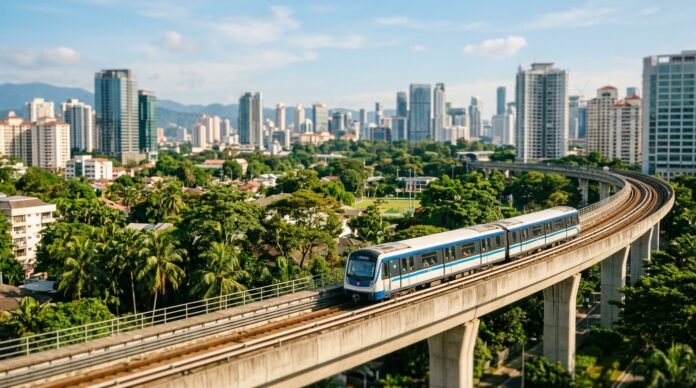

Getting around KL is easier than the busy looking train map suggests, and far easier than the traffic suggests. The short version is that you almost never need a car, the trains cover most of what visitors want, and Grab fills every gap cheaply. This guide walks through the airport run, the train network, ride hailing, staying connected, and getting out to other cities, with honest costs and the small tricks that save you time and money.
Some links below are affiliate links. If you book a transfer or an eSIM through them I earn a small commission at no extra cost to you. I only recommend what I actually use.
The short version
Skip the rental car. Get from the airport on the KLIA Ekspres train if you want speed and no traffic, or a Grab if there are a few of you with luggage. In the city, use the MRT, LRT, and monorail, which beat the traffic, and Grab for everything they do not reach. Sort a Touch n Go card or an eSIM early so payment and data are not a daily hassle. For other cities, use the train, a coach, or a cheap flight depending on distance.

Why you can trust this guide
I have lived in Kuala Lumpur for more than ten years and I move around it the way a resident does, by train, by Grab, and on foot, not by tour bus. I have made the airport run more times than I can count, in every way there is to make it. Where an option is genuinely worth paying for I will say so, and where it is a waste I will say that too.
Getting from KLIA to the city
This is the first decision every visitor makes, so here it is laid out plainly. KL has two terminals, KLIA and KLIA2 (the budget terminal, where AirAsia and similar fly from), and your options are the same from both.
| Option | Rough cost | Time | Best for |
|---|---|---|---|
| KLIA Ekspres train | RM 55 one way (about $12) | About 30 min | Speed, avoiding traffic, solo or couples |
| Grab (ride hail) | RM 80 to 110 (about $18 to $25) | 50 to 75 min | Groups, lots of luggage, door to door |
| Airport coach | RM 12 to 15 (about $3) | About 75 min | Tight budget, time to spare |
| Pre booked transfer | RM 95 plus (about $22) | 50 to 75 min | Families, late arrivals, zero hassle |
The honest pick for most people is the KLIA Ekspres, because it is fast and immune to the traffic that can make the road trip drag, then a short Grab from the city terminus to your hotel. If there are three or four of you with bags, a single Grab door to door can work out similar in cost and simpler. For the full breakdown see KLIA to KL city and the terminal question in KLIA vs KLIA2.
My move: KLIA Ekspres into the city, then a quick Grab to the hotel door. If you would rather not think about it after a long flight, a pre booked transfer on Klook is the no stress option.
The trains: MRT, LRT, and monorail
KL’s urban rail is the secret to beating the traffic, and it is cleaner and simpler than first time visitors expect. There are three systems you will actually use, the MRT (newest and most useful for visitors), the LRT, and the monorail through the Bukit Bintang and city centre area, plus the KTM commuter line for some longer hops. They interconnect at several stations, the signage is in English, and trains are frequent.
The one thing to know is that the network does not cover every neighborhood, and some interchanges involve a walk, but for the central sights it is excellent and a fraction of the cost of anything else. Pay with a Touch n Go card (below) and you barely think about it. For the full how to with the map see the KL MRT and LRT guide.
The MRT
The newest and most comfortable part of the network, and the one visitors use most. Two lines, Kajang and Putrajaya, running through the centre with stations at Bukit Bintang, Merdeka, Pasar Seni, TRX and Muzium Negara. Air-conditioned, step-free, signposted in English throughout.
The LRT
Older, busier and still essential. Three lines: Kelana Jaya, serving KLCC, Masjid Jamek, Pasar Seni, KL Sentral and Bangsar, plus the Ampang and Sri Petaling lines covering the eastern and southern side. Kelana Jaya is the one most visitors use, and it gets genuinely packed at rush hour.
The Monorail
A single elevated line of eleven stations between KL Sentral and Titiwangsa, via Bukit Bintang. Slower, older and noticeably more cramped than the MRT, with short trains that fill quickly. Useful for short hops around Bukit Bintang rather than crossing town.
KTM Komuter
Commuter rail out into the suburbs, and the reason it matters to visitors is one destination: Batu Caves, direct from KL Sentral in around half an hour. Services are less frequent than the urban lines, so check the timetable rather than turning up and hoping.
The interchange trap
This is the thing that catches almost every first-timer. Not every interchange is a simple cross-platform change. At several, you tap out of one system, walk between separate station buildings, and tap in again, paying two fares rather than one. Masjid Jamek and the walk between Bukit Bintang MRT and the monorail are the two that surprise people most. Google Maps handles it correctly, so trust the walking segments it shows you rather than assuming a station name means one building.
Grab: how ride hailing works here
There is no Uber in Malaysia. Grab is the app everyone uses, and it is excellent: cheap, reliable, and cashless once your card is loaded. You see the fixed price before you book, so there is no haggling and no meter games, which is exactly why it has largely replaced metered taxis for visitors. Download it and set it up before you land, ideally while you still have airport wifi or once your eSIM is live, because that first ride out is when you most want it working. For the full tourist walkthrough see Grab in Malaysia and the honest take in taxi scams in KL.
Should you take a taxi?
Short answer, rarely. Street taxis still exist, but Grab is cheaper, the price is fixed in advance, and you avoid the small number of drivers who would rather not use the meter. The one time a taxi makes sense is a pre paid airport taxi coupon as a backup if Grab is surging. For why this matters see taxi scams in KL and Uber vs Grab in Malaysia.
Paying for transport: Touch n Go
The small piece of admin that makes everything smoother. Touch n Go is the local stored value card that taps you through the train gates and is the default way locals pay. You can buy a physical card at stations and convenience stores and top it up easily, and there is an eWallet app that ties into a lot of daily life here. Sorting this on day one means you are not fumbling for the right fare at every gate.
Do you need a travel pass? Probably not
Passes get pushed hard at the airport and in guides, and most visitors do not need one. Here is the honest arithmetic.
- Single rail journeys in KL are cheap, generally somewhere between about one and six ringgit depending on distance. Even four or five trips a day rarely adds up to much.
- A Touch n Go card already gets you a discount. Tapping with the card is charged at a lower cashless rate than buying a single-journey token, so the card pays for itself quickly without any pass at all.
- The My50 unlimited pass, RM 50 for 30 days, is for Malaysians only. Tourists cannot buy it, so ignore any guide that recommends it.
- There is now a pass visitors can buy. The Rapid Bulanan Pass is RM 150 for 30 days, open to everyone, and covers the same network as My50: LRT, MRT, monorail, BRT, Rapid KL buses and MRT feeder buses. At RM 5 a day it only beats paying as you go if you are here for weeks and riding constantly. Note that it covers neither KTM Komuter nor the KLIA Ekspres, since neither is a Rapid KL service, and buying it online needs an NFC Touch n Go card, an NFC phone and a verified TNG eWallet account.
- Tourist passes bundling airport transfer with unlimited rail can work out if you are doing the airport train both ways and riding heavily in between. Do the sum against the airport fare plus a Touch n Go card before buying.
For most trips of a week or less, a Touch n Go card with credit on it beats every pass on the market, and it also works on buses, tolls and many shops. Buy the card, top it up, stop thinking about it.
Staying connected: eSIM and data
Getting online the moment you land makes every other part of getting around work, because Grab, maps, and train apps all need data. The easiest route now is an eSIM you set up before you fly, so you step off the plane already connected with nothing to buy at the airport. A local physical SIM is still an option and can be cheaper for heavy data, bought at the airport or in the city, but for most visitors the convenience of an eSIM wins. For the comparison see the best eSIM for Malaysia.
My recommendation: set up an Airalo eSIM before you fly so you land connected, then sort a local SIM only if you are staying weeks and need heavy data.
Do you need to rent a car?
No, and I would actively steer most visitors away from it. KL traffic is heavy, parking is a hassle, and the trains plus Grab cover the city far more cheaply and with less stress. A car only starts to make sense if you are doing a string of rural day trips well off the train and coach network, and even then a driver for the day is often easier. For the full reasoning see renting a car in KL.
Getting to other cities and day trips
KL is a great base for trips further afield, and you have good options without a car. For the popular runs, here is the rough shape of it: the train and coach network is cheap and comfortable, and short hops can be flown for very little.
| Trip | Best option | Rough time |
|---|---|---|
| KL to Melaka | Coach | About 2 hours |
| KL to Penang | Train, coach, or short flight | 4 to 5 hours by land |
| KL to Singapore | Coach, train, or flight | 5 hours plus by land |
| KL to Langkawi | Flight, or train plus ferry | About 1 hour by air |
For each route in detail see KL to Melaka, KL to Penang, KL to Singapore, and KL to Langkawi. Intercity coaches and trains are easy to book in advance on 12Go.
Accessibility, women-only coaches and other things worth knowing
- Women-only coaches operate on KTM Komuter and on the MRT Putrajaya line, marked in pink at the platform. Optional, and worth knowing about if you would prefer them at busy times.
- Step-free access is good on the MRT, which was built recently with lifts throughout. It is patchier on the older LRT and monorail stations, so check ahead if you are travelling with a wheelchair, a pram or heavy luggage.
- Peak hours run roughly 7.30 to 9am and 5.30 to 7.30pm. Trains are genuinely crowded then, especially on the Kelana Jaya line. If you can shift a journey by half an hour, do.
- First and last trains run from around 6am to roughly 11.30pm, varying by line. There is no all-night service, so late nights out mean a Grab home.
- The GoKL city bus is no longer free for visitors. It loops around the central districts and is still cheap, but since 2026 only Malaysians who register a MyKad with Touch n Go ride free. Foreign visitors pay RM1 a ride by Touch n Go, credit or debit card, and under 12s ride free either way. Slow, but useful for short central hops in the heat.
- Grab is not the only app. AirAsia Ride and inDrive also operate here, and comparing across two apps occasionally saves a meaningful amount at busy times.
Common mistakes
Renting a car for a city trip and then fighting traffic and parking you never needed. Landing without data and getting stuck unable to open Grab or maps. Assuming the train reaches everywhere, when some neighborhoods need a short Grab. Taking a street taxi when Grab is cheaper and fixed price. And underestimating the heat, since a ten minute walk between stations in midday humidity is not the same as it looks on the map.
Frequently asked questions
How do you get around Kuala Lumpur?
Mostly by the MRT, LRT, and monorail, which beat the traffic, plus Grab for anywhere the trains do not reach. You almost never need a car. Pay for trains with a Touch n Go card and set up data with an eSIM so the apps work from the moment you land.
What is the best way to get from KLIA to the city?
The KLIA Ekspres train is fastest at about 30 minutes and avoids traffic, then a short Grab to your hotel. For groups with luggage, a single Grab or a pre booked transfer door to door can be simpler for a similar cost.
Is there Uber in Malaysia?
No. Uber left the region and Grab is the ride hailing app everyone uses. It is cheap, reliable, shows a fixed price before you book, and is cashless once your card is loaded.
Do I need a car in Kuala Lumpur?
No. KL traffic is heavy and parking is a hassle, while trains and Grab cover the city cheaply and with less stress. A car only makes sense for rural day trips well off the transport network.
Is the KL MRT easy to use for tourists?
Yes. The signage is in English, trains are frequent, and the network covers the main sights. Pay with a Touch n Go card and it is straightforward, with the only catch being that not every neighborhood has a station.
Should I get an eSIM or a local SIM for Malaysia?
For most visitors an eSIM is easiest, since you land already connected with nothing to buy at the airport. A local physical SIM can be cheaper for heavy data over a longer stay.
Plan the rest of your trip
- Where to stay in Kuala Lumpur
- Things to do in Kuala Lumpur
- Day trips from Kuala Lumpur
- KL in 3 days: a first timer itinerary
- Kuala Lumpur neighborhoods
- Is KL easy to get around?, the short honest answer if you are still deciding where to base yourself
Ready to sort the basics?
Land connected and stress free: set up an Airalo eSIM before you fly, and book an airport transfer on Klook or intercity travel on 12Go if you would rather have it locked in.
Official & useful resources

